

Enough With The 'Actually, Electric Cars Pollute More' Bullshit Already
I know, I know, dunking on the Wall Street Journal editorial board is a bit like smacking your four-year-old nephew's would-be jumper out of the air before it even leaves his hands. But in an Op-Ed last week it peddled the tired and disingenuous notion that electric cars, by the very virtue of their production, pollute more than fossil fuel cars. This is wrong, and it cannot stand.
Specifically, the Journal cites a German study that says that, over the life of the vehicle, a diesel Mercedes would pollute less than an electric Tesla. (German-made diesel cars are the center of a bit of a culture war in Germany at the moment, but that's a lot to get into.) From the Journal:
A study this month by the IFO think tank in Munich found that a popular electric car releases more carbon dioxide into the atmosphere than a comparable diesel engine. The authors compared CO2 output for a Tesla Model 3 and a Mercedes C220d sedan. They calculated that the diesel Mercedes releases about 141 grams of carbon dioxide per kilometer driven, including the carbon emitted to drill, refine and transport its fuel. The Tesla? Between 156 and 181 grams.
The IFO study, bizarrely, seems to advocate for natural gas-powered vehicles as a "transitioning" technology on the way to cars powered by hydrogen, which, sure, I guess, and "'green' methane," a product which does not exist.
The joke of a transitionary technology aside (the time period for a "transitionary" fuel source was probably about 100 years ago, if we don't switch to a zero-emission economy fast we're pretty much entirely fucked, if we're not entirely fucked already), the argument that "well actually, electric cars pollute more" has been thoroughly debunked.
Let's go to the Union of Concerned Scientists, which looked at this non-issue back in 2015, and found that the whole "batteries produce more carbon dioxide to manufacture" argument goes straight out the window and down into the pit of hell itself as soon as you drive anywhere (emphasis mine):
A full-size long-range (265 miles per charge) BEV, with its larger battery, adds about six tons of emissions, which increases manufacturing emissions by 68 percent over the gasoline version. But this electric vehicle results in 53 percent lower overall emissions compared with a similar gasoline vehicle (see Figure ES-2). In other words, the extra emissions associated with electric vehicle production are rapidly negated by reduced emissions from driving. Comparing an average midsize midrange BEV with an average midsize gasoline-powered car, it takes just 4,900 miles of driving to "pay back"—i.e., offset—the extra global warming emissions from producing the BEV. Similarly, it takes 19,000 miles with the full-size long-range BEV compared with a similar gasoline car. Based on typical usages of these vehicles, this amounts to about six months' driving for the midsize midrange BEV and 16 months for the full-size long-range BEV.
The UCS goes on to note that advances in battery manufacturing are happening all the time, consistently reducing the emissions associated with assembling electric cars.
This whole concept is so easy to grasp, even for those with brains the size and consistency of a garbanzo bean, that the UCS made a video about it:
The WSJ editorial board, as it tends to do, turned this whole manufactured "controversy" into a pedestal from which to condemn renewable energy sources in general:
The country's ruinously expensive energy policy has stimulated renewable electricity but also reliance on coal plants to keep the lights on when the wind isn't blowing and the sun isn't shining. This heavy-emitting fuel mix means that charging a Tesla in Bavaria releases some 83 grams of carbon per kilometer driven.
And while yes of course, Germany's energy policy is "ruinously" expensive, as anyone who has waded through the decrepit ruins of the once-proud city of Stuttgart can attest, that makes total definite sense and is true, the entire argument falls flat on its face in a bizarre pratfall just as soon as an ounce of thought is put into it. Electrical grids powered by wind and solar do not just completely collapse as soon as the wind stops blowing or the sun stops shining. Not only are there stacks of traditional batteries to store excess energy for those low times, humanity has devised ingenious ways to store massive amounts of power in ways you might not think, just to get around this notion:
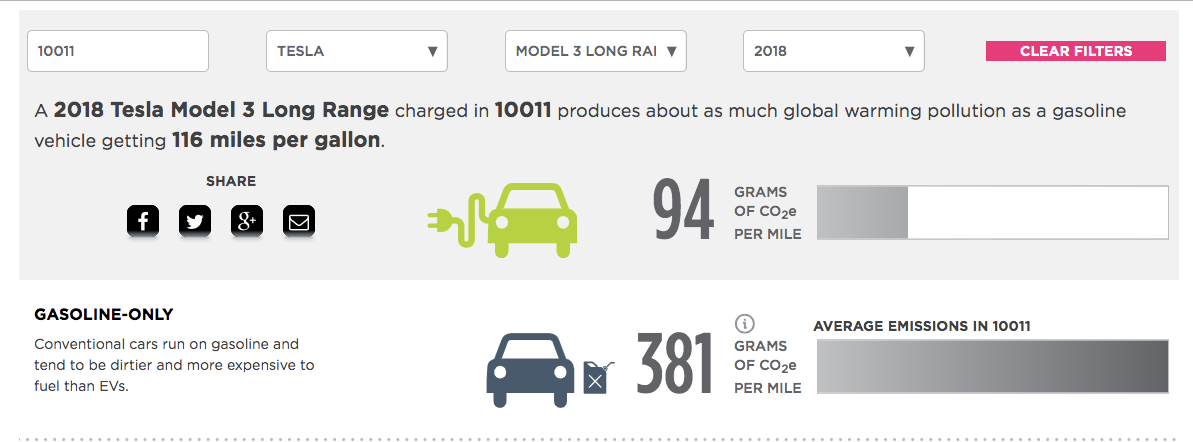
And charging a Tesla in Bavaria is one thing, but charge it anywhere else, and you'll be doing great. I used the handy widget on the UCS website to imagine a world in which I charge a Tesla Model 3 here at the Jalopnik Grand Palace in New York City, and already I'm doing better than any gasoline-powered car on American roads today:
The WSJ goes on to pretend it's acting with some semblance of rationality, saying that "this isn't a universal condemnation of electric cars, which may emit less carbon in countries such as France that rely heavily on nuclear power," which sort of undercuts the entire argument, considering that coal power plants have been declining for years under a collapsing coal economy.
"Recall the false promises about corn and cellulosic ethanol," it bleats, which my recalling tells me was just promises from politicians trying to win the Iowa primaries that a bunch of corn farmers would get rich.
But, as always, the real purpose of an op-ed like this is always reserved for the kicker:
These subsidies and exemptions inevitably divert consumer euros and corporate investment toward electric vehicles no matter their true environmental impact. Better to heed the report's authors, who suggest allowing room for a range of possible auto technologies to blossom and compete.
Ah, now I see. "Please stop subsidizing electric cars," in other words, "lest they be able to compete with fossil fuels, which are incredibly, massively, hugely subsidized themselves, to the tune of $20 billion a year."
No, electric cars aren't perfect. They demand a massive amount of resources, resources that are finite just like all fleeting ephemera of this universe, and which will surely run out sooner than would be convenient for us to find replacement technology.
But that's not the argument being made. This particular whole argument is stupid.
Stop it.