

The US Navy Will Retire Its Oldest Active Aircraft Carrier After 52 Years Of Service
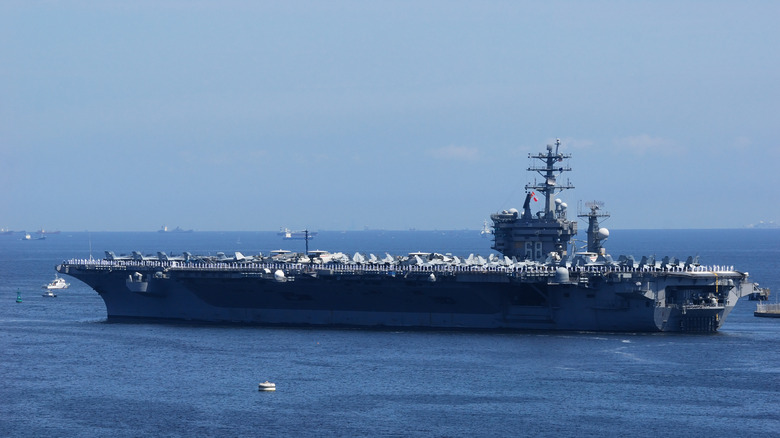
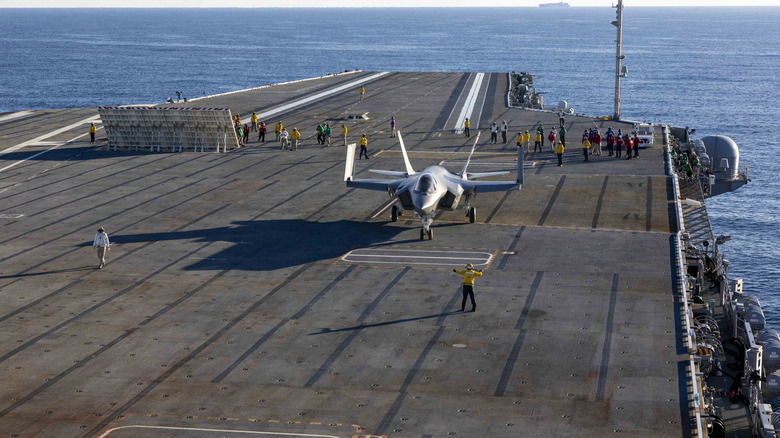
The oldest aircraft carrier still in service, the USS Nimitz, was commissioned on May 3, 1975, and it's quite something. Measuring approximately 1,092 feet long, it boasts a crew capacity of about 5,000, and — configuration dependent — it can carry up to 90 aircraft. It's essentially a floating air base, so rather than relying on land-based air fields, the U.S. Navy can deploy the Nimitz and operate jets, helicopters, and the like from its deck instead.
Power is sourced from a duo of Westinghouse A4W nuclear reactors, which themselves power four turbines, enabling speed of up to 30 knots. The major benefit of harnessing nuclear power on ships is that it lets them operate for decades before refueling is required. When refueling is required, though, the process takes years to carry out. A major overhaul of the Nimitz, including nuclear refueling, was finished in 2001, but the entire process took the best part of a decade, including planning.
The reason for the ship's retirement now is simple; Nimitz-class carriers were designed with a 50-year service life, and that's been reached. It should really already be tucked up in retirement, but as its replacement, the USS John F. Kennedy, has been delayed, its service has been extended to March 2027. U.S. law dictates that the Navy must keep a minimum of 11 aircraft carriers in service, so the extension of its service was necessary.
Uncovering past records and future outcomes of USS Nimitz
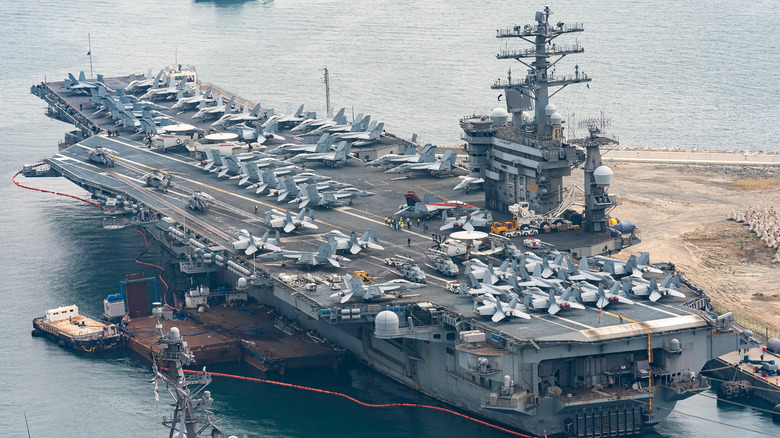
The Nimitz hasn't been the longest-serving U.S. aircraft carrier for all that long. In fact, it only took hold of that record in May 2026, pinching the title from the USS Enterprise. Other impressive numbers associated with the aircraft carrier include that in April 2023 it recorded its 350,000th arrested aircraft landing, another record, and it has also played host to more than 200,000 sailors in its time. There'is no denying, it's been a busy ship.
Now that its record-breaking run is coming to an end, questions are being raised about how it can be disassembled and recycled in the most effective, least damaging way possible. However, retirement doesn't mean immediate scrapping. It must be de-armed, safely shut down — including the defueling of its nuclear reactors — and then be prepared for dismantling. First, everything from weapons through to harmful materials, like lead and asbestos, must be carefully removed. Only then — some years down the line, when it's fully inactive and stripped — can disassembly begin.
A quick look at its replacement
Its replacement, the USS John F. Kennedy has been a long time coming. We watched it float for the first time seven years ago, and now we're only months away from seeing it officially enter service. The new vessel belongs to the newer Gerald R. Ford class, and it boasts some significant improvements over the Nimitz's now half-century-old design.
Traditional steam-powered catapult-style aircraft launch systems will be replaced with electromagnetic systems, although President Donald Trump has ordered later ships of the same class to revert back to steam catapults. Plus, the new ship sports far more advanced radar and combat systems. It's also far more efficient than the old design, with operations and support costs estimated at $4 billion lower over its life than the costs with Nimitz-class carriers.
The Kennedy's basic size and weight are remarkably similar its predecessor's, though, at 1,092 feet and 100,000 tons. It, too, will use nuclear power, but although its A1B reactors are smaller, they can triple the Nimitz's energy output. Ultimately, the idea is to launch a vessel that can operate aircraft more efficiently, with less maintenance, reduced operational costs, and a higher rate of sorties.