

NASA Pushes Further Ahead With The Non-Space Side Of Its Mission, Teases New Experimental Plane

NASA has unveiled, sort of, its newest experimental plane. And by that, the agency appears to mean a plane meant to conduct experiments, rather than the plane itself being the experiment. Called the X-70 Fractal, the aircraft's primary selling point is its modular design, both inside and out. This means that payloads can be swapped out easily, whether they are hanging off the wings or nestled inside the plane. Even the flight controls can be reconfigured in case the agency wants to test different ways for the pilots (and it is piloted) to maneuver. The X-70 is really a platform to allow for a wide array of experiments on a single airframe, rather than creating a bespoke airframe to conduct one mission, like the X-59 is doing now.
As for the plane itself, the X-70 Fractal is... well, more announcement than vehicle, at least for now. NASA says that it can carry 2,000 pounds of science equipment and take off with up to 10,000 pounds total. It will fly up to 45,000 feet in altitude, far above most airliners and well into the stratosphere. It will go up to 1,500 nautical miles, broadly on par with an F-35. It also looks like an F-35, I think, maybe? For images, all we've got is this misty photo that looks AI generated. NASA seems to want to copy the energy of the F-47 and F/A-XX reveals, which are also foggy renderings and not actual photographs. Show me you're making an airplane without showing me you're making an airplane, I guess.
NASA's mission here on Earth
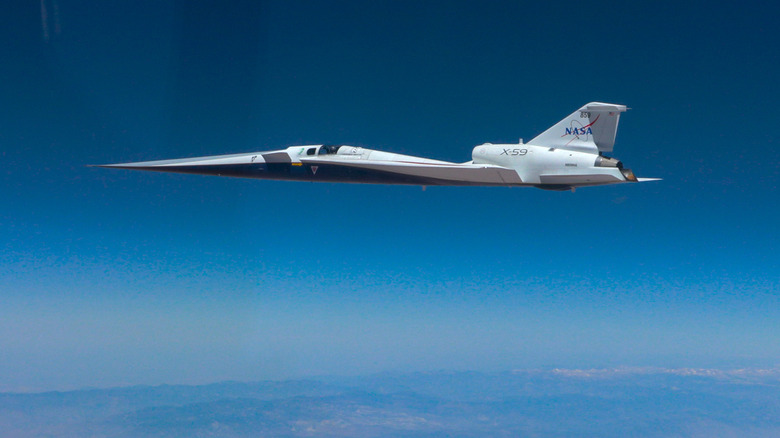
NASA achieves such historic feats in space that it's easy to forget that it is also an "Aeronautics" administration. Part of its remit is to push forward the boundaries of aviation here on this planet, which NASA Administrator Jared Isaacman has renewed focus on. Isaacman himself is a pilot who owns his own MiG-29 Soviet fighter jet, so this is an area of personal interest for him. In fact, he's promising that more experimental aircraft are on their way; rumors abound that the agency may be returning the famous SR-71 Blackbird, the fastest plane ever made, to service.
By doing so, NASA does important R&D on airplane technology that is then released into the public record, to the benefit of all aviation companies and everyone who flies on their products. That's the whole point of the X-59, which is trying to reduce the impact of sonic booms enough to make commercial supersonic planes financially viable. In addition, NASA's latest budget points to aviation as an area of strategic competition, per Wired. To that end, it may do some research alongside the Pentagon as well. This is where something like the X-70 is useful: it could do scientific, commercial, or military research as needed, simply by swapping out equipment payloads via its modular design. Now all NASA needs to do is, you know, build it, possibly with a contractor. Details!