

Open Your Mind And The 2027 Mercedes-AMG GT 4-Door Coupe Will Blow It
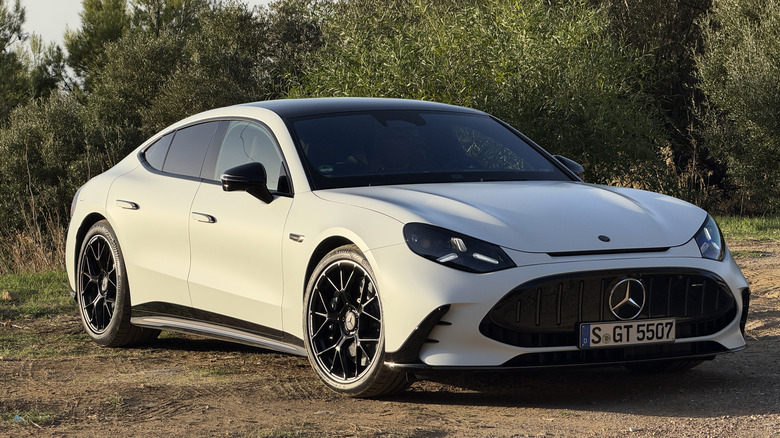
Appealing to enthusiasts and buyers of performance cars is already hard enough with internal combustion engines, whether we're talking affordable hot hatchbacks or high-end supercars. As many automakers have been learning the hard way, it's orders of magnitude tougher to build and sell a good electric car to those same enthusiasts. They want their cars to feel real, with tactile sensations and character and emotion and all those other valid clichés, and few (if any) EVs have achieved that or even really gotten close.
Now, the wizards at Affalterbach have done it. The 2027 Mercedes-AMG GT 4-Door Coupe has unbelievable performance figures when it comes to power and speed as well as efficiency and charging, it has advanced technology features and F1-derived aerodynamics, and months after the reveal its design still has everybody talking, to say the least. Most importantly, it is absolute dynamite to drive – a grand slam, a home run, the automotive equivalent of an EGOT, however else you want to say it – and much of that is down to how it emulates a combustion powertrain, complete with V8 noises and shifts that will stretch your definition of "real."
Head of development Oliver Wiech told me that even the most staunch anti-EV car enthusiasts, from people on Mercedes' own engineering teams to its dealers and long-time AMG customers, have been completely enamored by the electric GT once they've experienced it for themselves. Regardless of how you feel about its styling or its powertrain or its perceived gimmicks, if you go into a drive in the new Mercedes-AMG GT 4-Door Coupe with an open mind, prepare to have your mind blown.
Full disclosure: Mercedes flew me to Málaga and put me up in a lovely hotel so I could spend two days driving the GT55 on the road and the GT63 on track at Ascari. I spilled a latte on my MacBook Pro on the first day of the trip, so if you see any typos in here, I blame the crappy PC I've had to write this on.
More spacious than you'd expect
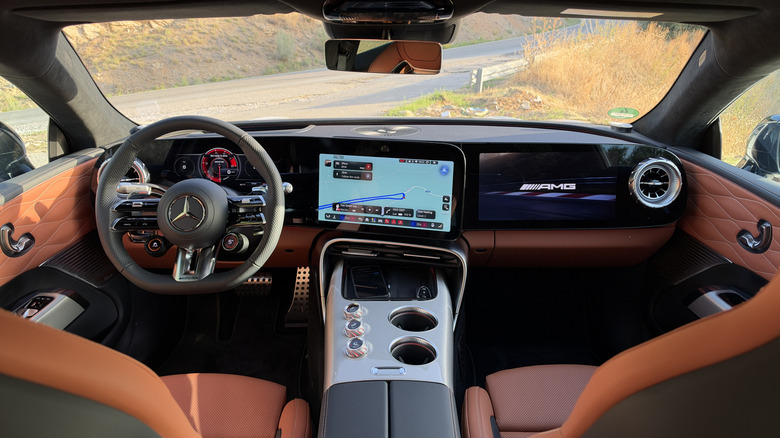
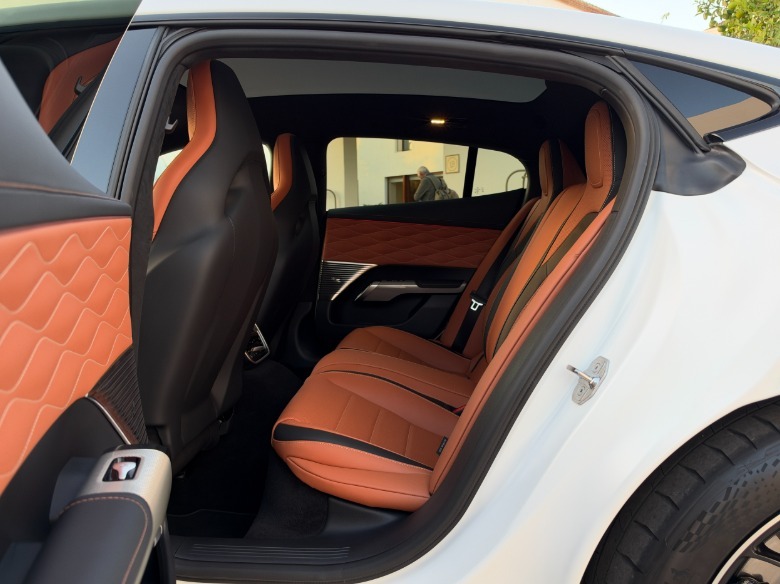
In many ways this car is the heir to the first-generation Mercedes CLS, particularly because of its sloping roofline that's the reason for the four-door coupe moniker, and thankfully the new GT is much easier to get in and out of than both the original CLS (which I own) and the first-gen GT 4-Door Coupe that this EV replaces. Even people much taller than my 5-foot-9 self won't really have to worry about smacking their head when getting in or fitting comfortably in the seat. Despite being almost two inches lower in height than the old GT 4-Door, its interior seems far more spacious, even in the back seats.
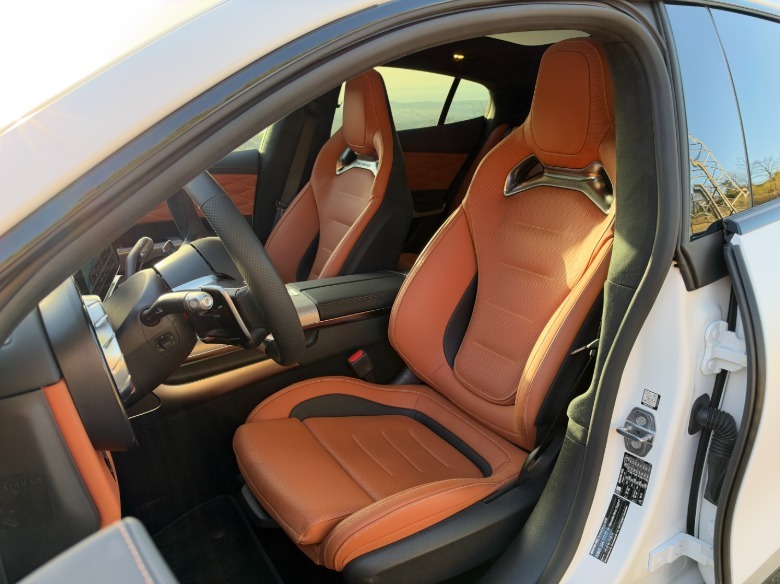
I settle into a sports car-like driving position with a low H-point and a great view out ahead; the rear window seems small at first but visibility isn't that bad through it, and the C-pillar blind spot is better than in my 20-year-old CLS. Progress! All of the cars I drive are equipped with the optional performance seats with integrated headrests, which look cool and are very supportive and comfortable, even after spending hours in the car. They have a heat function and adjustable bolsters and lumbar support, but unfortunately if you want ventilation and massage (and I do want them) you have to stick with the still-supportive base seats.
 Daniel Golson/Jalopnik
Aside from some flourishes like the center screen canted toward the driver and the surrounds of the air vents, the GT's interior feels much like any other new Mercedes EV, and that same feeling extends to how it drives – in Comfort mode, at least. This is an easy car to drive around the city, with standard six-degree rear-wheel steering giving it a tight turning radius. The cars we're driving have staggered-width 21-inch wheels wearing Continental SportContact summer tires, and even with that big rubber the optional Active Ride Control hydraulic suspension keeps the ride firm and sporty but never uncomfortable or rough. It's certainly much more comfortable than the last-gen GT, which had a horrible ride.
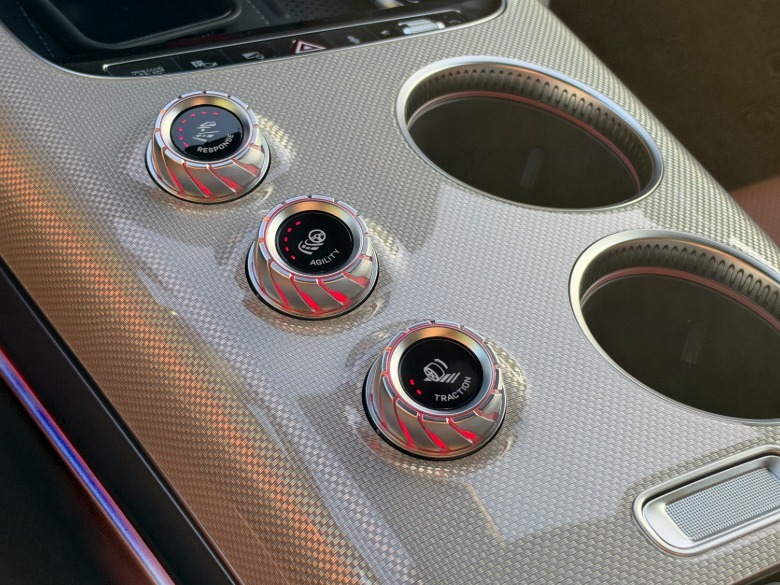
When still in Comfort, I try out the first of the three Race Engineer knobs on the center console, which adjusts the responsiveness of the throttle pedal. (More on the other two later.) The dial goes from 1 to 9, with 1 being the least-responsive and 9 being the most, and boy does turning it up all the way make a difference. In addition to adjusting the actual responsiveness of the motors, the physical feel of the pedal changes, giving you less resistance when you press it like when cycling through regen braking settings.
Please don't make me explain what axial flux means
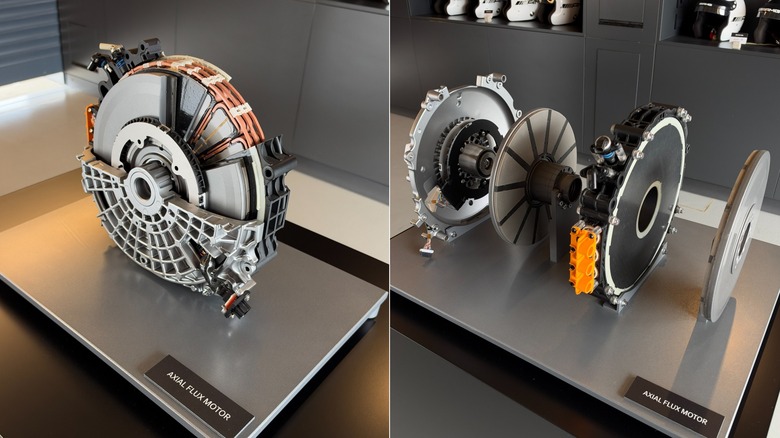
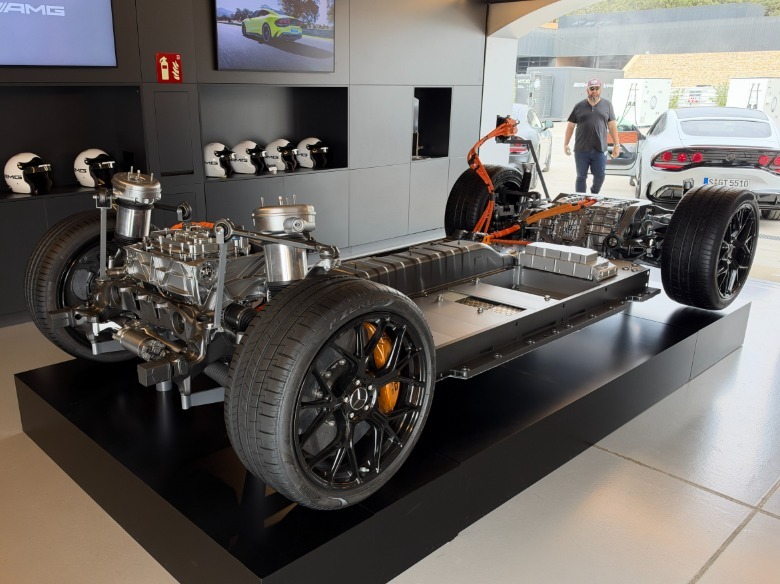
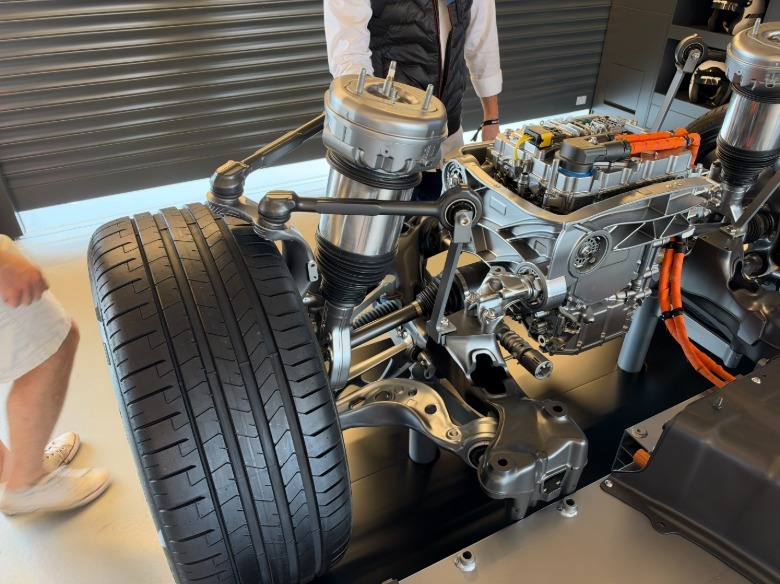
On the road we're driving GT55s, which have one electric motor on the front axle and two on the rear axle. Those motors are axial-flux units created by YASA, a British company that was acquired by Mercedes a few years ago. (YASA already has similar motors in plug-in-hybrid supercars like the Koenigsegg Regera and Ferrari 296.) The rear motors are combined together in a housing with planetary gearsets, an oil cooling system and two water-cooled silicon carbide inverters; the motors can spin to more than 13,000 rpm. The front motor, which also has an SiC inverter and a spur transmission, is activated when more power or traction are needed and can reach over 15,000 rpm. They're juiced up by an 800-volt battery pack with a usable capacity of 106 kWh, which has Formula 1-derived tech like skinny cylindrical cells and an electrically non-conductive cooling oil that flows between them all.
AMG's main goal with the GT's powertrain and the dedicated AMG.EA platform it rides on was sustained, repeatable performance in all aspects – especially important when there's this much power on tap. The GT55 has a peak output of 805 hp when using launch control or Boost mode (output is 577 hp continuous) and a massive 1,372 pound-feet of torque. Accelerating from 0 to 60 mph takes only 2.7 seconds (or 2.4 seconds with a 1-foot rollout included), and it'll reach 124 mph in 9.0 seconds (also three tenths quicker with the same rollout). It feels absurdly quick both from a stop and when accelerating at speed, even when in Comfort.
 Daniel Golson/Jalopnik
Switch the car into Race mode and the suspension hunkers down and tightens up, the front motor is permanently engaged, and special powertrain preconditioning is turned on. It's hard to think of a better point-to-point car than this, especially if your route includes spectacularly twisty mountain roads like the area around Ascari. The Active Ride suspension keeps the car extremely flat and stable in corners by using hydraulically interconnected dampers instead of mechanical anti-roll bars, and I promise you the car feels much lighter than its 5,501-pound curb weight suggests. Its steering doesn't have quite as much feedback as a Porsche Taycan, but it's sharp and direct, maybe the best-tuned setup that AMG currently offers.
The tri-motor setup allows for fully variable torque vectoring between the rear wheels, and with stability control in its regular on setting, there is an unstoppable amount of grip. Power out of a corner hard and the traction control light flashes, the car blasting ahead with zero drama. Put it into ESC Sport and the GT gets looser and more playful, the tail kicking out in easily controlled little slides without feeling like the computers are constantly reigning in the fun.
 Daniel Golson/Jalopnik
Very strong one-pedal regenerative braking can be dialed in using the steering wheel paddles; while I really enjoy driving fast EVs with just the throttle, and it's great to do so in the AMG, I prefer turning the regen to a milder setting and actually using the brake pedal. It's a hydraulic brake-by-wire system, with the GT coming with 16.5-inch carbon-ceramic brake discs up front and 14.9-inch steel discs in the rear. There's great initial bite and pedal feel, with seemingly no loss of performance after some hard driving. This setup is more than strong enough for most people, but I'd want to spec the optional ceramic high-performance compound braking system, partially just because it adds beefier carbon brakes to the rear that look a lot better than the base setup. Those stronger stoppers are part of a package that includes bronze calipers and a 186-mph top speed, instead of the normal 161 mph.
Feel the AMGFORCE
If that was all and the review ended there, I would say the AMG GT is one of the best EVs (or any sort of car) on the market. Once you try the AMGFORCE Sport+ mode with its V8 noises and shifts, though, you won't want to drive it in any other mode again. In fact, you probably won't want to ever stop driving the GT, and no other EV will scratch the same itch. It's hard to think of the right words to describe it. I definitely wouldn't call it "fake", and "simulated" doesn't feel right either. Saying the noises are "synthesized" is probably the way to go, but really it doesn't matter at all. Who cares that the sounds and shifts are not "real" when the end result is this absurdly good?
AMG recorded more than 1,600 sound files of the previous-gen GT R's twin-turbo 4.0-liter V8, capturing every situation from every possible angle, and they're mixed in real-time to match driver inputs and what the powertrain is doing. That means you're never hearing the same noises twice, and everything feels unique and organic to how you're driving the car. The same goes for how it "shifts" when you leave the car to its own devices, though you of course can and should use the paddles to shift, too. Put anyone into the GT as either a passenger or a driver without telling them what's powering the car, and they'll all think there's actually a V8 under the hood. It adds a ton of engagement and sensation to an already engaging drive, eliciting feelings of sheer joy and excitement.
First of all, it's loud, but not in a way that's obnoxious or too much. If you switch into AMGForce Sport+ when the car is stopped it'll burst to life sounding just like the real V8 on startup, but it's much funnier if you change the drive mode at speed, since the car will kick itself into a low gear with the revs up pretty high, resulting in a hilariously good sound. Keep the car in Sport+ around town and it emits wonderful burbles, while at cruising speeds it fades into the background and shifts smoothly like a V8 would. Drop a few gears and start driving more energetically, though, and it gets really gnarly. As my drive partner and friend of Jalopnik, Roberto Baldwin, points out, the placement of the speakers and the rumbling exciters in the seats make it sound like the car is mid-engined, or that there are big side-exit exhaust right underneath us. It roars under acceleration, utters pops and bangs on "overrun," barks when I shift. Nothing about the noises sound artificial, unnatural or repetitive.
 Daniel Golson/Jalopnik
It's just freakin' awesome, and after just a few minutes you might totally forget that you're in an EV at all. Except that even in this mode, with shifts that come with an authentic cut in torque, the GT's acceleration still gives the tunnel-vision feeling you'll only get from an EV. Engineers tell me that the GT is just as quick to accelerate and fast around a track with the shifts on as it would be with them turned off, and in fact the aural and physical feedback will probably help you post even better lap times than you otherwise would.
Crack off shifts with the paddles, and you'd swear there's a real DCT transmission in here. There's an urgency and gut punch quality to the upshifts, and downshifts can be quite forceful too. Using the vibrators in the seats, the car mimics the mechanical clunks and thumps you'd feel in an ICE car's drivetrain. When in S+ you can't mess with the regen, which is set to the minimum level, but downshifting does aid in deceleration, like strong engine braking. It will "rev" to 7,200 rpm, and the car will hold gears for pretty long and upshift right at redline.
You can hear the sounds outside the car as well, and it's loud enough that we can hear GTs driving on track from pretty far away. If you really want to be obnoxious you can park the car, put it in neutral and rev it, putting any nearby Dodge Charger Daytonas to shame. Keep your foot pinned to the floor and it will bounce off the redline seemingly indefinitely – we wouldn't know, because after about ten seconds of doing it for a TikTok, a few Germans walked over to ask us to please shut the hell up.
 Daniel Golson/Jalopnik
The GT's Boost function is also at its best in S+, though it's available in all drive modes. Pull both paddles at once and it instantly activates, providing maximum power for a long time. Like, a really long time. Most cars that offer a Boost do so for 10, 15, maybe 20 seconds, and sometimes you have to wait before activating it again. That's one of the big benefits of the GT's powertrain – in the GT55 the boost lasts for 55 seconds while in the GT63 it'll stay on for 63 seconds, and as soon as it finishes or you manually turn it off, you can immediately activate it again. One AMG representative told me the boost could theoretically last forever, and they needed to come up with an arbitrary time limit. It is actually nice to have it last so long, like if you're coming up on a particularly complex and lengthy set of switchbacks. Turning on the Boost always comes with louder sounds and a countdown timer in the gauge cluster, but with the V8 activated it's a lot more dramatic. The engine noises sound like they get 25% louder, and the shifts feel even more aggressive. It rules.
OK, sure, you might try the AMGFORCE mode and still come out hating the sounds and shifts, even though I can't imagine not loving it. At least you can just switch into one of the other drive modes and it all turns off. It is really nice to be able to go back into Comfort once I'm on the freeway or get stuck behind slow-moving traffic on a twisty road, the car immediately settling back down into a silent, swift electric cruiser. Our group of journalists was unanimous about one thing during dinner conversations with AMG execs and engineers, though: We want to be able to turn on all the AMGFORCE stuff in all modes from Comfort to Race, not just be restricted to Sport+. It really is that compelling, and that's something Mercedes could easily change with an over-the-air software update.
Twist the knobs
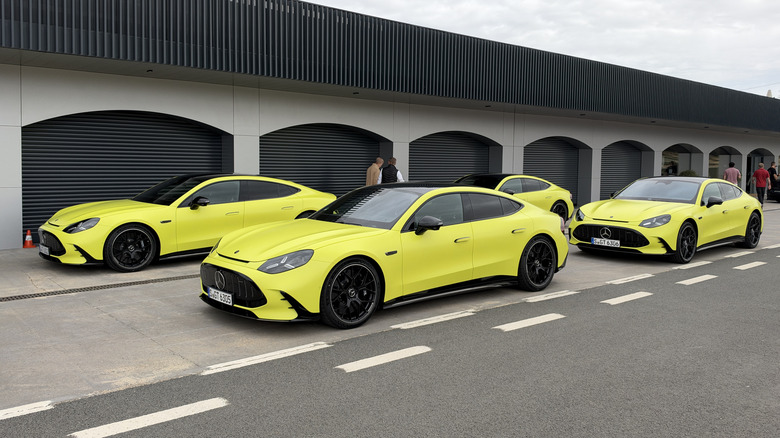
Good as the mountain roads are, AMG's real reason for bringing us to this part of Spain is so we can drive the GT around Circuito Ascari, a track you certainly recognize from "Top Gear" and racing games. Luckily I've been here once before, for the launch of the 992.2 Carrera GTS, so the track is a little less daunting. For this part of the day we swap into GT63s, which have the tri-motor setup boosted to produce a peak of 1,153 hp (711 hp continuous) and 1,475 lb-ft of torque. When accelerating to 60 mph the GT63 is 0.4 second quicker than the GT55, both when including or excluding that rollout, and it'll hit 124 mph a much more noticeable 2.3 seconds quicker than the GT55.
We complete our first two laps in Comfort mode (and at quite a fast pace immediately), with the car feeling fast and fun enough that you won't hate your sighting laps when first starting a track day, and on the second lap we play around with the responsiveness dial. For laps three and four AMGForce Sport+ gets activated, and our instructors talk about how nice the feedback is for executing cleaner and faster laps, and how much more fun it is to rip around a track with the V8 soundtrack turned on. After doing one lap with stability control on, we switch it to ESC Sport for the next lap to experience the difference in grip and slip that it allows.
 Daniel Golson/Jalopnik
Then we switch into Race mode to try out the other two Race Engineer dials. In the middle of the array is the agility control, which messes with the torque vectoring and chassis systems to simulate shortening the wheelbase for, well, increased agility, and to change the car's handling behavior from favoring a bit of understeer to a lot of oversteer. At the bottom is the traction dial, which adjusts the level of traction control intervention – at the loosest 9 setting, up to 90% of torque can be sent to the rear wheels. These two are only available to change yourself when stability control has been fully turned off; with it on, in Sport+ mode the car defaults to agility at 5 and traction at 2.
For the first lap, we crank all three dials down to 1, which means the powertrain is the least responsive, it's the least agile, and the traction control intervenes the most. Even set up like this the car is great to drive fast, but it's clear that the GT is being held back – traction control is butting in more prominently, turn in isn't super sharp, it favors a bit of understeer on corner entry and exit, and torque is obviously being deployed more sensitively.
 Daniel Golson/Jalopnik
The next lap we crank the responsiveness up to 9 and turn the agility and traction dials to 5, and the car's demeanor completely changes. It eagerly dives into corners and rotates like a sports car should, the rear end kicking out quite a bit as I accelerate out of the apex while giving it a dab of oppo, as so many British dudes have probably said to camera on this track. The GT feels so much more lively now, and still totally controllable. On the following lap we turn agility to 7, and the car feels even more precise. Sadly we don't get to try it out with everything turned all the way to 9, going back into Comfort for a cool-down lap, but if we were to do so, things would get quite lairy. There is a lot of video evidence out there of just how effortlessly the GT will drift, or pull off instant burnouts that would shame any muscle car.
Will buyers of this car take them to track days and actually mess with this stuff? Probably not, but they really should. It's fast as hell but fun too, an extremely competent car on track that can be perfectly adapted to anyone's driving skills and desires, allowing you to unlock more capability when you want.
Always ready to rock
Mercedes hasn't released U.S. range estimates for the GT yet, and neither has the EPA, but I do have some real-world data to give you. Depending on wheel and tire setup Mercedes says the GT55 has a range of between 371 miles and 435 miles on the European WLTP cycle; with a 91% charge at the start of our drive day, the GT55 shows an estimated range of about 300 miles, and that's with it calculating based on how the cars have been driven along the same routes in the hands of other journalists. At the start of my track session the GT63 has 80% charge, and after the eight laps the charge sits at 60%, which ain't bad. The range estimate only dropped by 30 miles, too.
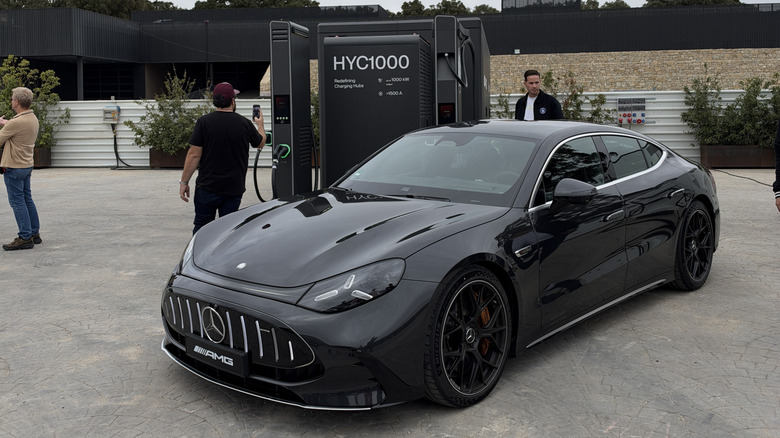
In order to keep the baker's dozen of GTs juiced up for all our track sessions and routes to and from the hotel, AMG brought a bunch of fast chargers to Ascari, including one massive Alpitronic rig that is part of the charging company's partnership with Mercedes. This machine can dole out more than 1,000 kW of power, which the GTXX concept was able to handle and is a goal for future models. The production GT can "only" handle 600 kW of charging power, according to Mercedes. That's still more than nearly any station in the U.S. can provide, and it can take the GT from 10% to 80% in only 11 minutes. In a demo using that Alpitronic monster, we see a GT charge from 17% to 80% in exactly 10 minutes, reaching a peak of 647 kW, and that's with the charger experiencing infrastructure problems and not operating as well as it could.
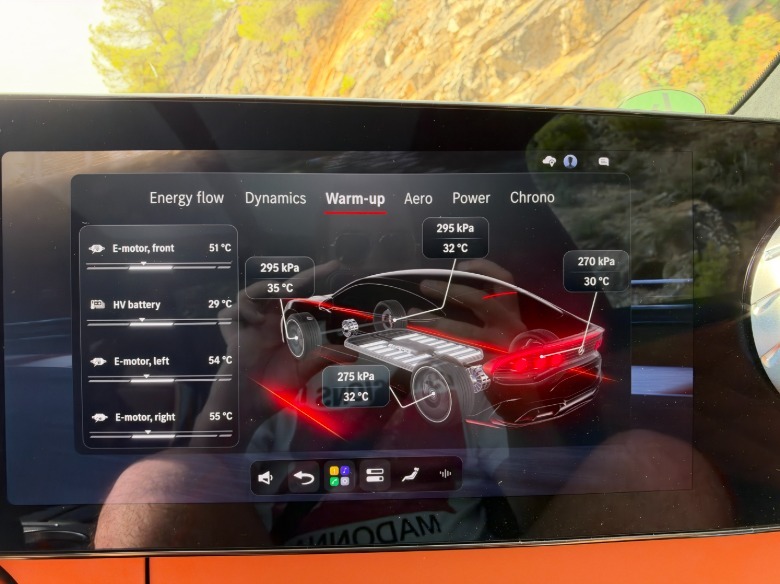
Thanks to AMG's thermal management system, the harder you drive the more primed the car is for fast-charging. In one of the gauge cluster's many display options you can see the temperature of the battery and motors, and it'll show how much fast-charging power the car is ready for. Doing spirited driving in the canyons it easily shows well over 400 kW available, and when that demo GT63 came right off a track session to charge, it was receiving more than 560 kW in less than a second after being plugged in. As soon as a fast-charging session is finished, the car is ready to go right back on track and keep driving at maximum attack. There's no loss or delay in power delivery, energy and thermal efficiency, or anything else that could hold the car back.
Well, looks are subjective...
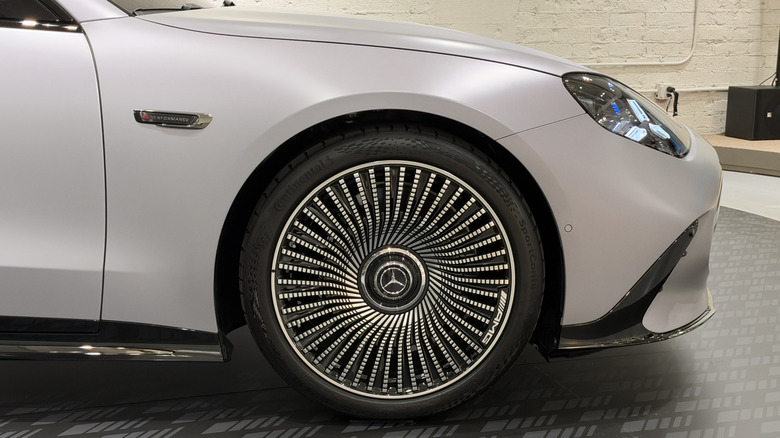
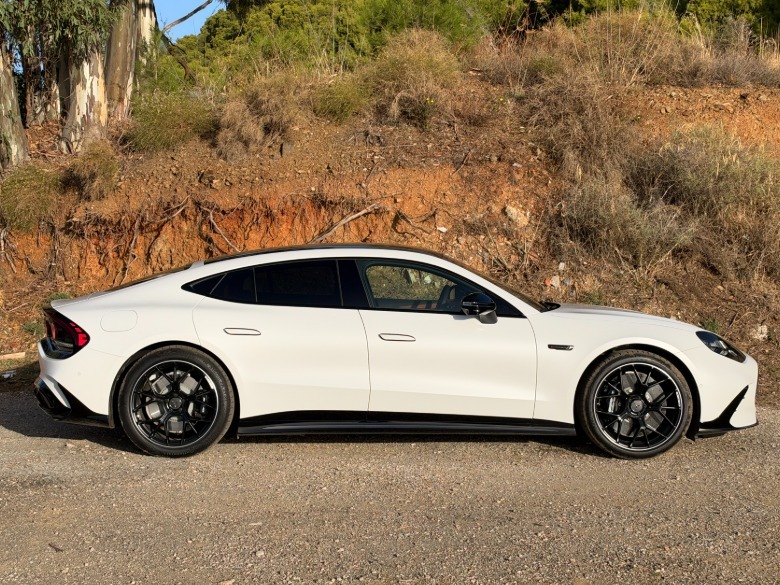
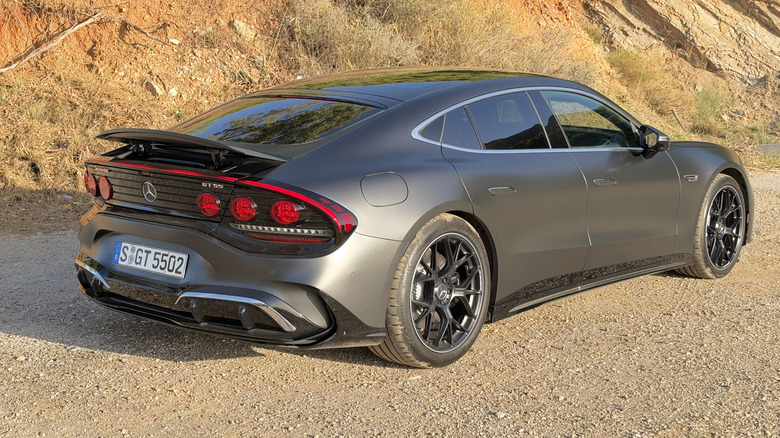
Now I'm not going to try and change anyone's opinions when it comes to how the new AMG GT looks, but I do think it could really grow on you, especially once you start seeing them in the dozens and dozens of different paint colors that Mercedes offers through the Manufaktur program. The turbine wheel design you see above looks fantastic, and gets you more range. The interior is also offered in some great leather schemes too, like a classy full beige or bright blue or yellow, and you don't have to get carbon-fiber trim inside.
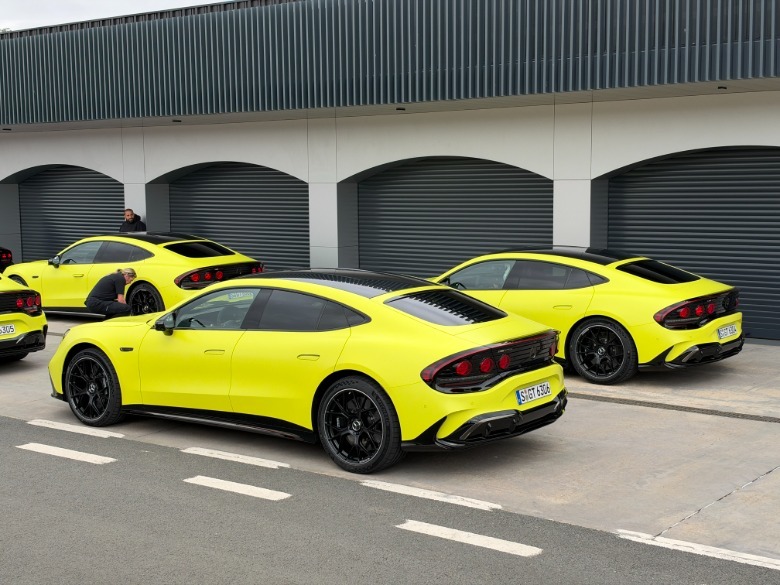
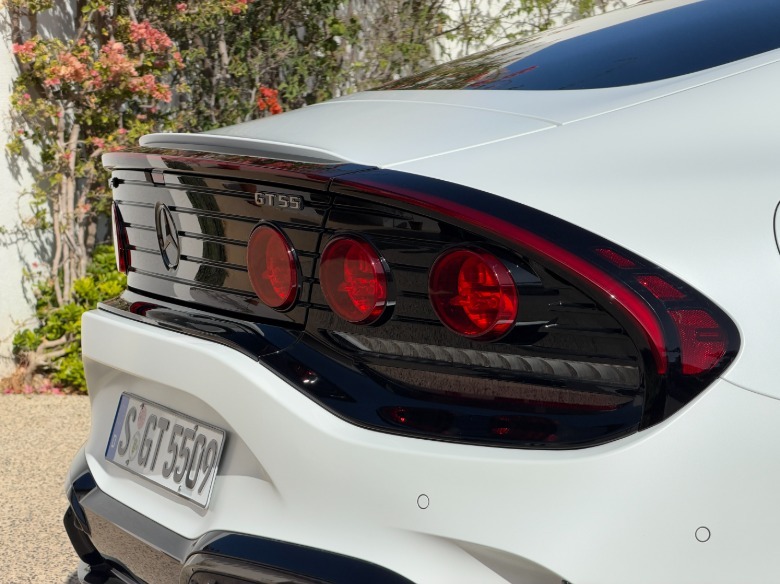
At the very least, the new GT's proportions and silhouette are a big improvement over the outgoing car. It's lower and longer, with a longer wheelbase and dash-to-axle ratio plus a more rakish, shark-like nose. With the 21-inch wheels its stance is pretty killer, and I genuinely do love a lot of the details, like the execution of the AMG grille and the trio of afterburner-style taillights set into that black panel. It's pretty practical too, with the liftback rear end opening to reveal 14.7 cubic feet of cargo space.
 Daniel Golson/Jalopnik
This may be the rare car where a passenger screen is something you'll actually want to use, at least if you're a bit of a data nerd like me and Roberto. When each of us sit shotgun while the other drives, we can't stop swiping through all of the performance data pages available on the 14-inch passenger touchscreen. (You can pull them up in the center screen, too, and there are a bunch of different designs for the gauge cluster that can also tell you performance info.)
These show the current rpm, torque and electrical output of the motors; pedal inputs, steering angle, suspension compression and g-forces; temperature of the motors and battery pack; the position of the various active dynamic elements such as the deploying rear diffuser; and an IWC stopwatch, among other things. The animations and graphics are all excellent, and looking through it all while the driver is really putting the hammer down must feel like how cats do when they watch birds at a feeder.
It must be experienced to be believed
Somehow, this performance comes at a reasonable price, at least as far as this class of car is concerned. The GT55 will start at $145,000 before a $1,550 destination charge, putting it right between the Taycan 4S and GTS in terms of price. That also makes it about ten grand cheaper than the outgoing GT63 4-Door, the cheapest V8-powered one that made do with a meager 575 horsepower. For that price you get tons of standard active-safety features, a Burmester 3D surround sound system, fancy digital headlights, three-stage adjustable air springs, and the trio of screens. (A dual-motor GT53 with less power and equipment is coming later in 2027, but we don't have pricing details yet.)
The GT63 will start at $175,000 before a destination fee that Mercedes hasn't announced yet, making it about $25,000 cheaper than the old GT63 S E Performance PHEV and ten grand cheaper than a Taycan Turbo. That also undercuts a Lucid Air Sapphire by almost $100,000. It gets the Active Ride Control suspension, Race Engineer dials, Race mode, the Drift mode and AMG Track Pace features, all of which are available in the GT55's Dynamic Plus package. Other standard features on the GT63 include ventilated and massaging front seats, Nappa leather, a head-up display, and Magic Vision Control wipers.
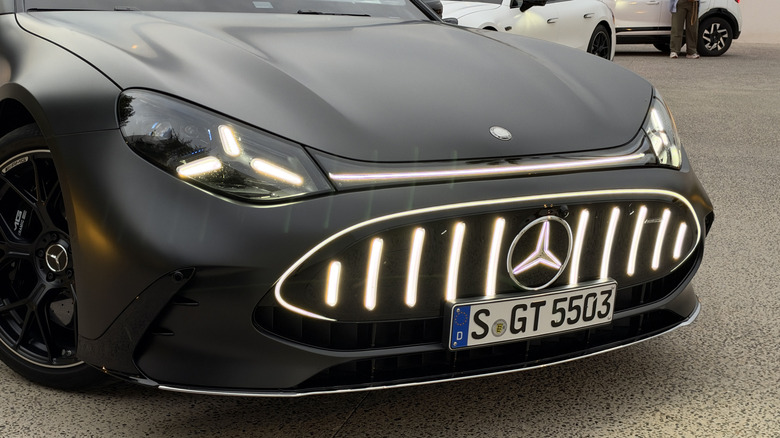
Available on all GT 4-Door Coupes are a Sky Control panoramic sunroof with dimmable glass and illuminated AMG logos, soft-close doors, a three-person rear seat instead of the standard two, an even fancier Burmester sound system, and all sorts of styling options. An exterior lighting package adds a lightbar between the headlights, a light strip along the trunk edge, and illumination to the grille bars and surround; I would definitely get this, but lots of people prefer the front end without the light bar.
 Daniel Golson/Jalopnik
As awesome as it is, at the end of the day this is a niche sort of vehicle regardless of what's powering it. The GT 4-Door is never going to be a major seller for AMG, though the brand is very optimistic about its prospects around the globe, including here in the States. What makes the electric GT truly exciting is what it means for the future of AMG, and performance cars as a whole. Its axial-flux motors, advanced battery solutions, dynamic focus and spectacular sounds will spread across the AMG lineup – we've already seen its AMG GT SUV twin and the "entry-level" 671-hp CLA45, and models like the GLC and C-Class are coming with over 900 hp – and just think what other brands might dream up once they've driven one.
Like all the best magic acts and wonders of the world, the 2027 Mercedes-AMG GT 4-Door Coupe must be seen — or rather, heard and experienced — to be believed. This is a car that could truly win over even the most extreme internal combustion enthusiasts, as long as they'll open their minds and let it.