

SpaceX Starship Will Need To Re-Fuel 22 Times In Space To Make It To The Moon
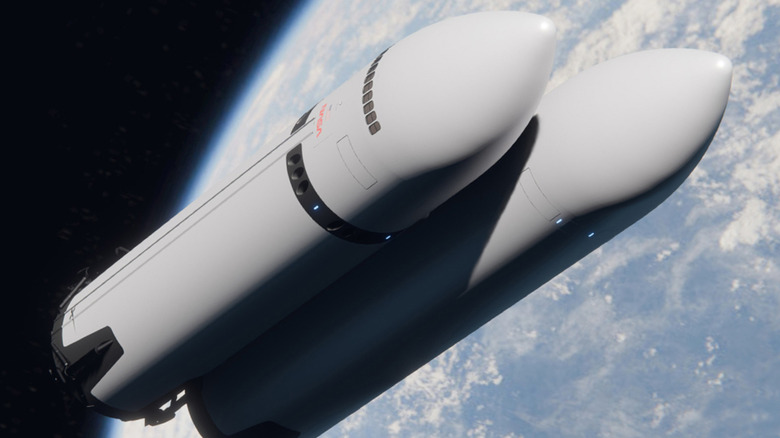
As NASA plans to send astronauts back to the surface of the Moon in 2028, there's still the small matter of figuring out how to get them there. While the Artemis II mission proved that we can send people around the Moon and bring them safely home, the space agency needs a way to take astronauts out of the Orion capsule and down to the actual ground. The original plan was for a SpaceX Starship to fulfill this duty, and that could still be the case. But delays in the development of that ambitious rocket caused NASA to re-open the contract, which allowed Blue Origin to toss its hat in the ring. Still, SpaceX insists it will fend off this challenge from a rival billionaire-owned space company and win the contract all over again. The only thing standing in its way: the minor fact that it has to refuel the Starship in-orbit, something never done before and that SpaceX hasn't even attempted yet. Oh, and it has to do it many, many times. How many? Great question.
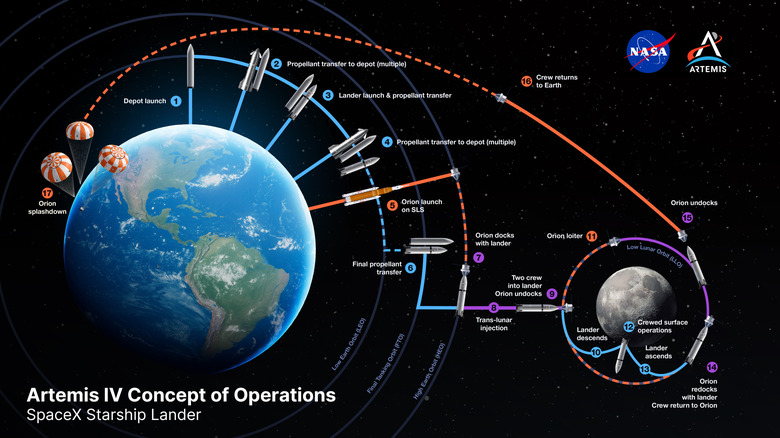
The NASA Aerospace Safety Advisory Panel recently announced that, by their calculations, a Starship would require fully 22 in-orbit refuelings to get that one single rocket to the Moon's surface, per Ars Technica. Again, the total number of times that any rocket has ever done this is zero. Specifically, the plan from SpaceX is to launch one Starship into orbit to act as a fuel depot; then launch many other Starships to load up that first one with fuel; then launch a final Starship to take on that fuel from the depot and head out to the Moon.
If 22 sounds like an insane number to you, you're not alone: SpaceX CEO Elon Musk said on the social media platform X, which SpaceX owns, "Actual number will be more like 6 to 8." That makes for quite a broad range of estimates. The reason this is so fuzzy is because the fuel we're talking about here isn't gasoline, but rather a mixture of liquid oxygen and methane. This actually boils off in the vacuum of space, so how much fuel can be transferred depends on the efficiency of the technology involved. Technology that has never actually been tested in orbit.
How long it takes to refuel a Starship
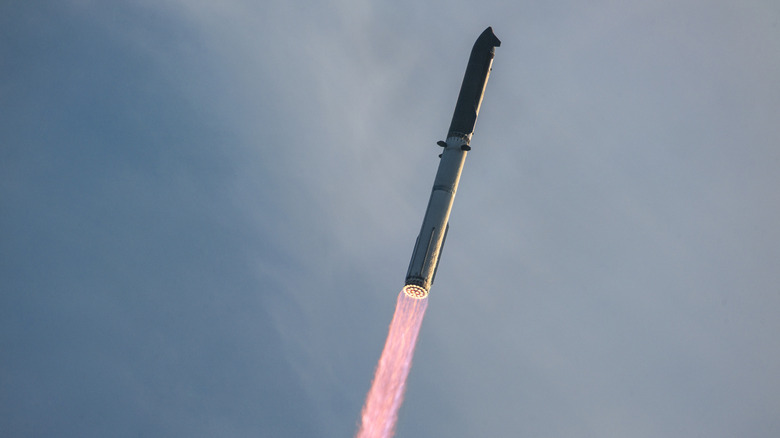
Currently, SpaceX plans to perform its first test of orbital refueling in early 2027, just a little over a year before it will theoretically do it for the Moon landing. If that doesn't work, well, SpaceX's lunar ambitions are in trouble. Even if it does go well, and there are absolutely no issues whatsoever with this unprecedented capability, there's still the small matter of actually launching all of these rockets. Right now, the still-in-development Starship only launches once every few months. Musk claims it will be launching weekly by early 2027, just months away. And then he further claims it will launch twice a week by the end of 2027. Let's just say that would be, ah, truly remarkable if it happened.
For once, let us be optimistic, and believe in words. If these words be true, and Starship truly is launching twice-weekly, then launching 22 refueling Starships (plus launching the initial "depot" Starship) would take... three months. And that is assuming no failures, either of the rockets or of the fuel transfer process. That's reduced to three weeks if you also believe Musk's figure of six launches. At least Musk has never once lied about his companies capabilities! If for some reason you don't believe in that launch cadence, then total refueling will take potentially years. Either way, that would amount to the most complicated endeavor NASA, or any space entity, has ever attempted.
Will the Moon sing the Bezos Blues?
By contrast, Jeff Bezos' Blue Origin has a much simpler plan to get to the Moon. It's still complicated, let's be clear, but less so than SpaceX. The company's proposal calls for a mere four launches of its New Glenn rocket, assuming it doesn't explode and destroy its entire launchpad, again. The first three would park a booster stage in orbit; the fourth would put a Blue Moon lunar lander into orbit, where it will collect all the booster stages, stack them together, and then blast off towards the Moon. That is a wild dance all its own, but it doesn't require figuring out how to transfer any fuel.
If you're wondering where the actual astronauts are, don't you worry: they're on a completely different rocket altogether. The Space Launch System (SLS) rocket carries the Orion capsule into orbit with all the astronauts on board. The capsule then continues on from Earth orbit to lunar orbit on its own, as the Artemis II mission demonstrated. Somewhere along that path — whether in high-Earth orbit, high-lunar orbit, or low-lunar orbit (this part still isn't nailed down) — the Orion capsule will have to dock with either the Starship or the Blue Moon, depending on who wins the contract. The lander will then land, the astronauts will enjoy a nice walk around another world, and then the lander will return to lunar orbit. Then it's back aboard the Orion capsule and then back to Earth.
Sounds easy! Basically, a lot has to go right for NASA to make that 2028 landing date. How it shakes out in practice depends on how well a lot of untested equipment and procedures work. Then again, if you were to go back to the 1960s, the Apollo program wasn't exactly any more precedented, or safer. In that decade, though, NASA did have a lot more testing demonstrations before going for the Moon. This time around, the agency wants to get there faster.