

Rivian Is Doing The Damn Thing
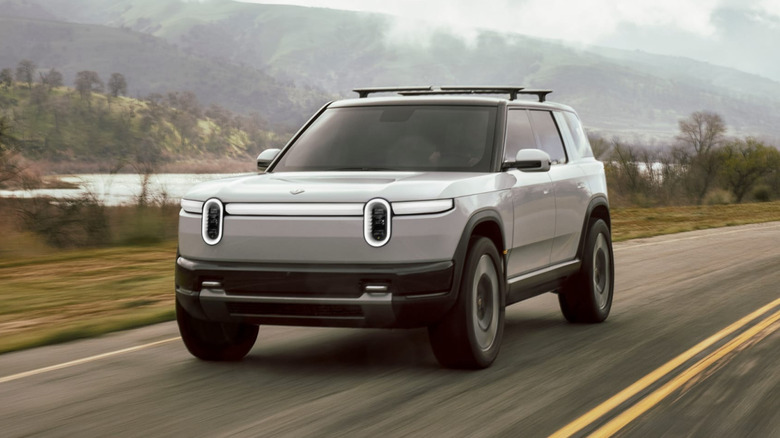
There's never a guarantee a startup car company will actually make it. Automotive history is littered with companies that never made it more than a few years, and after some of Rivian's early financial troubles, it wasn't out of the question that the Irvine, California-based company could join that group. Well, following the introduction of the R2, those fears seem to be all but squashed.
Rivian just posted its third-quarter results for 2026, and the compact-crossover-sized R2 helped raise the automaker's deliveries by 46% year-over-year to 19,248 vehicles, according to Car and Driver. That means Rivian is increasing its yearly sales projection to between 67,000 and 70,000 vehicles — up from 65,000 to 70,000. It also just so happened to outsell the larger and more expensive R1S and R1T flagships combined, as well as the EDV delivery van. I should note that Rivian didn't explicitly say how many R2s it sold, though. This news comes even though the only R2 that Rivian currently sells is the most expensive Performance version of the electric SUV, and the idea that Rivian is still "early in the ramp" of R2 production, according to CEO RJ Scaringe, who spoke with Reuters.
Theoretically, things are only going to get better from here, sales-wise, with the only currently available R2 clocking in at $59,485, including destination. Eventually, a $55,485 Premium trim and $46,485 base model will join its ranks, but the only information we've got is "coming late 2026" and "coming spring 2027," respectively. Of course, even the most expensive R2 is a hell of a lot cheaper than the R1S and R1T, which both start well north of $80,000.
Uber money
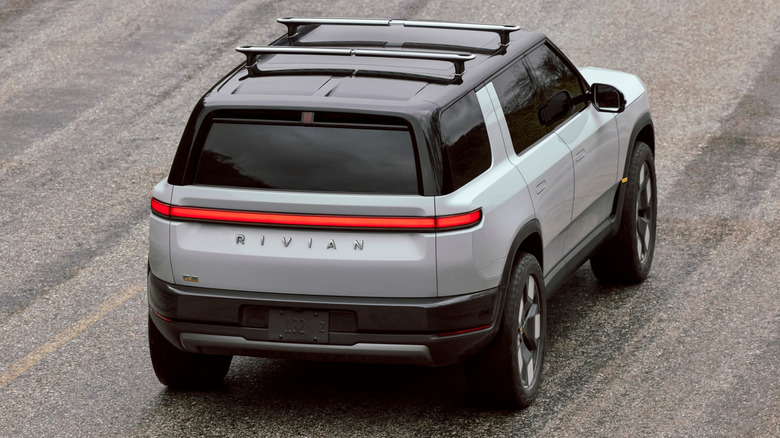
And good news keeps coming, because last week, Scaringe said he was "very confident" Rivian would hit an autonomy milestone this year that would unlock a quarter-billion-dollar tranche of investment money from Uber. That's part of an up-to $1.25 billion investment the rideshare company is making in the automaker through 2031, according to Reuters. It includes an initial $300 million and is contingent on several autonomy milestones. However, Rivian hasn't said exactly what those milestones are. Don't worry, though. Scaringe says Rivian is "right on time."
We do know that the partnership between Uber and Rivian targets the 2028 launch of a driverless R2 robotaxi on Uber's network — starting in a handful of cities and then expanding to about 25 over the next year and a half. Clearly, Rivian is aiming its R2 robotaxi directly at the Tesla Cybercab.
It needs to work, too. As Reuters points out, both the R2's success and the Uber partnership are imperative for making Rivian stick as a company. It's doing pretty well right now, don't get me wrong, but it's still burning through cash like the Bouvier Beale family, and it's looking for any way to narrow those losses.
No matter how you slice it, Rivian is truly showing it's a company that has the ability to stick around and be viable. Once R2 production is fully ramped up and the R3 is introduced, who knows where it could end up? All it needs to do is get that pesky cash burn problem under control.