

Ford's Sub-$30,000 Fathom EV Will Power Your Home Without Requiring An Expensive Inverter Install
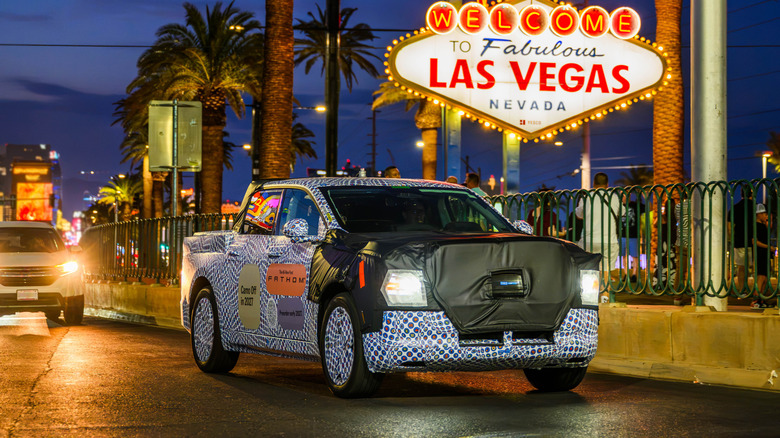
A big bank of batteries and a solar array beats a generator hands down, but the perfect off-grid setup does come with a downside — those batteries are expensive. What if you could drive those batteries and use them to power your car, too? That's the promise of electric vehicles, but once again, that silver bullet isn't perfect. In order to power your house with your EV, you need an inverter, and installation can be pricey. According to Ford, though, when the new Fathom EV goes on sale, you won't need an expensive wall-mounted inverter to power your house.
If you live in a storm-prone area, can't trust the grid, or just want those sweet longterm savings, this sounds like a pretty big deal. The F-150 Lightning came with bidirectional charging that allowed owners to take advantage of its massive battery (either 98 kWh or 131 kWh) to power other things, including your home. But if you wanted to actually power your home, that required spending about $4,000 on Ford's Home Integration System, and you still had to pay someone to install it. That's annoying, so Ford made bidirectional charging less annoying on the Fathom:
After acquiring the startup Auto Motive Power in 2023, we started from a clean sheet on the
Universal EV Platform's bidirectional hardware and software. Our goal wasn't just to add
bidirectional power to our EVs, but to redesign the system to cost far less.With fewer multifunctional parts and the inverter built right into the vehicle's E-box – one of
the five main modules in the vehicle – the system is simpler and more affordable, so more
EV customers can have bidirectional power.Fathom's system is also designed to meet all applicable UL 1741 requirements and comply
with IEEE 1547 interconnection standards to ensure the vehicle is safely connected to the
grid. It uses an existing communications technology standard called SAE J3068 (with LIN-
CP), developed at the University of Delaware, which also helps reduce the cost of Fathom's
charger
A truck that's also a generator
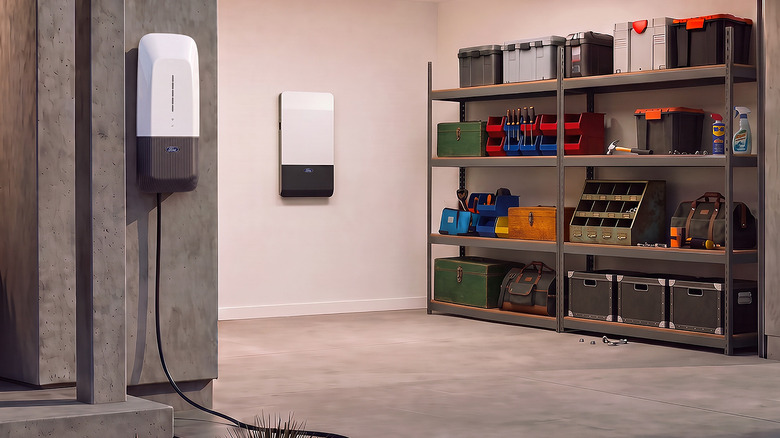
The Fathom EV will, of course, still work and drive like a truck, and it could be incredibly useful to have around the next time you lose power, but built-in bidirectional charging has benefits outside of emergency situations. The Fathom will also come with a feature called Home Power Management that lets you charge your battery while the electricity is cheap and then automatically switch to powering the home once electricity rates rise to a certain point. As long as you live in an area with variable charging rates, that should help lower your power bills.
Whether you want to power your home after a hurricane hits or moderate your power bill, there is a bit of a catch, though. While Ford's eliminated the wall-mounted inverter, you do have to buy some stuff. You'll need the Home Power Station if you want to use Home Power Management, and if you want to use the Fathom as a backup power source, you'll also need the Home Backup Panel. Those will cost money, which is more than free, but Ford says the Home Power Station will be about 50% cheaper than its first-generation bidirectional charger, and the backup panel will be about 60% cheaper.
We'll still have to drive it before we can tell you how successful Ford was (or wasn't) with the Fathom, but so far, it's shaping up to be a pretty interesting little EV. And with a starting price of less than $30,000, you have to imagine the Slate team is crossing all of its phalanges in the hopes that the Fathom has some fatal flaw. Some Achilles heel. Because otherwise, why would more than a handful of people buy the Slate?