

Audi's New Digital Matrix Lights Project Turn Signals Onto The Road And Won't Blind Other Cars
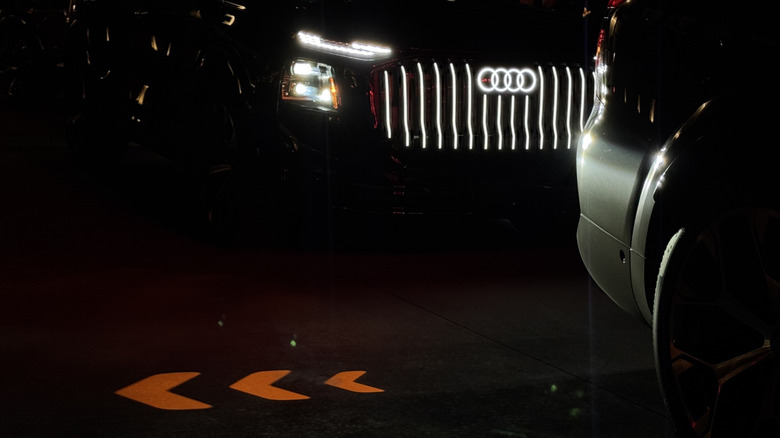
Audi is known for its advanced lighting technology, and has been since it first introduced the concept of LED daytime running lights (DRLs) that are now basically a prerequisite for all new cars. Many of its recently updated models have customizable DRLs that offer owners a chance to choose between several different lighting designs for both the front and rear running lights. The new 2027 Audi Q9 offers that feature, but more importantly, it's the first U.S.-spec Audi model to feature the brand's digital matrix LED headlights and new projections, too.
This is a technology that Audi has had for years now — nearly a decade, in fact — but U.S. regulations stupidly outlawed the brilliant technology on all cars in the country. This is the first Audi that's been programmed to meet the recently updated U.S. headlight requirements, while still providing functional matrix headlights.
 Audi
The tricks don't end there, though. On Q9s with the Prestige package, the car projects a solid white rhombus onto the ground beneath the front and rear doors that unfurls when the door opens, or when a cyclist or car is approaching to signal a passenger is getting out of the Q9. Of course, it also includes exit warning that uses the radar sensors in the rear bumper to detect approaching vehicles, cyclists, or pedestrians, that can prevent doors form opening or stop a door that's already opening into the obstacle. In a scenario like that, the projection lights also display warnings to protect everyone involved.
Beyond those functions, the headlights and taillights also contain little projectors that shine turn arrows onto the road when the headlights are on, which is pretty friggin' neat. The curved OLED taillights are the first of their kind to appear on any road car, and will also display a hazard triangle when the hazard lights are activated, as well as offering drivers their choice of eight DRL signatures.
Simple concept, complicated to execute
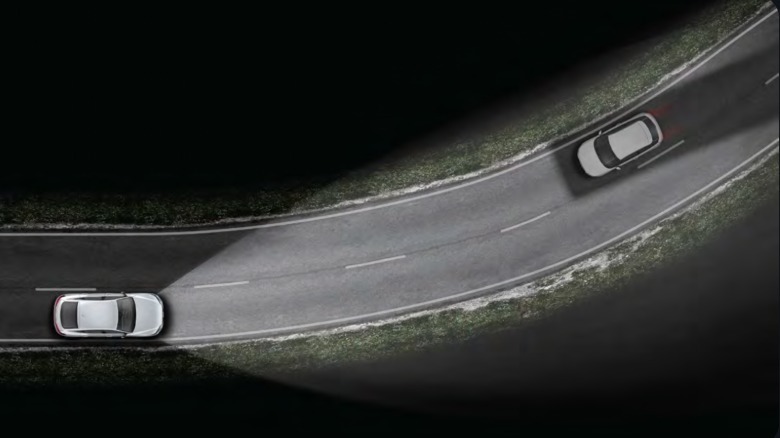
The matrix headlights use the camera mounted behind the rear-view mirror to scan the road ahead for other cars and road signs. When the driver has their high beams on, the car is able to create a gap in the high beam light projection that essentially creates a little box of darkness that follows any other cars or road signs ahead. This means the driver enjoys the increased illumination provided by having the high beams on, and all other road users don't end up getting blinded by them as a result.
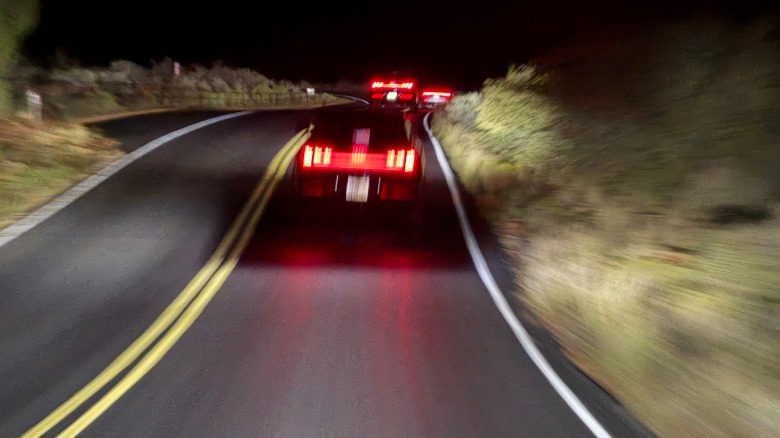
To showcase the tech, Audi sent us journalists out into the darkness of the Utah desert at night time, where I was clearly able to see the benefit of the system. Especially on unlit rural roads, the Q9's high beams provided a significantly better field of illumination, and I was hardly able to detect the darker boxes that surrounded other cars, both oncoming traffic and lead traffic, as well as road signs, so as not to blind the driver. I think this will be a big improvement for all road users, as well as Audi owners.
 Logan K. Carter/ Jalopnik
The turn signal projections weren't super bright and visible in all scenarios, but they could prove to be a valuable safety feature. The scenarios Audi used to demonstrate their efficacy make a good case for the technology. If someone in a Q9 was parallel parked on a busy road, the Q9 driver could signal to indicate their desire to pull out, and since the arrows are projected out wider than the car, upcoming traffic can see the arrows on the road before they would otherwise be able to see the integral turn signal lights.
Digital matrix lights are standard on the Q9 Premium Plus trim and above, and standard on SQ9. The advanced turn signals are only included in the $4,750 Luxury package that also includes the powered doors on the SQ9, and they come included in the $14,700 Prestige package on the Q9. It's all really cool, and probably obscenely expensive to replace when they go wrong or get bonked in a busy parking lot, so maybe park at the back of the lot.