

Debris From Chinese Rocket Found In Minnesota Cornfield
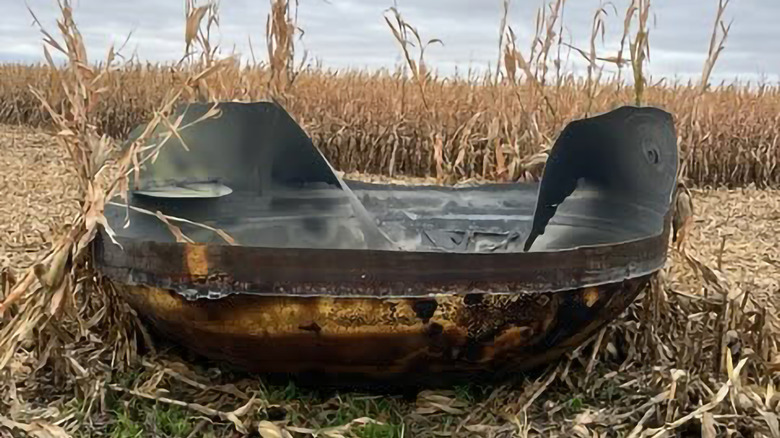
A farmer in rural Minnesota found an 11-foot-wide charred metallic circle in his cornfield last week. He didn't stumble upon an alien spacecraft carrying an infant Kryptonian, which would be a fun find, but instead, it was debris from a Chinese rocket that deorbited in September. The launch was part of the country's effort to build a communications satellite constellation to rival SpaceX's Starlink. Having the debris come back down to Earth is better than adding it to the debris in orbit, but the rocket should have been deorbited over the ocean, not land.
A Zhuque-2E rocket launched from Dongfeng Aerospace City in the middle of the Gobi Desert on September 15. The spacecraft successfully deployed 10 satellites for the Qianfan constellation. According to Ars Technica, the flight lasted at most 80 minutes and the rocket flew over Antartica, then over the Americas as it deployed its payloads, eventually dropping out of orbit. Onlookers on the ground shared images of the rocket's fiery re-entry over Kansas on social media. With the bright re-entry, it would be easy to assume that the entire thing burned up in the atmosphere before reaching the ground, but that wasn't the case.
More satellites mean more launches and more opportunities for mishaps

In a press release on social media, the Stevens County, Minnesota Sheriff's Office stated that it received a phone call last week Wednesday afternoon. The caller reported a foreign object in a cornfield in Scott Township, a sparely populated area with only 117 people. The deputies went to the scene and found "a large, metallic object, approximately 11 feet in diameter." The scorched rocket remnant was massive by typical standards. Most space debris, like the thermal tiles on Space X's exploding Starship rockets, is typically measured in inches. It's a streak of luck that this Zhuque rocket didn't fall out of the sky over a more densely populated area.
With the soaring demand for independent satellite-based communications, there has also been a corresponding increase in launches. The state-based Qianfan constellation had 108 satellites in service by the end of 2025 after six launches over two years. Operations ramped up this year with 11 launches so far. Its operators hope to have 1,296 satellites by the end of the project's first stage and 15,000 satellites at its conclusion. With more launches, there are more opportunities for mishaps to shower the planet with space debris.