

Boeing Wins Navy Contract, Will Make All Sixth-Generation Fighters Across All U.S. Service Branches

After winning the contract to build the F-47 sixth-generation fighter for the U.S. Air Force in March 2025, Boeing has just won the contract to build the F/A-XX sixth-generation fighter for the U.S. Navy. This will account for all American fighter jets for this era, giving Boeing a monopoly on the future of air superiority. This comes after Lockheed Martin had its own monopoly in the fifth generation, since it built both the F-22 Raptor and the F-35 Lightning II. The F/A-XX is intended to be flying sometime in the 2030s and will replace the Navy's aging F/A-18 Super Hornets as it does so. The Navy will continue to operate F-35s, however.
It was a long road getting here, and there was a running possibility that the Pentagon might scrap this project altogether. The major question was whether the American defense-industrial base could even handle producing two highly advanced, very complex planes at the same time. Three, actually, if you count the B-21 sixth-generation bomber, built by Northrop Grumman. So even though there was a clear need to keep pace with adversary capabilities, there was a case that the U.S. simply couldn't handle it all. As the War Zone points out, this may be why Boeing won the bid in the end: by giving both fighters to one company, hopefully shared knowledge and economies of scale will make production feasible.
A terror of the air (we're told)
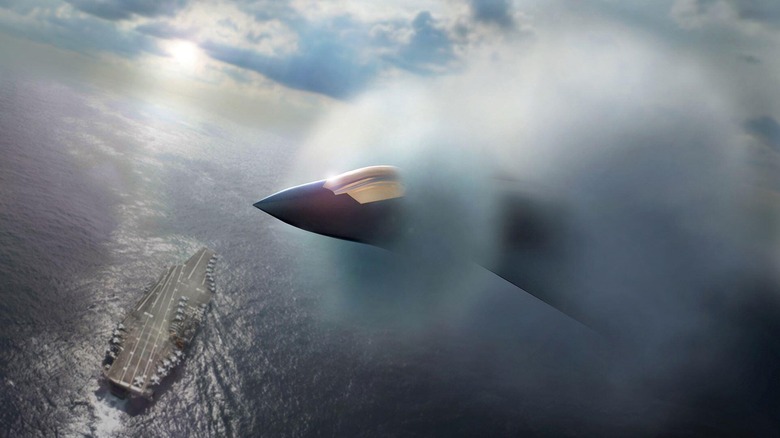
Other than the fact that it exists and a few foggy artist's rendering, we don't know much about the F/A-XX. It looks broadly similar to the F-47, as a relatively large fighter that appears to have no tail fins. Based on what little's been said, the priorities for the jet appear to be stealth and range. If the entire point of an aircraft carrier is power projection, then how far you can project that power is pretty important. The F/A-XX is meant to be an air dominance platform, but with longer range, it could also be a deep-strike asset.
It's also worth noting that the F/A-XX won't just be replacing the F/A-18, but its close cousin the EA-18G Growler. This has the same airframe but is specced for electronic warfare rather than explosive ordnance. That indicates that the F/A-XX will also be also be equipped with an electronic warfare suite, providing both capabilities in one plane. The F-35 fulfills a similar role.
Finally, the F/A-XX will be able to operate alongside Collaborative Combat Aircraft (CCAs), essentially drone fighters like the MQ-28 Ghost Bat, also built by Boeing. This is widely considered the future of air warfare: traditional piloted warplanes leading a flight of CCAs, which are either autonomous or controlled by a backseater on the plane. The F/A-XX sets the Navy up for this future, which it might have struggled with otherwise.