

Nancy Grace Roman Space Telescope Began Life As A Spy Satellite That Never Launched
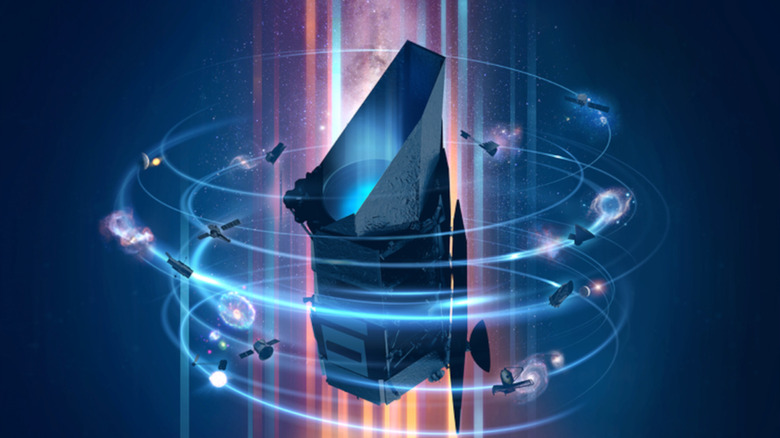
NASA's Nancy Grace Roman Space Telescope is on its way to Earth's Lagrange Point 2, where it will conduct a detailed survey of the sky 1,000 times faster than Hubble did. It will do so with a primary mirror 7.9 feet in diameter, the same size as Hubble's, but under a quarter of the weight. NASA says that's due to "major improvements in technology," but doesn't go on to mention what those are.
It turns out there might be a reason there isn't more detail: NASA didn't build that mirror. In fact, it wasn't originally intended to take scientific surveys of the cosmos. Instead, it was built to spy on America's adversaries here on Earth, part of a classified espionage satellite program. And yet, fate takes strange turns sometimes, so rather than searching for Taliban camps, that mirror will look for stellar phenomena from across the universe. How did this happen? The short answer is: The spies didn't need it anymore.
As laid out in Scientific American, the National Reconnaissance Office (NRO) started developing a next-gen spy satellite program in the 1990s. Called Future Imagery Architecture, it would deploy multiple Hubble-like satellites into orbit, except they'd be pointing down to Earth instead of out to space. The NRO even built a few. Trouble was, after billions in cost overruns, the NRO lost faith that the satellites' manufacturer, Boeing, could actually deliver the promised assets in the time and budget allotted.
After a deeper analysis, the government pulled the plug on the whole program. Two satellites never left the ground, forced to suffer the indignity of storage in a warehouse in Rochester, New York. Couldn't the government find a better use for space camera lenses? Enter NASA.
The right gift at the right time
The agency's acting deputy director for astrophysics, Michael Moore, heard through his contacts that these assets were just sitting in a warehouse. He called the NRO and asked if NASA might be able to take possession of them, but the spy satellite office declined. That was that, except it wasn't. In 2011, the NRO called Moore back unexpectedly and told him that, never mind, NASA could come take a look.
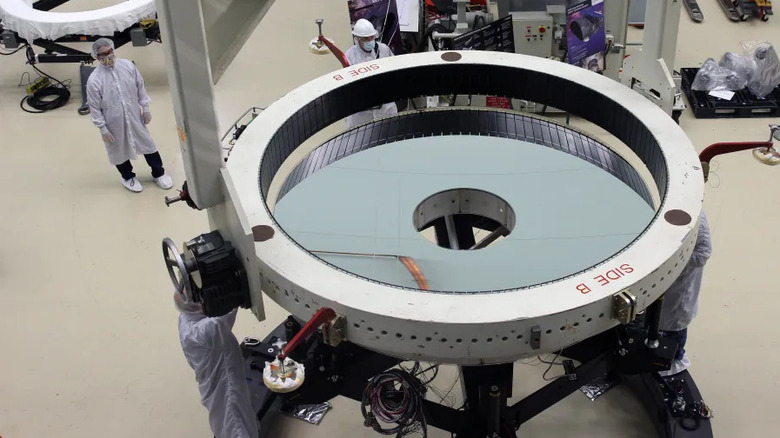
That it did, visiting the warehouse and getting an up-close look at two partly dismantled Hubble-like satellites sitting there, along with a third mirror. The timing was perfect: NASA was just starting to think about what its next space telescope would be, but given budget constraints, would probably have had to settle for something smaller than the old Hubble. A measly 5-foot mirror didn't exactly light the scientific world on fire, per the New York Times. Would the new space telescope even be worth the price?
That answer becomes a fairly easy "yes" once you get a much bigger (and lighter) mirror for free. NASA gladly took possession and re-designed the entire space telescope design around it. The new mirror allowed for much wider, more detailed images. It also let NASA dare to dream of an advanced coronagraph, which could reduce the light captured from distant stars, letting scientists better observe the planets around them. Pretty great!
No such thing as a free lunch
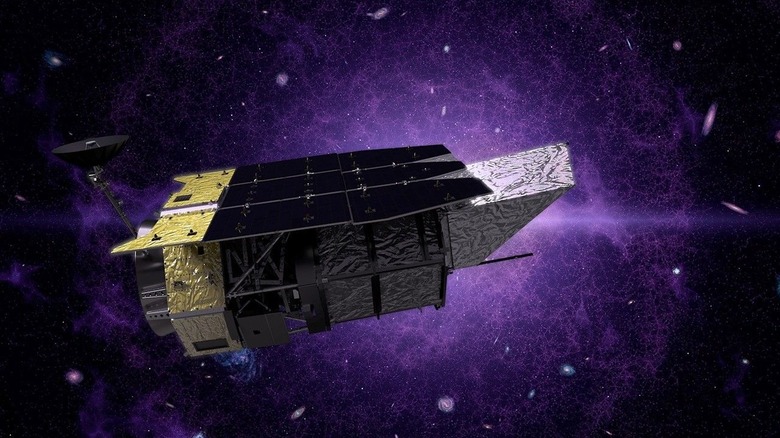
In the end, however, even a free mirror isn't free. Since it was originally designed to spot military bases, NASA had to do some re-engineering to get it ready for an astronomy mission. The shape had to be modified, and it was coated with a 400-nanometer thick layer of silver, roughly 200 times thinner than a human hair. Then, of course, NASA still had to design the satellite the mirror would fit into (the spy satellite wasn't suitable for scientific use), plus all the instruments. According to Scientific American, these costs were high enough for NASA to only take possession of one mirror, even though the NRO offered more; according to the New York Times, NASA actually took a second mirror, but later returned it.
Still, that one mirror is now in the Nancy Grace Roman Space Telescope and on its way to do science. The whole Roman enterprise ended up ahead of schedule and underbudget, words not usually associated with space. Fortunately, due to ace remote piloting from NASA, Roman has already doubled its fuel lifespan, meaning a spy mirror first built in the early 2000s has about 22 years of groundbreaking astrophysics ahead of it. It just goes to show you, kids: Even if you try and fail, you never know whether it might all come back around and work out in the end.