

7 Tips For Safely Walking Along A Highway (Especially At Night)
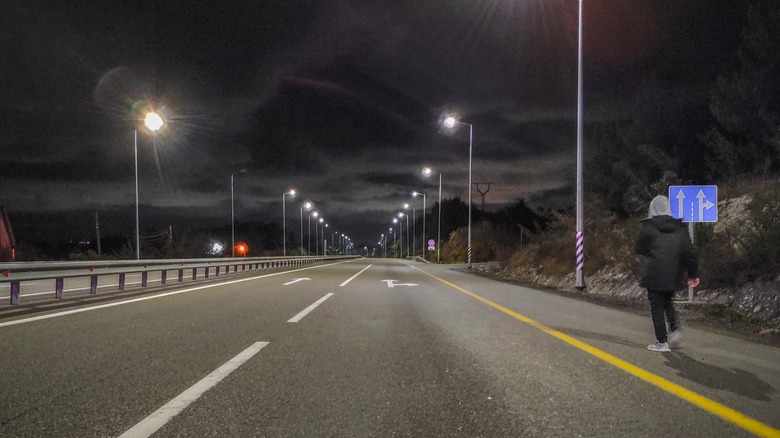
Probably the best advice anyone can give about walking along a busy highway, especially at night, is not to do it. That goes double for highways that are interstates or freeways. It's best to find an alternate route, preferably a quieter street or road with a sidewalk. But for the times when it may be unavoidable, and you decide that you have to walk along a highway, it's good to be aware of the risks involved.
According to the National Highway Traffic Safety Administration (NHTSA), 7,080 pedestrians were killed on public roads in 2024 — one pedestrian every 74 minutes. However, it gets a lot more dangerous at nighttime. In fact, 76% of those pedestrian deaths in 2024 took place after dark. Showing that highways are especially risky for pedestrians, the Insurance Institute for Highway Safety (IIHS) says that 62% of pedestrian deaths in 2024 happened on roads where the speed limits were 55 mph or higher. Meanwhile, according to the GHSA, 62.2% of pedestrian deaths during that year happened along roads without sidewalks.
The two most important things for safety while walking along a highway, then, are visibility and awareness. So, wear reflective gear, if possible, and carry a flashlight. Walk and cross only where it's allowed. Don't assume you have the right of way or that cars are going to stop for you. Don't walk while under the influence, and don't let yourself get distracted by your smartphone. If you break down, think twice about walking for help. Lastly, always try to walk facing the traffic.
Make sure you're legally allowed to walk there
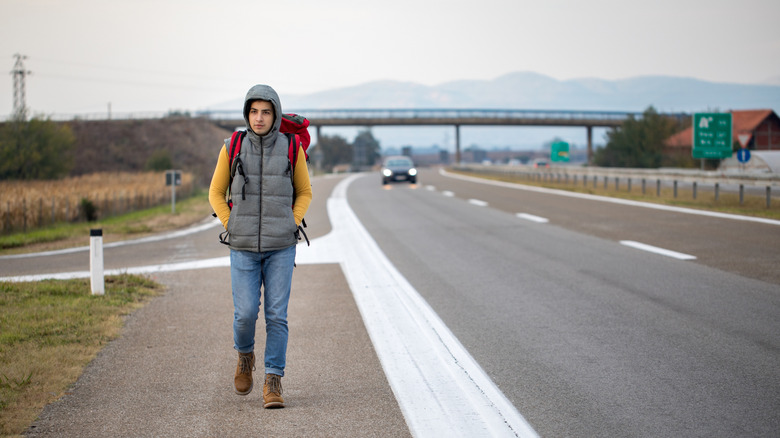
On August 29 of this year, 46-year-old Lee Malveaux of Opelousas, Louisiana tried to cross both northbound lanes of I-49 at 8:30 pm. He never made it across. A driver in a Nissan Pathfinder was traveling along in the right lane when they struck Mr. Malveaux. He was pronounced dead once emergency responders arrived on site. As tragic as this was, the fact is that Lee Malveaux didn't have to die. Louisiana law makes it illegal to walk on or along interstates and freeways, except for emergencies.
Of course, you might argue that common sense says not to try to walk across an interstate, and you'd be right. These roads are not meant to be shared with pedestrians. In Florida, even the shoulders are sometimes used as an extra lane. Aside from the fact that there are no sidewalks or crosswalks, vehicles travel at or over 75 miles per hour on many of these roads, frequently driven by folks who are either drowsy, distracted, or otherwise impaired. According to the IIHS, 16% of pedestrian deaths in 2024 took place on interstates and highways. Notably, the IIHS says that "a larger proportion of pedestrians killed on interstates or other freeways died on dark and unlit roads."
Make yourself and your surroundings as visible as possible
Lee Malveaux, the man cited above who was struck and killed at night on I-49 in Louisiana, happened to be wearing dark clothes. Unfortunately, there are plenty of examples of nighttime and early morning accidents involving pedestrians wearing dark clothes. In September of last year, 33-year-old Nathan Guidry, who was also wearing dark clothing, was walking along a frontage road near another part of I-49 when he was struck and killed. In June of this year, an unidentified male in dark clothing was struck fatally by two different cars in the same accident along U.S. Highway 90 in Louisiana.
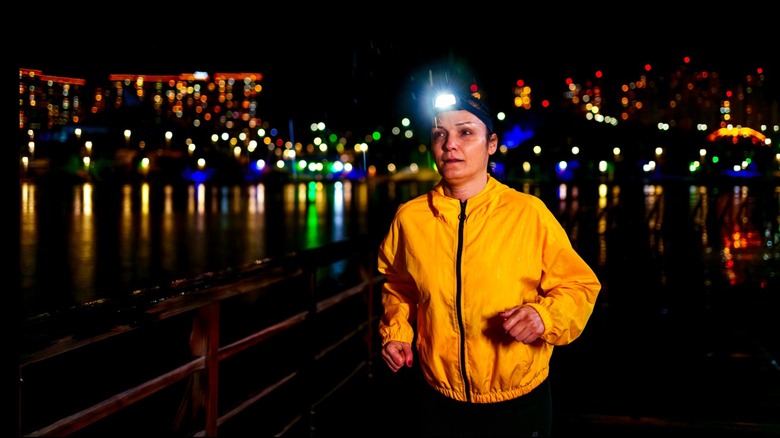
Would the outcome have been different if these folks had been more visible? We can't say. But the NHTSA recommends wearing reflective gear when walking along streets and roadways at night. Reflective clothing does not just mean light-colored; we're talking about fluorescent yellow or orange, or something that will shine back when picked up by headlights. It might be good to keep a vest or jacket with reflective stripes in the trunk in case of a breakdown. Carrying a flashlight can also make pedestrians more visible — just don't shine it at oncoming traffic. The Federal Highway Administration found that reflective gear can make someone visible from 1300 feet away, as opposed to 200 feet for someone in a white T-shirt and blue jeans.
Don't automatically start walking for help when your car breaks down

Probably the most likely reason someone would be walking along the side of an interstate in the first place is that their car had broken down. But getting out isn't always the safest option. On March 25, 2025, two people in their 30s from New Castle, Delaware, had a flat tire along an off-ramp from State Route 1. They pulled over to the shoulder, and the man got out to change the tire, while the woman walked around the back of the vehicle. Shortly thereafter, a driver in a GMC Sierra drifted onto the shoulder, striking both people and their vehicle, killing the woman.
Usually, the safest thing to do in a breakdown is to get the vehicle well away from traffic, then stay inside the vehicle while you wait for help. That's not always practical or advisable, especially if you can't get the vehicle far enough away from traffic. So, if you must leave the vehicle, exit on the side of the car that is opposite the roadway. Unfortunately, one-third of all drivers don't move over when there is a broken-down car on the shoulder. According to the IIHS, accidents involving disabled vehicles were the second most common type of crashes on interstates and freeways in which pedestrians were killed between 2015 and 2017, and 37% of those crashes were along roadways where the speed limit was at least 70 miles per hour.
Don't assume you have the right of way
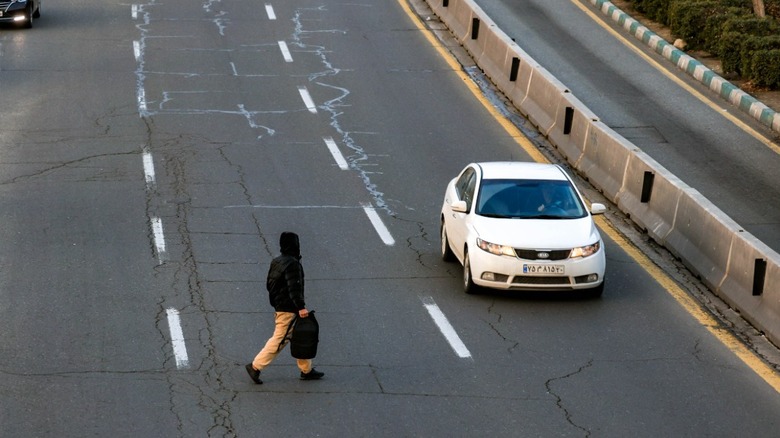
There seems to have been a false impression in Florida, where I live, that pedestrians always have the right of way. That's a dangerous idea that has led a lot of pedestrians to be reckless. I can't tell you how many times I had to slam on the brakes to avoid a pedestrian who just strolled out mid-block to cross a busy six-lane street, as if crosswalks were just a suggestion and "Don't Walk" lights were just there to burn off excess electricity. But this idea that pedestrians always have the right of way just isn't true. There is a whole Florida statute that defines when and where pedestrians may cross a street. And according to the Florida Department of Highway Safety and Motor Vehicles, "If crossing mid-block cannot be avoided, pedestrians must yield right of way to vehicles on the roadway."
Sure, every driver in Florida is legally required to do what they reasonably can to avoid an accident, even when the pedestrian is crossing illegally. We'd hope that's true everywhere. But that doesn't take the legal responsibility off of the pedestrian to cross where it's allowed and to yield when required. But aside from what the law says, if you're the pedestrian, it is your life that is at risk. Why put it in the hands of random strangers behind the wheel, assuming they will always do what they are "supposed to do?"
Don't walk next to highways while under the influence
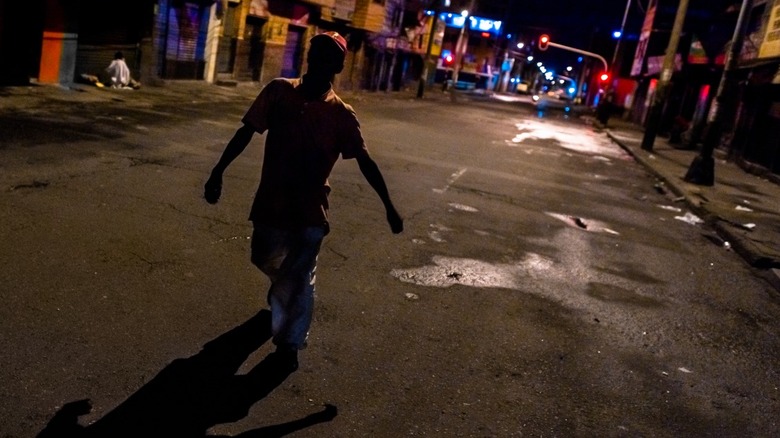
We all know we're not supposed to drive drunk or even buzzed. That's been drilled into us for years by tons of public service announcements and commercials paid for by Mothers Against Drunk Driving. So, we may feel we are doing the responsible thing by leaving our car at the bar and walking home. But walking along busy highways when we've had too much to drink comes with its own risks. According to the Governors Highway Safety Association (GHSA), 29% of pedestrians aged 16 or older that are killed in motor vehicle accidents in 2024 had blood alcohol concentrations of at least 0.08. Drivers who blow a 0.08 on a Breathalyzer test are going to jail for driving under the influence.
The truth is that we don't make good decisions when we've had too much to drink. As an example, the IIHS says that between 2015 and 2017, 40% of pedestrians killed while trying to cross an interstate or freeway had blood alcohol concentrations over 0.08. Would they have tried to cross if they were sober? It's impossible to say, but we're guessing the answer would have been "no" for a lot of them, and the rest would have had a better chance of getting across were they not impaired. So, what should you do instead of getting behind the wheel when you've been drinking? Get a ride. Call an Uber or ask someone you trust (not the guy you just met at the bar) to drive you home.
If there is no dedicated sidewalk, walk facing the traffic
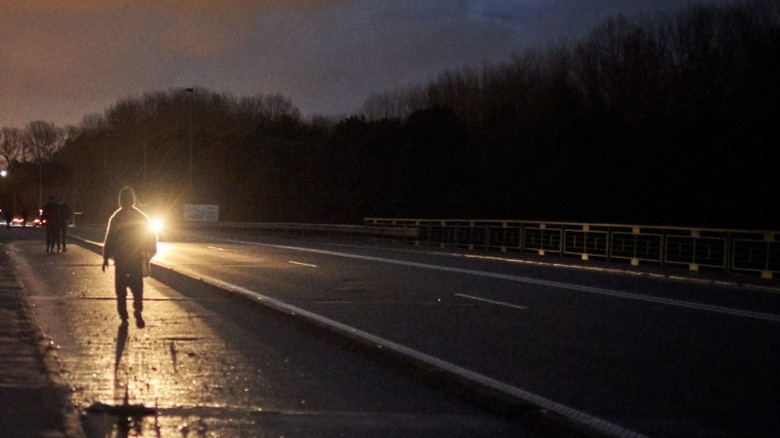
During the pre-dawn hours of August 20th of this year, 69-year-old John Scritchfield was struck by a Honda CR-V while he was walking along an unlit road in Roanoke County, Virginia. He was taken to the hospital where he later died from his injuries. Investigators noted that he was walking in the traffic lane, in the same direction as vehicle traffic. While it looks like multiple factors contributed to this accident, it is dangerous to walk with your back to traffic, especially at night. That's because you are far more likely to see the headlights of an oncoming car than the driver is to see you, as long as you are facing traffic. Keep in mind, only half of vehicle headlights tested by IIHS got a good rating.
The sooner you see oncoming cars, the quicker you can react and get out of the way. The NHTSA says, "Walk on sidewalks whenever they are available. If there is no sidewalk, walk facing traffic and as far from traffic as possible." The data backs that up. A study done in Finland of accidents from 2006 and 2010 involving vehicles that struck pedestrians found a 77% decrease in those kinds of accidents when the pedestrian was facing traffic. We feel we should note that the rules for bicyclists are different, and you should always ride in the direction of traffic, according to the NHTSA. Besides, it's often the law.
Put the phone away
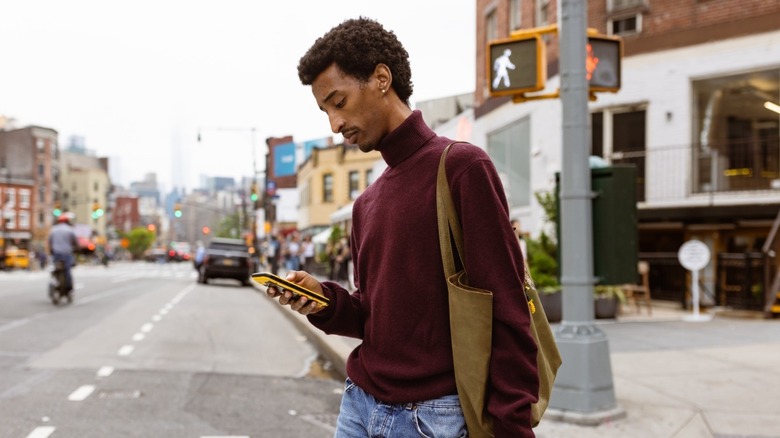
Looking at your phone while driving is dangerous. That's not exactly a hot take, but it follows that having our eyes glued to a screen while walking along a highway at night or crossing a busy intersection is dangerous as well. You can't afford to be distracted in those situations, and as a pedestrian, you're at even greater risk of personal injury or worse. The NHTSA warns, "Stay alert at all times and be predictable. Don't get distracted by electronic devices that take your eyes (and ears) off the road."
Researchers have a name for pedestrians who are looking at their smartphones while walking: "smombies." Studies going back years have shown that pedestrians who are looking at or talking on their phones are much less likely to be aware of their surroundings and more likely to engage in risky behavior. In a 2009 study titled in part, "Did you see the unicycling clown?" researchers observed that pedestrians on their phones were less likely to notice unusual activity on their route, such as the titular clown. Another 2012 study observed that pedestrians using smartphones were four times more likely to engage in risky behavior. Meanwhile, a more recent study noted that 42% of pedestrians who violated traffic signals were looking at their phones. The lesson here is: Don't be a smombie.