

Maine Once Buried 20,000 Tires Under A Road, But Here's Why No One Does This Anymore
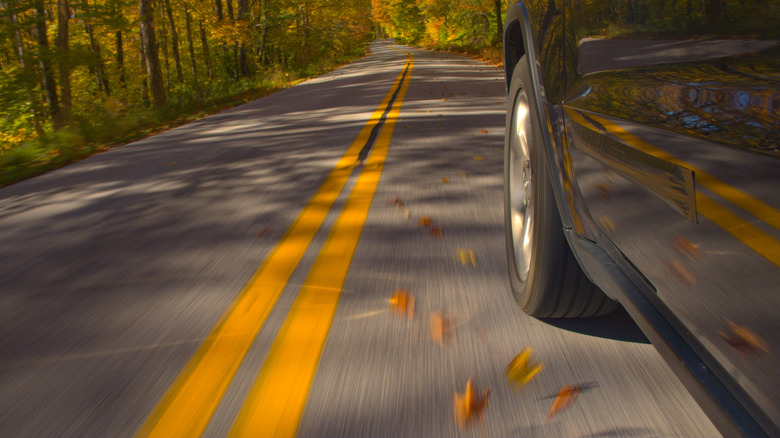
Back in 1992, the state of Maine shoved about 20,000 old tires worth of rubber underneath a stretch of Dingley Road in the town of Richmond. It was an experiment to see if the state could basically kill two birds with one stone: help roads hold up to the freeze-thaw cycle that causes potholes, and cut down on rubber waste, too.
The freeze-thaw cycle is the phenomenon of water in the ground wreaking havoc on roads when temperatures swing between seasons. We know what you're picturing, though, and no, they didn't just stack a bunch of tires in the ground, Costco Tire Center-style, and pour gravel on it. Old tires were shredded into chips measuring 2 to 3 inches, then stacked into a layer 6 to 12 inches thick, and only then did they pour about two feet of gravel on it.
Developed by University of Maine civil engineer Dana Humphrey, the scientific rationale behind this was that old tire rubber is relatively light, a better insulator than soil, and drains moisture well. Maine also had way too much of it with nowhere good to go — after all, tires expire even if they're not physically worn out yet.
And guess what? In the short term, it seemed to work. When that first spring swung around, the 600-foot tire rubber-filled section had about half the frost penetration and was in much better shape than the regular gravel-only sections of that same road, which were almost impossible to drive on. With this result, another "rubber road," finished with asphalt this time, was planned to be built in North Yarmouth.
Underground tire fire
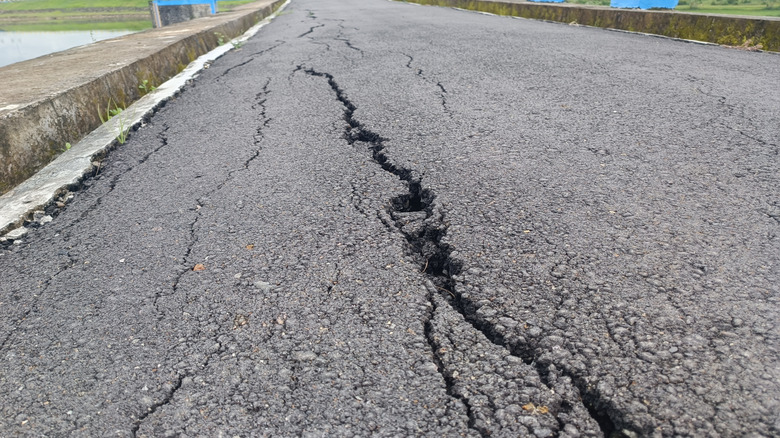
Fast-forward to 1996 and, according to the Los Angeles Times, two highways that had been supported with old tires in Washington State began emitting smoke and a poisonous gooey substance, posing an environmental threat to nearby marshes. And something similar had already happened to a tire-supported interstate in Colorado the fall prior.
The underground rubber had heated up to the point of cracking the pavement on top and giving off noxious smoke (and in one stretch of Washington road, the odd flame) and a smell that reportedly resembled creosote and burnt plastic. The state Transportation Department said temperatures got up to 160 degrees Fahrenheit at the surface, and deep interior temperatures were estimated around 450 degrees. A Coast Guard lieutenant said the substance was producing benzene, a known carcinogen.
Effectively, what happened was underground tire fires, and the rubber would need to be dug out, an operation that would require workers to wear protective masks and cost $1 million to $3 million, per official estimates — and these are 1996 dollars. Adjusting for inflation, that's $2.1 million to $6.4 million in today's money.
'Million-gallon oil spill'
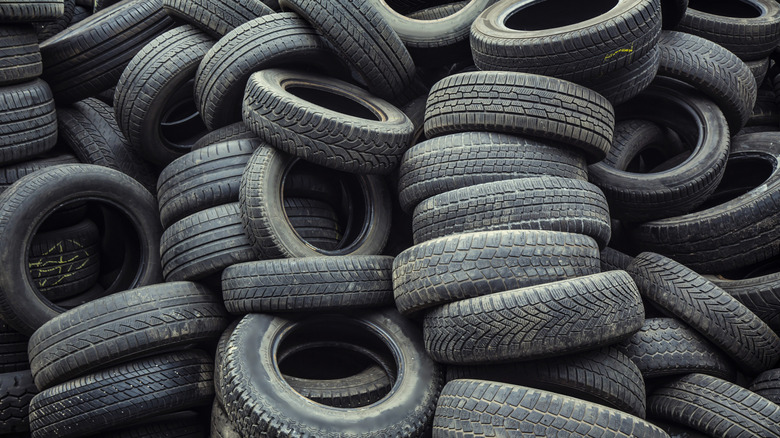
To underscore how potentially bad this was for the environment, experts said that each tire's worth of rubber down there contained about a gallon of oil's worth of hydrocarbon compounds. The Coast Guard lieutanant, a member of the service's oil-spill strike team named Rob Myles, said, "We're here because there is potential for a million-gallon oil spill."
Humphrey, the engineer who came up with the experiment, theorized that the heat was coming from steel belts still in the tire material rusting, or perhaps rubber compounds breaking down and creating sulfuric acid. Whatever the cause, the chemical reaction stopped in Colorado when the top layer of road was taken off.
For the record, this is different from the practice of grinding old tire rubber in making asphalt itself, which is an established road-building technique. Not only is that rubber not buried under a layer of something else, but it's said to be handled and processed carefully. This makes for softer roads that, as you may have noticed when driving over them, provide quieter motoring. It also helps that they don't result in environmental disasters that cost millions to fix.