

What The BCI Group Size Number On Your Car Battery Means
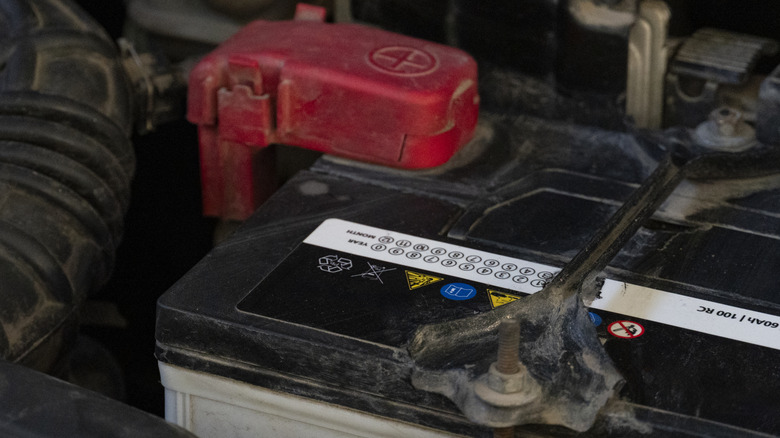
Ever seen an alphanumeric code on the label of your car battery and wondered what it meant? The lead-acid batteries used in most cars look pretty similar on the outside, but their internal chemistries, terminal placement, and dimensions can vary widely across different makes and models. To eliminate confusion and prevent car owners from installing the wrong batteries, the Battery Council International (BCI) — an American trade association founded in 1924 — established a standardized numbering system dubbed BCI group sizes. This system assigns letter-and-number codes to car batteries based on their physical dimensions, electrical characteristics, and terminal placement.
BCI group size numbers act as a reference guide for automakers, parts retailers, and car owners, particularly in North America — other regions use different nomenclatures such as the Japanese Industrial Standard (JIS) and European Norm (EN). BCI numbers also ensure that battery terminals align properly with a car's electrical cables. This is important because installing a battery with swapped positive and negative terminals can blow fuses, melt cables, and risk an explosion. In effect, BCI group sizes ensure that any battery, regardless of brand, will fit and connect properly in your car as long as the number matches the manufacturer's specification.
Making sense of BCI group size numbers
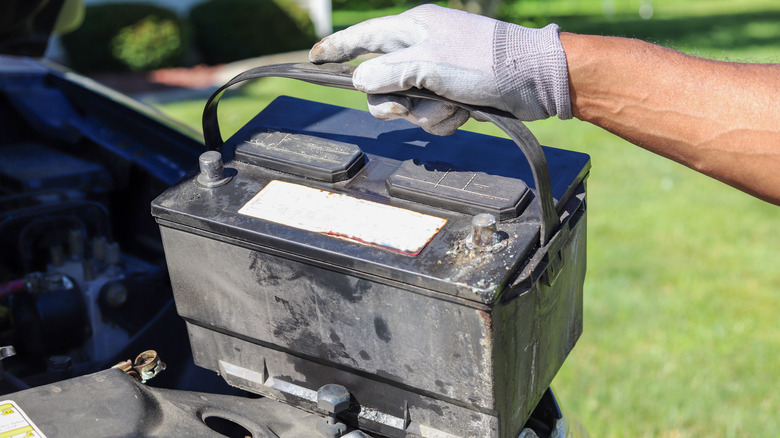
For passenger vehicles, the BCI group size numbering system uses two- or three-digit codes, sometimes followed by a letter — Group 86 and Group 153R, for example — to categorize batteries according to precise dimensional tolerances. A group size number is built from four distinct characteristics.
The first is physical size, where batteries in the same group must match in length, width, and height with a tolerance of about 0.08 inches. Next comes battery performance, which refers to the burst of power needed to turn over an engine at zero degrees Fahrenheit and is typically measured in cold cranking amps (CCA). The third is terminal position, which keeps the car's positive and negative cables correctly aligned with the battery's respective terminals. Finally there's chemistry, where a battery is assumed to be of the standard flooded lead-acid type unless otherwise specified with a unique tag, like absorbed glass mat (AGM) or enhanced flooded battery (EFB). Even lithium-ion batteries, commonly used in electric vehicles, are assigned an "LFP" label per the BCI nomenclature.
Coming to the letters that follow the BCI group size number, they can be a descriptor for the terminals, such as "R," which signifies that the terminals are reversed compared to the standard version of the BCI group, or "F," which indicates a swapped terminal layout often used by Ford cars. The letters can also signal a tall case design (T) or a marine-grade battery (M) that's built for watercraft.
Using BCI group size numbers to pick the right battery for your car
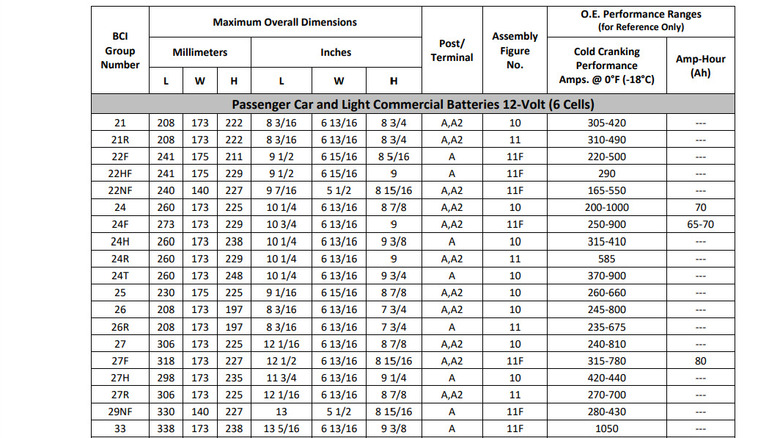
When looking at BCI group sizes (snippet provided above), it's worth noting that the numbers aren't sequential and don't directly represent the battery's size, voltage, amps, or capacity. Referring to the table above, a Group 24 battery is longer, taller, and can deliver more CCA than a Group 26. Therefore, the BCI group size number should be treated purely as a battery size and terminal identifier. The BCI website offers a handy document that details the entire numbering system for reference. To know the BCI group size number of your car battery, you can consult the owner's manual or just check the label on the existing battery in the engine bay.
When the time comes to replace your car battery, it may be tempting to go for one that delivers higher CCA or a larger reserve capacity — the latter is basically how long a battery can sustain the car's electronics without having to start the engine. However, automakers design electrical systems around specific battery characteristics like power, size, and weight, and ignoring them can affect the longevity and operation of the car's battery and electronics. Therefore, it's crucial to stick to the recommended BCI number when replacing a car battery.