

The Army Spent $6.9 Billion On Stealth Helicopters That Basically Just Went To A Museum
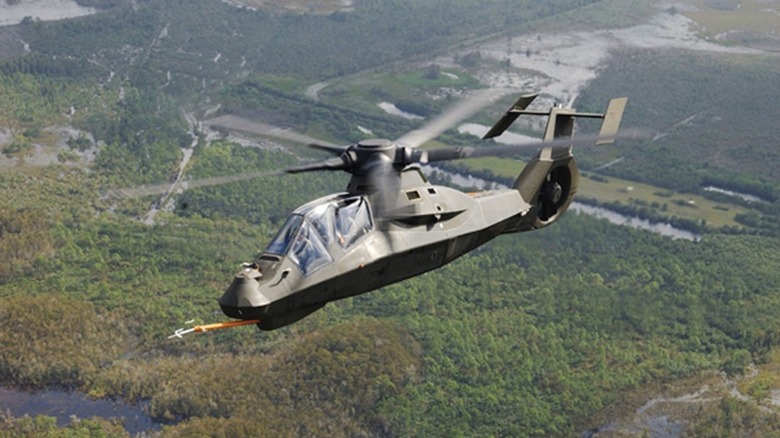
The U.S. Army once spent $6.9 billion developing just two Boeing Sikorsky RAH-66 Comanche stealth helicopters. But neither of them were used in actual combat, and both now reside in a museum.
It all started in the early '80s when the Army commissioned the development of a new, lighter, stealthier helicopter. The program was called Light Helicopter Experimental, or LHX for short, and the idea was that this new stealth helicopter would fly in near the enemy at night and/or in bad weather, scouting out and classifying targets, then send that data back to a heavier, gun-toting Apache. This recon aircraft would still be armed for light attacks, though, carrying a retractable 20-millimeter cannon as well as external wings that can accommodate missiles and rockets if necessary. Detection-evading features included a fuselage made of materials that absorbed radar, extremities like weapons and landing gear that could retract, exhaust that was mixed with cool air in the tail to avoid infrared detection, and rotors designed to be quiet.
LHX produced the first Comanche prototype in 1995, which was joined by a second prototype four years later. There were supposed to be six prototypes, by the way, but that was reduced to two, thanks to post-Cold War budget cuts. In any case, test flights apparently went well, with the choppers said to have met or exceeded operational objectives, with sideways and rearward agility being highlights. In case you were wondering, yes, you can drift with helicopters.
Expensive, unnecessary, and shelved
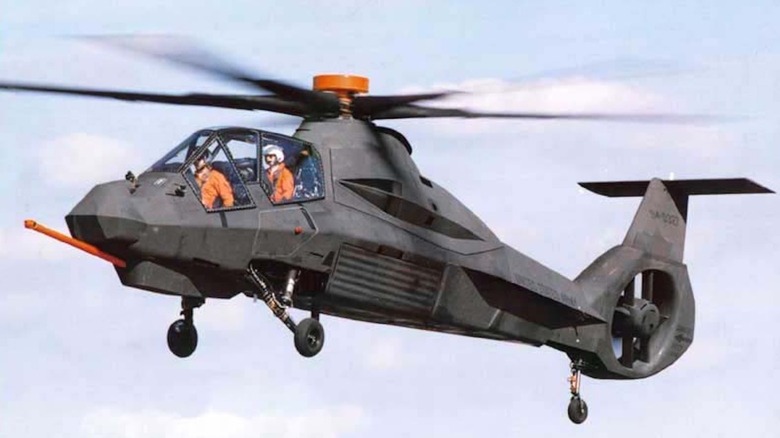
After 20 years and almost $7 billion of budget-blowing development, hardware, testing, and, of course, management overhead later, a 2001 Government Accountability Office review looked at not just the money that was already spent on this project but also how much it was still expected to cost in the near future. The original plan was to produce 650 units for a total price of $26.9 billion, and the Army decided to restructure (read: shrink) the program once again. For perspective on how much that is in the context of U.S. Army contracts, General Motors recently finalized a $1 billion deal for 10,000 trucks, and that's in 2026 dollars. Add to that battlefield shifts post-9/11 that altered what the Army arguably needed (upgrades to existing aircraft and, of course, unmanned drones) and the whole thing was finally canceled on February 23, 2004.
Today, both Comanche prototypes are on display at the U.S. Army Aviation Museum in Fort Rucker (formerly known as Fort Novosel), Alabama, as confirmed by the museum's display list showing serial numbers 95-00001 and 94-0327. Neither has ever been deployed in active combat, meaning American taxpayers collectively paid for two museum exhibits for $3.45 billion apiece.
For the back-of-napkin bean counters in the crowd, the whole thing cost about $45 per person, given 2022's count of about 154 million taxpayers. On the bright side, admission to that Aviation Museum in Alabama is free, if you ever find yourself in the area and would like to see what you might have paid for.