

The Panic-Inducing Song NASA Regretted Allowing As A Wake Up Call In The '70s
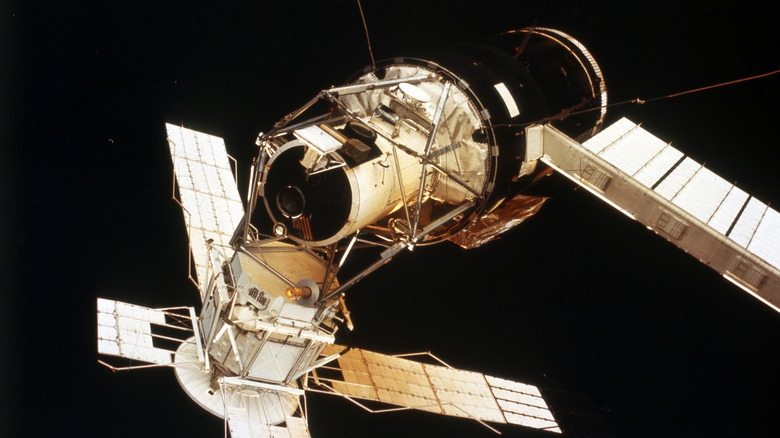
According to the study "Alarm tones, music and their elements: Analysis of reported waking sounds to counteract sleep inertia," published in PLOS One, waking up to something with a melody can help get your days off to a better start. That's because it can help reduce reports of sleep inertia, which is that unfocused feeling calling you back to bed when you first try to get up. So it does make sense that wake-up music officially became part of the astronauts' routine beginning with the Apollo 10 mission.
What makes less sense is the particular choice made on September 15, 1973, to get the crew of Skylab 3 up and about. The tune was "Paralyzed" by the Legendary Stardust Cowboy, aka Norman Odam. It's what we might call "outsider music" today, but the song found its way from a Texas recording studio to Mercury Records to the Billboard 200 — all before making it into orbit with the Skylab crew.
From there, it's easy to imagine the astronauts waking up worried about an alien invasion or the sudden appearance of a Cybertruck-driving raider from our apocalyptic future. After all, the song kicks off with a desperate scream as if Odam himself were waking up from a nightmare. Then he starts "singing" in a language that doesn't seem wholly of this planet. One of the crew, Owen Garriott, supposedly compared it to the sound of the U.S. Marines' close-order drill. Either way, when the song was first played, the astronauts' sudden leap into consciousness was strong enough to also open eyes back at Ground Control.
When did NASA start using wake-up music?
The starting point came in mid-December of 1965. That's when Grammy-winning singer Jack Jones delivered a rendition of "Hello, Dolly" that was played for the Gemini 6 crew — but with the lyrics changed to gently joke with astronauts Wally Schirra and Tom Stafford.
Music would be broadcast to other Gemini flights as well, but — as mentioned — it didn't become a regular part of the day until Apollo 10. Now, to be clear, the concept wasn't originally based on the science of sleep inertia. It was developed as a way of boosting team spirit among the astronauts and the team at Ground Control. Astronauts have even gotten to hear Muppet comedy sketches like "Pigs in Space" and received a special "Good Morning Discovery!" greeting from Robin Williams. And contrary to any evidence about "Paralyzed" being literally banned, it's worth noting it wasn't played only for Skylab 3. Skylab 4 astronauts had to listen to it on at least two separate mornings.
Songs have changed with the times, too. The music for the Apollo missions began with Frank Sinatra, known for his unquestionably good taste in cars, along with likes of Tony Bennett and the Tijuana Brass — with the occasional dose of classical music or a college fight song thrown in. Fast forward to the 2026 Artemis II mission, which took us to the Moon for the first time in 50 years, and the playlist was even available on Spotify.