

Here's Why You Pay A Core Charge Every Time You Buy A New Car Battery
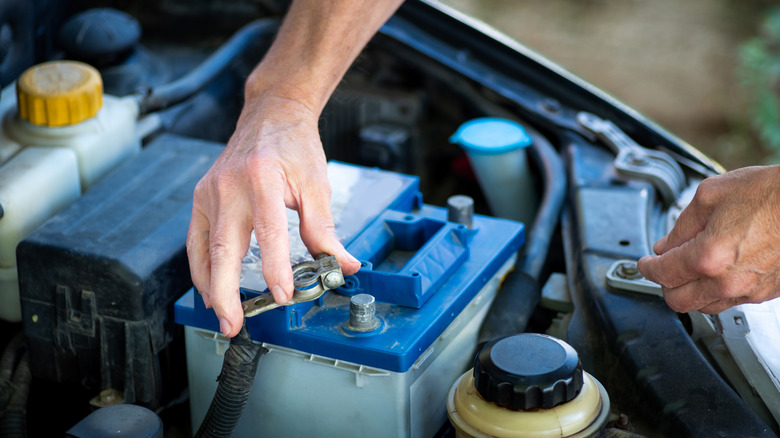
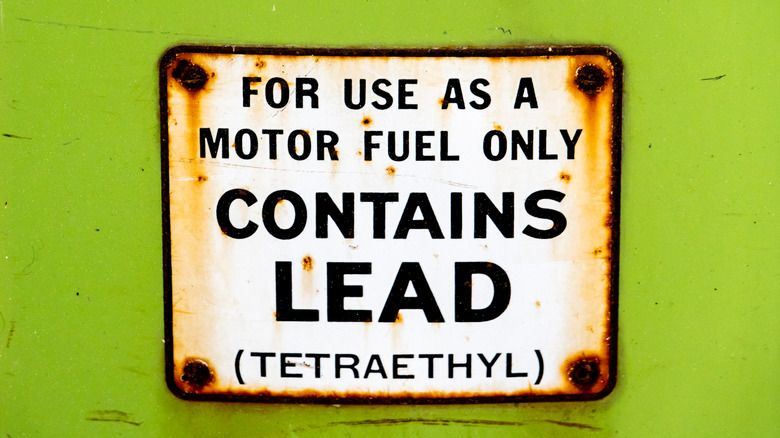
The simple answer to this question is that lead-acid batteries should never go into the trash — because lead is poison. To prevent that, every U.S. state has a different scheme to incentivize recycling. But wait: Just how evil is lead? The Environmental Protection Agency says it's particularly toxic to young children, and pregnant and nursing mothers can pass lead to their fetuses or infants, which can lead to premature births, as well as subsequent brain and nervous system damage. Lead poisoning has also been tied to many other illnesses among children, and it's one reason why leaded gasoline was eliminated. Lead's also a probable human carcinogen, and there are links to a boom in anxiety, depression, and ADHD, too.
To spur us to recycle batteries and keep them out of landfills, where the lead can leach into groundwater, industry and government invented the core charge. The Battery Council International, a trade group, calls it a deposit, like when you rent a keg for a backyard barbecue. The brewer wants that container back, so you're charged a steep fee if it's not returned. And, like with a rental car, you don't own that keg, you're just borrowing it.
Core charges work, too. While we Americans are pretty crappy at recycling lots of stuff, we rock at recycling lead-acid batteries. The Battery Council says we recycle lead-acid batteries at a nearly 100% rate. The EPA backs that up and says we're also very good at recycling cardboard, at a rate of 96.5%. The EPA says most states' core charges, ranging from $5 to $20, have led to the very high rate of recycling, with, of course, a few asterisks.
Recycling isn't quite enough
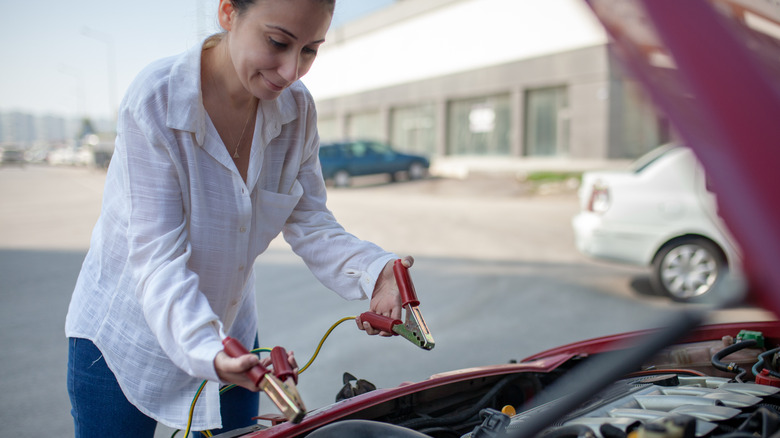
The core charge system is a little more multifaceted than you may guess. It creates a circular economy. If and when you need a new battery, because you've jump-started the old one beyond its sell-by date, you'll return that old product for a new one. In the process, you become a customer, too, for the intermediary (the retailer). That retailer sends the old battery and other car parts — since there are core fees associated with other components, too — to a recycler to retool the old into the new.
However, even if this system works decently, it's not perfectly circular. The EPA says when you purchase a new battery it contains about 80% recycled material. The U.S. Department of the Interior, via the U.S. Geological Survey, says 70% of our battery consumption comes from recycled content. If you're perceiving a gap in supply and demand, you'd be performing some correct math.
The issue, according to the Battery Council, is that there isn't enough capacity to recycle all of the lead used or enough lead smelters. And in 2025, the Department of the Interior labeled lead a vital critical mineral — toxic, yes, but vital.
You're still reliant on a lead-acid battery to start the car in your driveway and, once running (via the alternator), to power its electric windows and your fancy massaging seats. And, yes, even EVs have lead-acid batteries, because stuff inside, like the car's sound system, cannot run on the high voltage that moves that EV's motors. This is why you can still deplete a 12-volt battery in an EV, and even, kind of, jump-start an EV's battery.
A nasty legacy that still needs to be cleaned up
As you'd probably guess, Americans have responded to the toxicity of lead by exporting the poison rather than fully cleaning up the process of recycling batteries. The process is profoundly harmful. A groundbreaking New York Times feature from last year investigated battery recycling plants across Africa and found poison in the farms and soccer fields surrounding these factories.
This legacy is also American. According to research published in the journal Environmental Justice in 2017, before it was shuttered in 2015 and turned into a Superfund site, the Exide battery plant just outside Los Angeles recycled 11 million car batteries every year since the late 1970s and released 3,500 tons of lead. Later research at USC found that as many as 250,000 residents, mostly Latinos, were exposed, and researchers also found lead in the baby teeth of children in the community.
There is a cleaner way to recycle batteries — and one reason that we wound up exporting our spent batteries to other nations is that the EPA requires stricter emissions controls from recyclers than what happens overseas. In the U.S., recyclers use multiple methods. One system collects emissions through venting and then electrostatically charges the captured lead particles and magnetizes them, so they cannot escape. Another dissolves lead particles in acid and then replates them (essentially, reusing them in their least harmful, solid state).
Neat! But these better practices aren't deployed globally. Still, the core charge is one way to hinder individual car owners from tossing a lead-acid battery into the trash, which would likely lead to groundwater contamination. But recycling, sadly, still doesn't eliminate lead contamination from being a global scourge.