

Meteorite Strikes On Cars Are Rare, But It Has Happened At Least Thrice
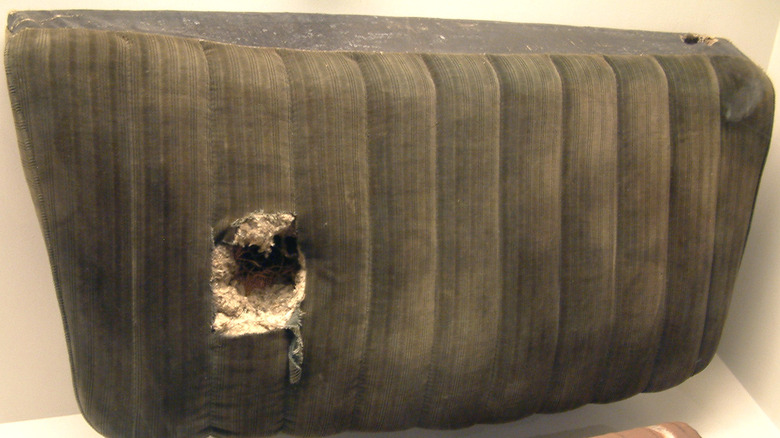
Nobody likes it when their car takes a hit. Conversely, you do like the glory of the cosmos and the astounding physics of matter beyond the confines of our tiny world. So, what are you to do when these two things quite literally collide? Would that just be the worst luck or the coolest thing that's ever happened to you? The answer — to both — is yes. (Un)fortunately, this doesn't happen very often. In fact, in the whole of car history, it seems only three have been properly documented as having had a head-on collision with a meteorite.
The first known instance of personal vehicle vs spaceborne menace was on September 29, 1938, in Benld, Illinois. A 3.9-pound, stony-iron meteorite decided that day that Edward McCain's Pontiac coupe was just a little too full of itself and needed to be taken down a peg, so it smashed through the roof of his garage, then the roof of the car itself, the seat, and the floor. Was the Pontiac sufficiently humbled? No! Our celestial hero ricocheted off the muffler to then lodge itself back in the seat (via Astronomy). Oddly enough, later examination of the meteorite found that it had a fusion crust only 0.04 inches thick. A fusion crust is the outer surface of the rock that melts in atmospheric reentry. Such a thin one indicates that the rock was relatively cool during its descent. That makes sense, since meteors normally burn up completely before ever striking the Earth's surface; one way they don't do that is by coming in at a lower velocity, which causes less friction and burning. That way, a tiny little piece just makes it to the ground — or, you know, a Pontiac.
Meteorites make your grandma's car more valuable
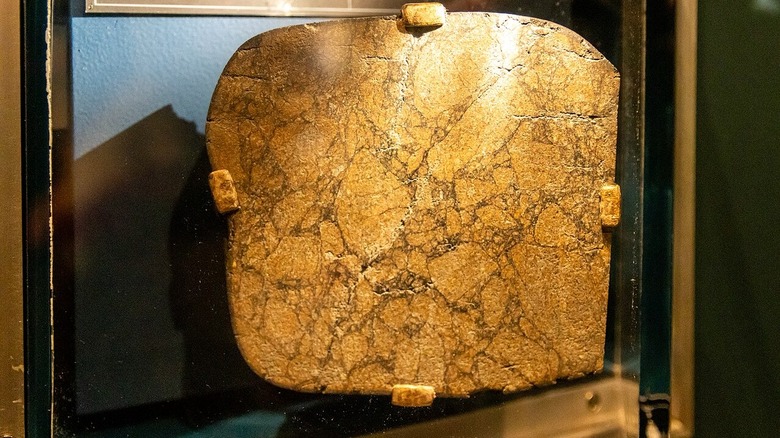
Remember what it was like to be 18, buy your very first car, and then have it be destroyed by a traveler from the depths of space? Ah, youth. On October 9, 1992, a meteor splashed into the small town of Peekskill, New York. A full 26.5 pounds of iron-rich chondrite space rock then smashed into the 1980 Chevrolet Malibu of 18-year-old Michelle Knapp, who'd only just bought it from her grandmother for the handsome sum of $400. Punching all the way through the passenger side of the trunk, it left a six-inch crater in the ground below, according to the Peekskill Herald.
As it turns out, cosmic destruction is good business. Worth only a few hundred bucks on its own, Knapp ended up selling the Malibu for $10,000. The car has since become a touring museum piece, never repaired. The meteorite did even better at $50,000. Descending chondrites make for appreciating assets, apparently (via Peekskill Herald).
When your windscreen gets hit by a (space) rock
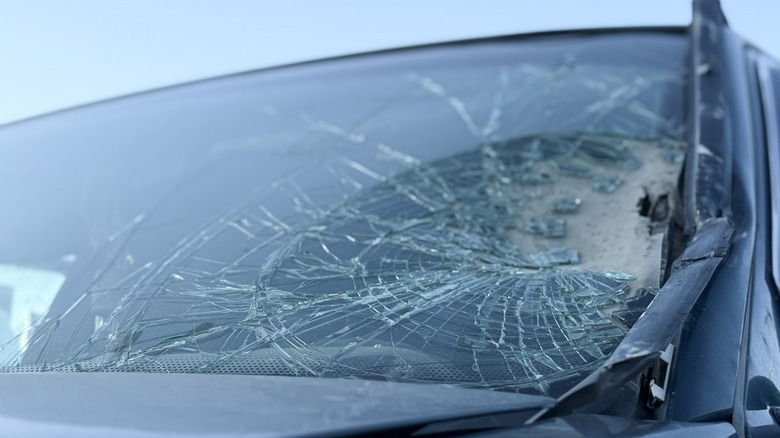
On September 25, 2009, a meteor fell over Grimsby, Ontario. Scientists went on the record to ask for help locating the rock, a 0.1-pound little chondrite that was 4.6 billion years old (via CBC). Faced with the awe and wonder of this ancient relic from the dawn of our solar system, local resident Yvonne Garchinski could only think of one thing: her Nissan Pathfinder's windscreen. Yes, after traveling across the sky at 47,000 miles per hour, melting all the way through, the meteorite decided that it wanted to end its journey with a little light vandalism. Jerk. Several other fragments were found around the area, though none of the others caused any property damage. No word on whether Garchinski's insurance covered cosmic phenomena. Probably not, but can it happen to you?
No. Well, unless you are very, very unlucky. NASA says that Earth gets hit with over 100 tons of space dust every day, but this all just burns up in the atmosphere. Something big enough not to entirely burn up only hits about once a year; if anything survives intact, it might fall anywhere on Earth. The ocean, a desert, a distant mountain — anywhere. The odds of it hitting a populated area, let alone yours, and let alone your car, are very, very low. Still, it's notable (if not suspicious) that all three of the known examples were in the U.S. or Canada. There's no particular reason for meteorites to go there, particularly given current immigration policies. Have there been other impacts on cars in other parts of the world that have gone unnoticed? No way to know, but I wouldn't rule it out.