

Test Driver Who Crashed Tesla Into Salon Was Ineffectively Prepared For Driving EVs, Lawsuit Claims
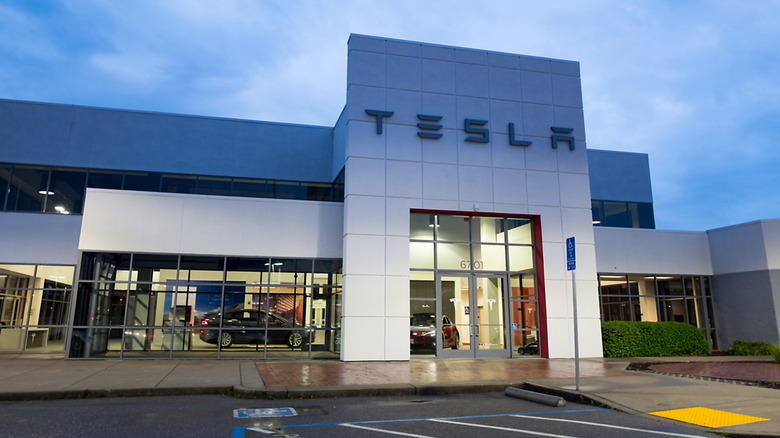
There have been many lawsuits against Tesla over the functionality (or lack thereof) in its Full Self-Driving system. But this one is all about the human driver, who claims that Tesla representatives failed to tell her about the differences between driving an EV and a traditional car before a test drive, reports the Independent. This lack of knowledge allegedly caused her to crash into a hair salon where she was severely hurt.
According to Road & Track, Alemzewd Lawgalet was test driving a Tesla Model Y on September 21, 2024, in Arlington, Virginia. Before getting behind the wheel, she told Tesla sales representatives that she had never driven an EV before, and asked if there were any differences from driving a gasoline vehicle. The lawsuit claims she was told it's exactly the same. Although she asked for a sales rep to accompany her on the test drive, she was sent out alone, with her only instruction being to bring the car back when she was done.
Lawgalet took the car out on the highway, and was shocked at how quickly it slowed down just from taking her foot off the gas pedal. We know this is due to regenerative braking, but it could easily surprise someone with no prior EV knowledge or experience. Instead, she thought there was something wrong with the brakes, so she took the next exit intending to head back to the Tesla service center. Lawgalet stopped at a red light. When it turned green, "the vehicle lurched forward at an extreme speed and horsepower compared to the force placed on the accelerator," causing her to lose control and crash into the salon, where she "suffered serious and permanent bodily injuries, which have caused and will continue to cause physical and mental pain and suffering," according to the lawsuit. She is suing for $10 million in compensatory damages and $350,000 in punitive damages for Tesla's "conscious disregard for the health and safety of others."
Who's at fault?
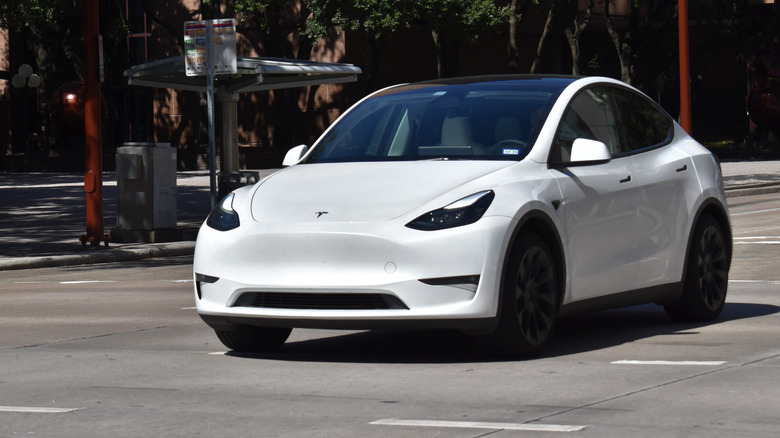
The Independent reports that the Model Y that Lawgalet was driving had been negligently left in Insane mode, giving what she expected to drive like a normal car the same 3.3-second 0 to 60 time as a Ferrari 296 GTB Speciale. The lawsuit does not make this specific claim, but does say that she was not made aware that different drive modes exist:
Defendants did not inform Plaintiff of the properties of varying acceleration modes prior to the test drive. Defendants did not inform Plaintiff of which acceleration mode she was in prior to the test drive. Defendants did not show Plaintiff the display features to show her which acceleration mode the vehicle was in. Defendants did not show Plaintiff how to change the acceleration mode that the vehicle was in.
Most modern vehicles, regardless of what's under the hood, have multiple drive modes, even if it's a simple choice between Normal, Eco, and Sport. The Model Y requires drivers to drill down through three touchscreen menus to change drive modes, according to the owner's manual. While I normally hate unnecessary touchscreen controls, I have to admit it's not a bad idea to make selecting the rapid acceleration of Insane mode this deliberate of a choice. We also don't know what version of the Model Y Lawgalet test drove. Different versions have different levels of acceleration, so she may not have been accidentally achieving Ferrari levels of acceleration in a lower-end trim level.
While EVs do have the same basic controls as gasoline cars (we can debate Tesla's turn signal buttons rather than a traditional stalk), EVs do drive differently. The least powerful EVs still accelerate quickly from a stop, which could surprise an inexperienced EV driver. Unless you've experienced engine braking in a manual transmission car, you expect a car to keep rolling if you take your foot off the gas, not slow down like you've already hit the brakes.
If I was driving a car that I thought had brake problems, I'd drive extra carefully to avoid gaining too much speed, which is the opposite of what happened here. But I have years of experience with limping janky vehicles successfully to my destination. A driver distracted by nervousness about the vehicle behaving in an unexpected way might have instinctively pressed the gas pedal the "usual" amount, leading to unexpected acceleration from an EV, losing control, and crashing. There are many things we can blame Tesla for, but the courts will have to decide who's at fault in this case.