

Elon Musk Changes Tune On 'Cautious' Robotaxi Rollout While Tesla's Net Income Falls Because Of AI Spending

Good morning! It's Thursday, July 23, 2026, and this is The Morning Shift, your daily roundup of the top automotive headlines from around the world, in one place. This is where you'll find the most important stories that are shaping the way Americans drive and get around.
In this morning's edition, Tesla's net income is down as CEO Elon Musk says the company is prioritizing robotaxi safety over rollout speed, Porsche is cutting 5,000 more jobs in Germany, Ford and Geely team up on a Spanish plant and Land Rover needs to drill a lot of holes in a lot of Discoveries.
Oh, and if you want a recap of the latest auto news delivered to your inbox each weekday morning because life is busy and you can't always head to our website, you can sign up for Jalopnik's free The Morning Shift newsletter right here.
1st Gear: Slow robotaxi rollout is hurting Tesla's profits
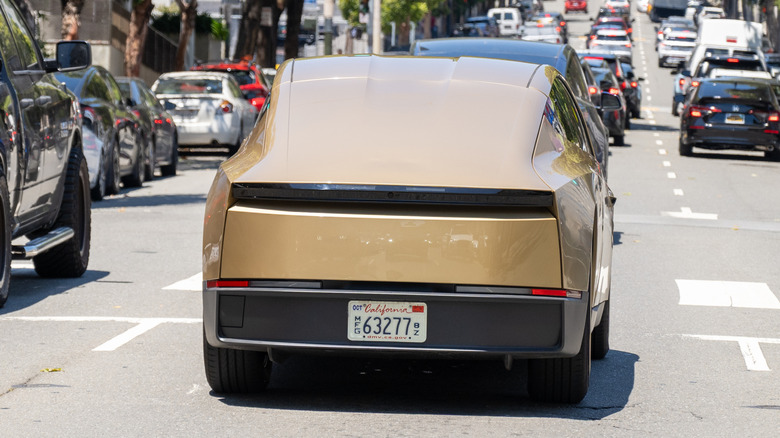
Tesla didn't have such a great second quarter when it comes to net income. That metric fell 5% to $1.1 billion despite the fact it saw a 25% surge in vehicle deliveries to 480,126 units, a 26% jump in total revenue to $28.2 billion and a 23% gain in automotive revenue to $20.5 billion. So, what's the deal? Well, it looks like CEO Elon Musk's continued fascination with AI spending around robotaxis and humanoid robots caused the Austin, Texas-based automaker to miss Wall Street's profit expectations. All in all, Tesla plans to spend about $25 billion this year on AI-fueled business ventures that have nothing to do with the cars that actually make it money.
Now, Musk — a guy who has been touting a rapid robotaxi rollout — is changing his tune and defending a slower pace that will put safety over speed. On an earnings call earlier this week, the CEO said the company was trying to avoid accidents that could trigger a regulatory crackdown. From Automotive News:
"Our goals are very ambitious with robotaxi, but we do need to be cautious about causing any accidents or causing any harm to anyone," Musk said. "If we injure even one person, it will be worldwide news and regulators will immediately clamp down on our activities."
In July of last year, Musk had predicted that Tesla's robotaxi ride-hailing service would scale quickly from its pilot project in Austin to cover half of the U.S. population by the end of 2025.
Since then, Tesla's robotaxi program has expanded gradually, adding several cities this year within limited service areas.
Tesla said in its most recent earnings report that its robotaxis are operating in six cities: Austin, Dallas and Houston, Texas; and Miami, Orlando and Tampa, Florida. Tesla said it was preparing to launch in Phoenix and Las Vegas.
Gradual is the key word here. Thus far, Tesla has only been using modified versions of its Model Y crossover for its ride-hailing service. By all accounts, the service isn't even that good.
It has also begun production of its dedicated Cybercab, but, aside from looking like poop from a butt, it's still very much in the testing phase. Meanwhile, its chief competition, Waymo, is pretty much lapping the field and is still burning through fistfuls of cash every quarter.
2nd Gear: Porsche slashes 5,000 more jobs in Germany
Porsche is cutting another 5,000 jobs in Germany after the automaker's supervisory board approved CEO Michael Leiter's latest plan. It brings the total workforce reduction to 8,900 as the company deals with waning demand in China and fizzling earnings. The vibes cannot be great over in Stuttgart.
These cuts, on top of the 3,900 already-announced layoffs, are going to come from natural attrition, early retirement and voluntary severance while extending employment guarantees at German sites through 2030. Porsche currently employs about 23,000 people in Germany, so a 22% workforce reduction is a massive chunk. From Automotive News:
Leiters has said that the company's initial cost-cutting program would not go far enough to restore competitiveness.
Administrative and research-and-development functions, where staffing expanded rapidly in recent years, are expected to bear the brunt of the latest reductions as Porsche simplifies its product portfolio and trims engineering complexity.
As Porsche reduces product complexity, demand for engineering resources is expected to decline. The Weissach development center, near Stuttgart, which employs around 7,500 people, is expected to be particularly affected, including management positions. Leiters has indicated that senior management would also be streamlined.
The restructuring follows a sharp slowdown in sales after Porsche delivered a record 320,221 vehicles globally in 2023.
Deliveries are expected to fall to about 250,000 vehicles this year as demand in China remains weak and the product lineup shrinks. The phase-out of the combustion-powered Macan in Europe, combined with delays to the electric Boxster and Cayman until next year, has created a significant gap in Porsche's lineup.
Leiters has said Porsche must lower its break-even point to around 180,000 annual vehicle sales to improve resilience through market cycles.
Porsche has its fingers crossed that new products (which have also been scaled back) will revive growth. This year, Porsche expects revenue somewhere between $39 and $41 billion and operating return on sales of 5.5 to 7.5%. That's well below the double-digit margins the company long enjoyed.
3rd Gear: Ford and Geely team up in Spain
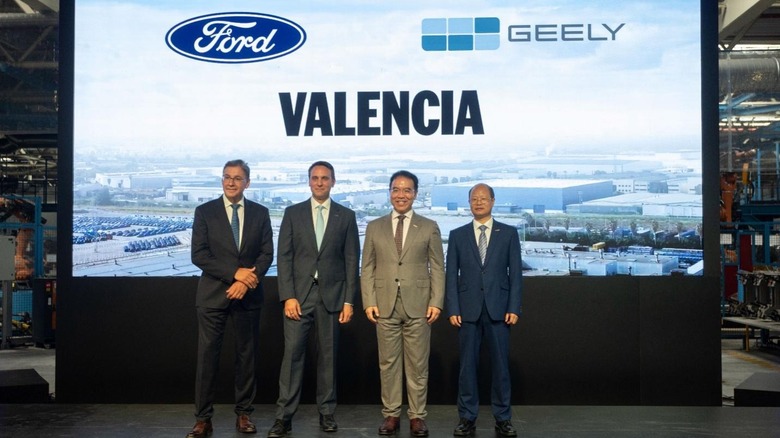
Ford and Geely sitting in a tree, K-I-S-S-I-N-G. That's right. The two automakers have agreed to a new manufacturing partnership that'll allow the Chinese car company to build some of its vehicles at Ford's Valencia plant in Spain, while also committing to jointly develop a new SUV. The deal marks the latest move by a Western automaker to open the doors to one of its European factories to Chinese competitors as it looks to fill capacity and secure future production sites amid rough market conditions. From The Wall Street Journal:
Tech-heavy Chinese-made cars continue to erode market share for Western carmakers both in China and increasingly in Europe, prompting companies to seek partnerships as a way to tap into Chinese technology while cutting costs through shared purchasing and engineering.
Jeep maker Stellantis said recently that two of its factories in Spain would produce electric vehicles with China's Leapmotor, while a separate deal will see Dongfeng assemble at least one of its premium Voyah branded electric vehicle models at a Stellantis factory in Rennes, France.
[...]
The agreement will see Ford and Geely form a new Europe-focused joint venture that will manufacture passenger vehicles for both brands that are tailored for the European market.
Ford will continue to produce its Kuga at the Valencia plant in addition to a new Bronco SUV, with production starting in 2028.
Geely will manufacture two electric SUVs at the site, with the first model to roll off the production line in 2028, while the two companies are also set to produce a new crossover SUV designed by Ford and jointly developed by Geely.
The companies said the venture supports Geely's international expansion and advances Ford's strategy of using partnerships to compete with speed, efficiency and scale in Europe.
The joint venture will officially start in the first half of next year, as long as no annoying regulators (read: haters of free enterprise) don't have anything to say about it. Under the proposed ownership structure, Ford will get a 66% chunk of the new entity, and Geely will get 34%.
4th Gear: Land Rover Will Drill Extra Holes In 15,500 Discoveries Because it Bungled Rearview Camera Instillations
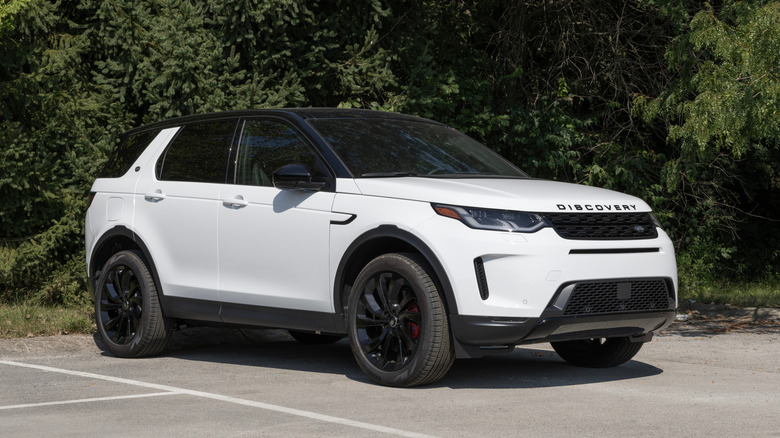
Do you own a 2021-2025 Land Rover Discovery Sport and feel there just aren't enough holes in it? Well, I've got good news, because LR agrees. The British automaker is recalling 15,535 of them because water may not be able to drain away from the rearview camera because the drain holes don't work properly. When that happens, the camera could break. The solution? More holes. From the National Highway Traffic Safety Administration:
Dealers will drill additional drain holes in the underside of the tailgate trim. Additionally, dealers will inspect and replace the rearview camera as necessary. Repairs will be performed free of charge.
Interim letters notifying owners of the safety risk are expected to be mailed out on September 11, 2026, so that you never forget about the recall. Once a remedy is available, another letter will go out in regard to the holes.
Reverse: At least your plans went better than Woodstock '99
 History.com
If you're ever feeling bad about plans you came up with not living up to expectations and falling apart, don't. Just look at Woodstock '99 and remember it could always be way, way worse. If you'd like to learn more about this unmitigated disaster of raw sewage, fires and misogyny on a disused upstate New York Air Force base, head over to History.com.
The Fuel Up
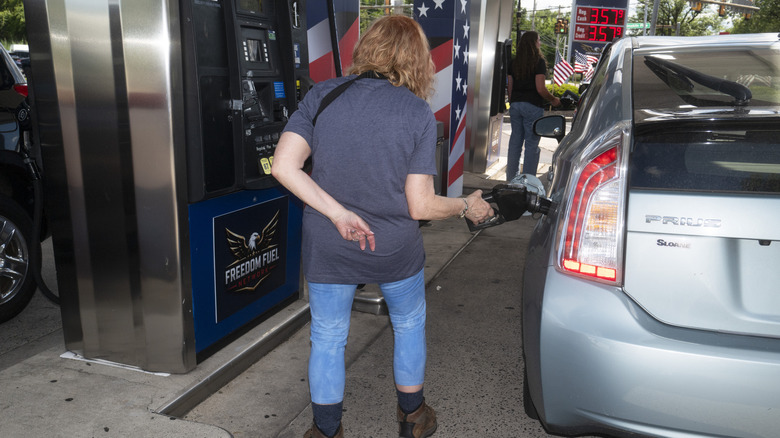
Womp! Gas prices are continuing their unrelenting climb past $4 per gallon as the U.S. and Israel's war with Iran rages on. I've got no idea what a peace deal would look like at this point, but I do know what elevated oil prices look like: WTI Crude Oil futures and Brent Crude are both up, sitting at $92 and $100, respectively, at the time of publication. That's right baby, Brent Crude is back over $100. We're living in Hell!
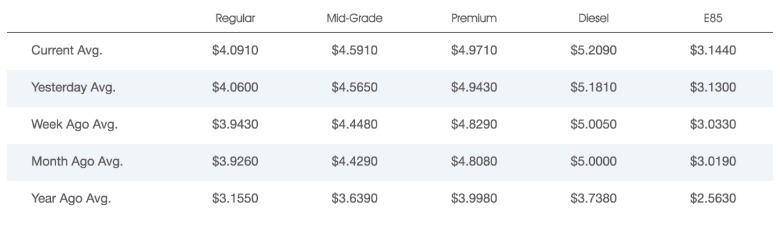
Here's where national average prices stand right now, according to AAA:
 History.com
What all this means is the average price of a gallon of regular gas was up another 3 cents overnight to $4.09, according to AAA. We're still a good bit off from the 2026 high of $4.56 that we saw back in May, but I wouldn't be surprised if we got there soon.
On the radio: Natasha Bedingfield - Unwritten
I don't know about you all, but I'm definitely feeling the rain on my skin today. It's a beautiful Thursday in July. It's basically the forever weekend. Everyone, get out there and enjoy yourselves.