

What's The Difference Between An AGM And A Flooded Lead-Acid Car Battery?
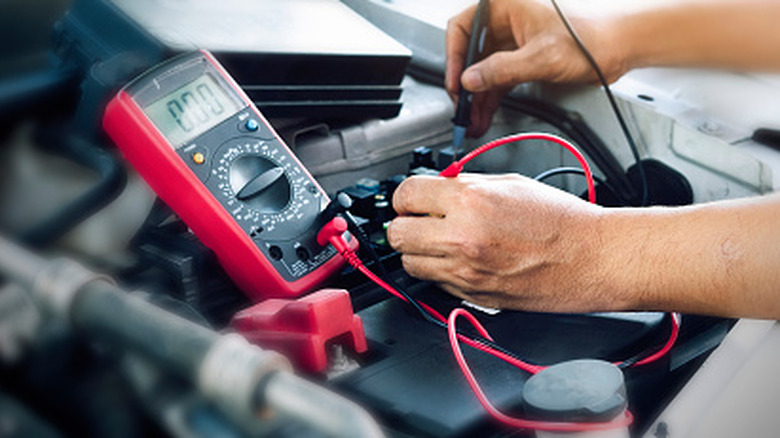
Depending on how long it's on the road, one of an internal combustion-powered car's most common replacement parts is its starter battery. These 12-volt bricks are integral to sending a jolt of electricity to the starter motor and spark plugs, and crank the engine before the alternator takes over.
If the battery has insufficient voltage, it won't do so. If it's dead, it won't power any interior components with the engine off, either. Luckily, their replacement interval is typically every couple of years or more, and, depending on the brand and model, it's generally easy to do so. But it's important to keep in mind that there are different types of batteries, two of which are slowly becoming more and more common.
Like a flooded lead-acid (or, lead-acid for short), AGM (absorbent glass matt), and lithium. We've discussed the pros and cons of lithium units before; it's time to cover the former two. They're the most common and have their own upsides and downsides — or, rather, positives and negatives. Like longevity, internal resistance, sturdiness, price, and more.
It's all about battery construction
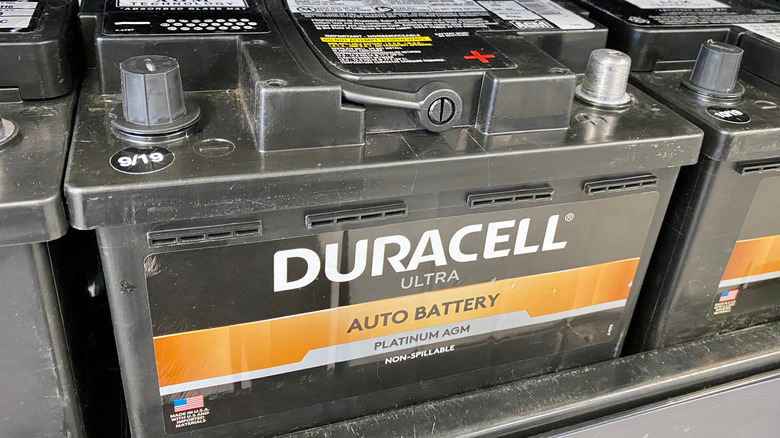
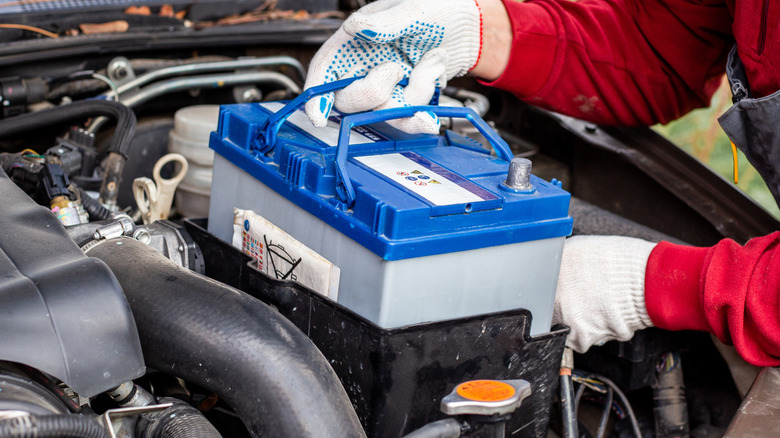
The most common and longest-running type is the lead-acid. Inside, lead plates are submerged in an acid bath of sulfuric acid and water. When charged and discharged, the chemical reaction inside stores and releases energy, and hydrogen and oxygen are released as byproduct gases, which is why they must be properly vented. They must also be mounted upright so as to avoid leakage, and in some instances, need occasional topping off with water. They typically range between $80 to $180 (or more, depending on size and CCA, or cold-cranking amps, and brand), and are vulnerable to vibration damage.
On the other hand, AGMs have lead plates that are separated by, you guessed it, fiberglass matt. No spa day for them. They're sealed, valve-regulated, cannot spill, and can be mounted in almost any orientation. Because they don't let out gasses, they're safer in places like under a seat or in a trunk, and deal with vibration far better — they're a much better choice for choppier environments like boating.
AGMs have the upper hand is many ways. They're better at dealing with extreme temperature change (such as in cold weather) and sustained load, have more consistent CCAs, and while a lead-acid unit can deal with around 200 to 300 deep discharges before wearing out, AGMs can manage 400-600 more.
Glass-filled pricing starts on the higher-end of the lead-acid range and typically tops out around $400, or more, depending on brand. But they typically last 5-8, or sometimes 10 years, whereas lead-acids only last three to five years (or less). Cherry on top: because of AGM's lower internal resistance (as low as 2%), they have increased voltage and recharge faster. Meanwhile, lead-acids have around 10-15% internal resistance.
In modern cars
The AGM one-ups the lead-acid in another department: modern electrical systems. Auto stop-start (or start-stop, but this isn't the place for a philosophical discussion) systems discharge batteries hundreds of times more than vehicles without them. Only AGMs and stronger enhanced flooded batteries (EFB) can withstand this kind of duty cycle. A regular ol' lead-acid will die prematurely when given such a task.
Then there's the fact that modern cars have so many electricity-rich features: complex premium sound systems, heated and cooled seats that can be adjusted in many ways, big screens, and more. AGMs' lower resistance and better charging makes them prime for such duty, in fact, they're often required in premium brand vehicles with such amenities on the sticker.
The difference between an AGM and flooded lead-acid car battery comes down to cost, longevity, toughness, maintenance, mounting, and internal resistance, ability to work with modern electrics, and a few other crucial details. The ol' standby lead-acid will get the job done in many applications, but for anyone driving something more modern, an AGM is a good thing to consider. Or, it may already be required by the manufacturer, especially if the vehicle's equipped with auto stop-start.