

Why The Ford Mustang Boss 351 Was Only Produced For A Single Model Year
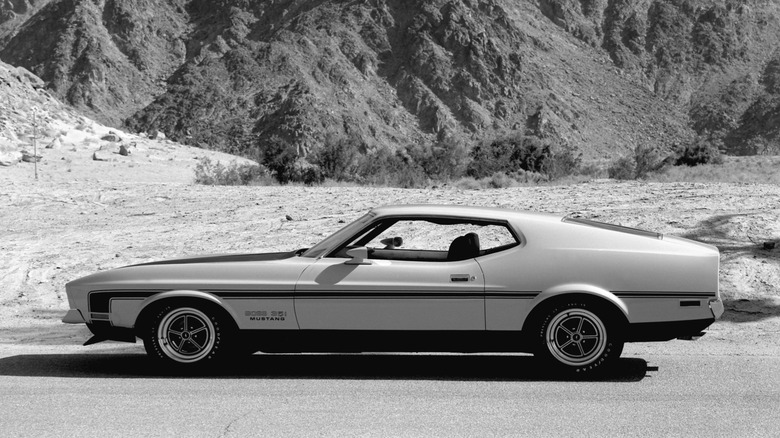
The early 1970s marked the end of peak muscle car, as new focus on safety and emissions regulations brought the classic era to a close. Life was particularly tough for Ford at the time, as the Blue Oval also had to drastically cut back on its racing efforts during this period, pulling its factory cars from both NASCAR and Trans Am competition. Nor did it help that muscle-car insurance rates had climbed right along with their horsepower ratings, making these factory-built hot-rods more expensive to own for customers. It was a combination of all those factors that killed off the 1971 Ford Mustang Boss 351 after a single year on sale.
The fact of the matter is that Ford was already moving away from racing when the Boss 351 was being developed, and the car's 351-cubic-inch engine was a direct outcome of the automaker's decreased emphasis on motorsports. Ford had introduced the Mustang Boss 302 and Boss 429 in 1969 specifically for its Trans Am and NASCAR efforts, and when those evaporated, so did the engines. The Boss 351 engine served as a sort of spiritual successor to past Bosses.
It did the job, too. While buff books like Car Life claimed the 1969 Mustang Boss 429 could run the quarter mile in 14.09 seconds with a trap speed of 102.85 mph, Motor Trend was able to get down to 13.8 seconds — at 104 mph — in the 1971 Boss 351. Heck, some Mustang fans are still salty that the Boss 351 took down a Mach 1 with a 429 Cobra Jet engine the same year.
The history of the Boss 351 V8 engine
According to Ford lore, the Boss engines owe their name to Larry Shinoda, an iconic auto designer whose creations further include the equally iconic 1963 split-window Chevrolet Corvette Sting Ray — which, in an odd bit of foreshadowing, also lived for only one model year. Shinoda was involved in a new project at Ford, and when he was asked what he was working on, he replied "the boss's car," per Petrolicious. The nickname evolved and stuck, both for the car and its engines.
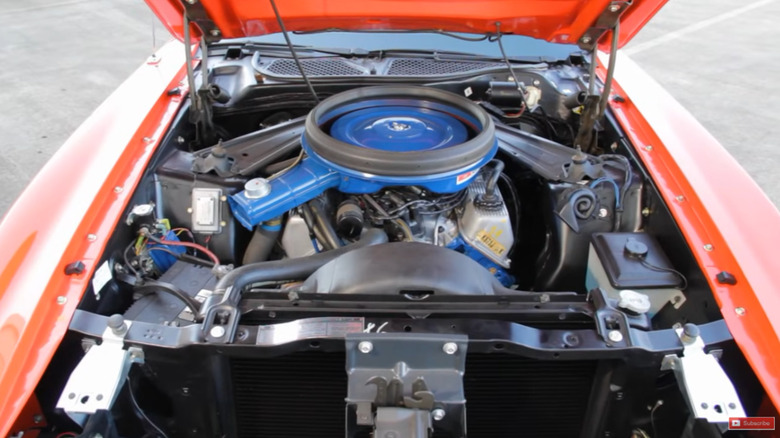
Speaking of motors, the 302, 429, and 351 V8s — with the numbers referring to their displacement — all came from different engine families. The Boss 351 was derived from Ford's Cleveland lineup, which was named for the city in which it was made. Note that the 302 did use an early version of the Cleveland heads, but the block was from the Windsor engine roster. The Cleveland motors themselves debuted for 1970.
The base engine boasted a computer-designed block with thin, precision-cast cylinder walls to go with compound canted valves for better breathing, an intake manifold heated by exhaust gases for quicker warmups, and lightweight pistons engineered to handle a higher-volume of the fuel-air mixture in each cylinder. To promote that engine to Boss status, Ford incorporated a wide range of go-fast upgrades. Four-bolt mains, forged-aluminum pistons, and both ends of the crankshaft — where it meets the balancer and flywheel — were enhanced as well. As a result, the Boss 351 V8 could belt out 330 horses and 370 pound-feet of torque, enough for the car to gallop from 0 to 60 in 5.8 seconds.
Another big issue with the Mustang Boss 351
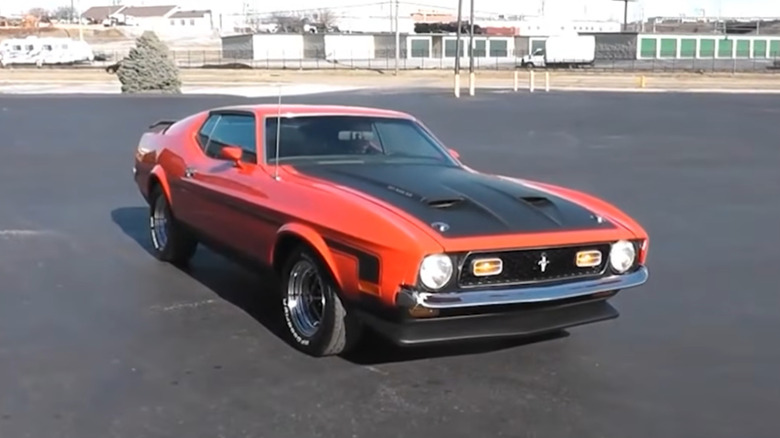
Ford produced a mere 1,806 examples of the Boss 351. Yet its low sales were likely due to more than the car's short production run. The reason behind this was likely that the Boss 351 debuted as part of a deep redesign of the Mustang that landed with a heavy thud on the marketplace. The 1971 car had become more than 2 inches longer and wider compared to the 1970 model. Oh, and beneath its flowing exterior, Ford added an inch to the wheelbase and 2.5 inches to the rear track. The sleeker new style then accentuated these bigger proportions to give the car a downright massive presence.
Nor did critics have much good to say about the Boss 351 cockpit. Car and Driver, for one, lambasted the cabin for its terrible outward visibility, hard-to-reach controls, and hard-to-see auxiliary gauges. To be fair, the upsizing did have a performance basis: Bunkie Knudsen – Ford's president at the time the car was being developed — had wanted the 1971 Mustang to be large enough to comfortably accommodate the automaker's 429-cubic-inch V8, as it had been a tight fit in the previous Mustang design. Coincidentally, Knudsen also was the boss behind the Boss name.
The bottom line, however, was that the big Mustangs — available only from 1971 to 1973 — had a three-year sales total of 410,448. Compare that to the original pony car, which racked up more than 1.75 million sales in its first 3.5 years at dealerships.