

Here's What's On The Golden Record, NASA's Message To Aliens Carried By The Voyager Probes
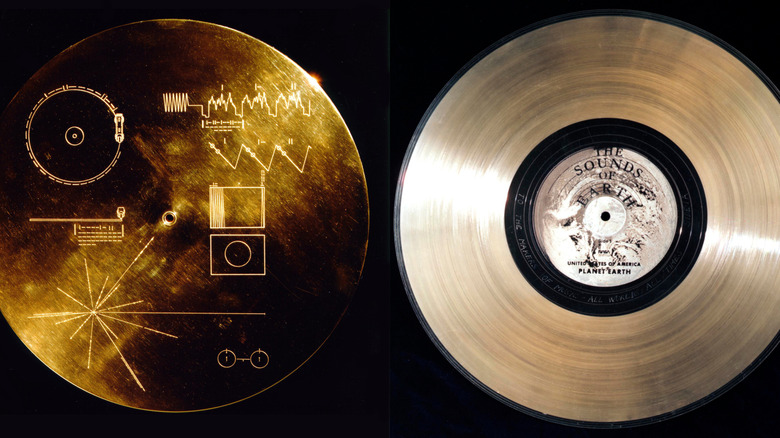
If there are indeed other beings in our galaxy, and they are sophisticated enough to traverse the expanse of space, their very first encounter with humanity might not be with a human. Rather, they might just chance upon our farthest-flung ambassadors, the twin Voyager probes built by NASA's Jet Propulsion Laboratory. If the alien astronaut (or perhaps a robotic probe itself) is good enough to catch one of them, it should be good enough to recognize a little something attached to the side of it, a small round disc plated in gold — and just a little uranium. If the traveler brought the disc back to its homeworld, its scientists, philosophers, and codebreakers would now be set their greatest challenge: decode this message from another planet. Success would mean first contact between two forms of intelligent life.
To us humans, the Golden Record is a highly elaborate version of an old-school phonograph record. Its origins go back to the mind of astrophysicist Frank Drake, of the famous Drake Equation which estimates the number of alien civilizations that might be out there, per the Planetary Society. Clearly a man with aliens on his brain, Drake proposed attaching a greeting from the people of our world to the people of another onto the Voyager probes, which NASA knew would be the first engineered objects to leave our solar system. This wasn't totally unprecedented: NASA's earlier Pioneer probes carried plaques for any alien astronauts to read. The pictograms featured a clever, astrophysics-based map to planet Earth, along with naked depictions of an adult male and an adult female human. The latter was considered scandalous by conservative types — imagine if aliens saw us without clothes! Although if said aliens were fully clothed conservative types themselves, maybe they'd agree.
Alright, so no heroic interstellar nudity on the Voyagers' message. But maybe this time, NASA could go a step further. Maybe this time, instead of a simple plaque, the Voyager twins could carry sounds, messages, and even images from Earth. Was that even possible? That, friend, is a question that scientists like to say yes to. Enter the legendary Carl Sagan.
What do you send an alien?

Before the Voyagers launched in 1977, NASA tapped a dedicated team to sort all this out. It was led by no less than Sagan, one of the 20th century's most well-known and beloved scientists. The idea they eventually landed on was to send our alien friends a 12-inch-wide phonograph record, because the basic concept would work anywhere. Unlike modern digital information, records are analog, encoding data into actual, tangible, physical grooves. A needle moving along those grooves can read this information and translate it into, say, the Beach Boys. But how do you get an alien to wish they all could be California girls?
Not with something as flimsy as vinyl, that's for sure! You need a material that will last a few years, maybe a billion or so. So the final objects are actually copper, plated with gold, which are encased in an aluminum cover. Great, so now the record can survive, how are our friends supposed to play it? NASA thoughtfully included a cartridge and needle, but the agency still needed to include instructions for how to decode its information.
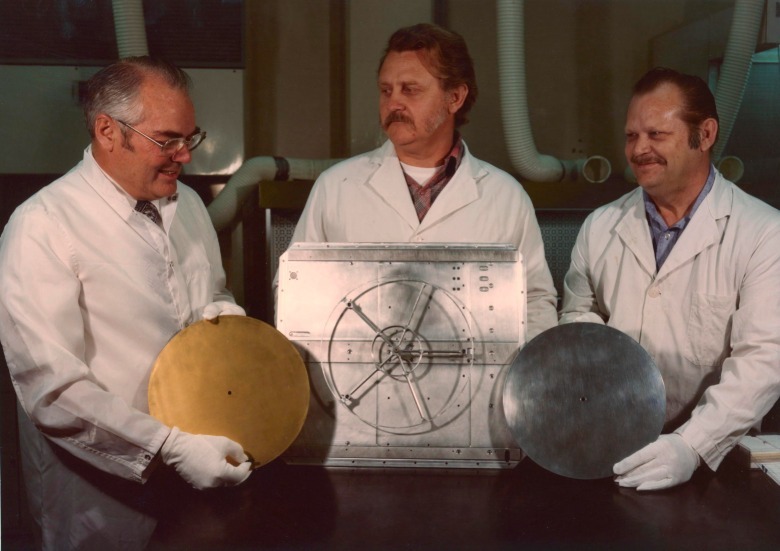
For that, Sagan's team created the greatest puzzle of all time, which you can only solve if your species understands the basic nature of the universe.
Instructions written in physics
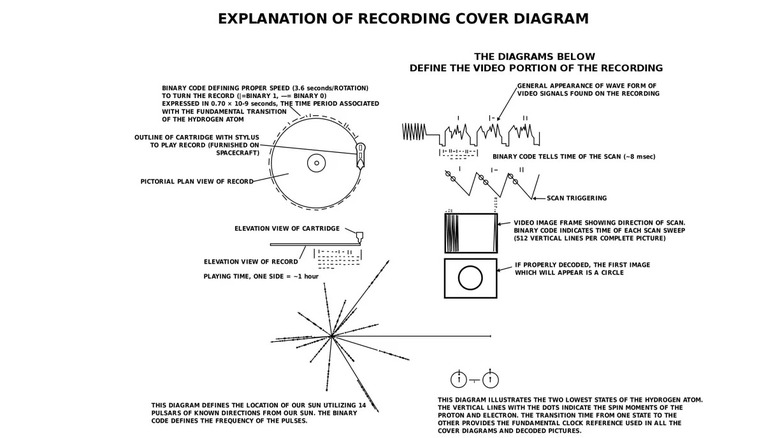
These are the pictograms on the cover of the Golden Record. To read it, start at the bottom left, two circles that represent the two lowest states of a hydrogen atom (which is the most basic, one-proton atom). The time it takes hydrogen to transition from one to the other is a universal constant, around 0.7 billionths of a second. The pictogram defines this time by the symbol "|". That sets the timing notation used throughout all the other pictures, along with its binary complement "-" for 0. So, how fast does the record need to be rotated? Every 3.6 seconds, as the aliens would know by following the timing notation. Now they can play the record properly with the provided needle and cartridge. Decoding the grooves into sounds and pictures is described on the right side of the cover.
In the lower left is the same cosmic map that the Pioneer plaques had. At the center is the Earth; around it are the 14 nearest pulsars, neutron stars that rotate at known intervals, "pulsing" signals out into space like a lighthouse. If you can read the timing notations, you can work out the distances, and thus triangulate (or 14-angulate) the Earth.
Greetings from planet Earth
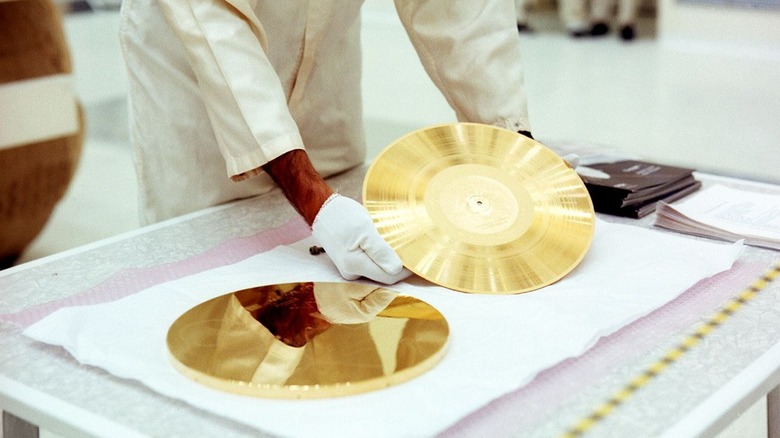
So you've recovered the Golden Record and your brightest minds have decoded how to understand its information. What information is on there? Sagan's team wanted this to be a warm, welcoming presentation of our planet, its life, and its diverse civilization. There are sounds of course, such as wind, whales, and most important of all to this website's readership, several different internal combustion engines. Then there is that most human of all sounds, music. Representing our strange species are various traditional songs from around the world; classics from the likes of Bach, Mozart, and Beethoven; and, apparently at the insistence of Sagan's then-student Bill Nye, a little Chuck Berry and Louis Armstrong too.
But the very first sound you'll hear is the voice of UN Secretary-General Kurt Waldheim. He's followed by greetings in 55 other languages, including dead ones like Akkadian and Hittite. (The order of the languages appears to be alphabetical in English, which I personally find funny.) If you can really figure out what those pictograms are saying, you can even decode a series of images from our little planet.

Last, but not least, is a small matter of uranium, a two-inch-wide disc's worth. This is a clock, since its predictable decay rate will tell you exactly how long the Voyager probe has been drifting through space.
Will any alien ever figure this all out? Just the odds of finding a Voyager are virtually zero, since it's a small little craft in the vastness of space. But the Golden Record has already done a lot. Sagan fell in love with fellow teammate Ann Druyan on the project, later marrying her. Their personal copy (one of only eight ever made, including the two in space) went on auction for hundreds of thousands of dollars; the Golden Record is not something people have forgotten about. The very idea of the record, and the fact that we pointed the way back to Earth, is a hopeful message of camaraderie with our cosmic neighbors, not fear. Maybe it's not just aliens who need a little help finding the way home.
This is a present from a small distant world, a token of our sounds, our science, our images, our music, our thoughts, and our feelings. We are attempting to survive our time so we may live into yours. We hope someday, having solved the problems we face, to join a community of galactic civilizations. This record represents our hope and our determination, and our good will in a vast and awesome universe. – U.S. President Jimmy Carter