

At $18,000, Is This 1994 Porsche 968 Cabriolet A Big (Four) Deal?
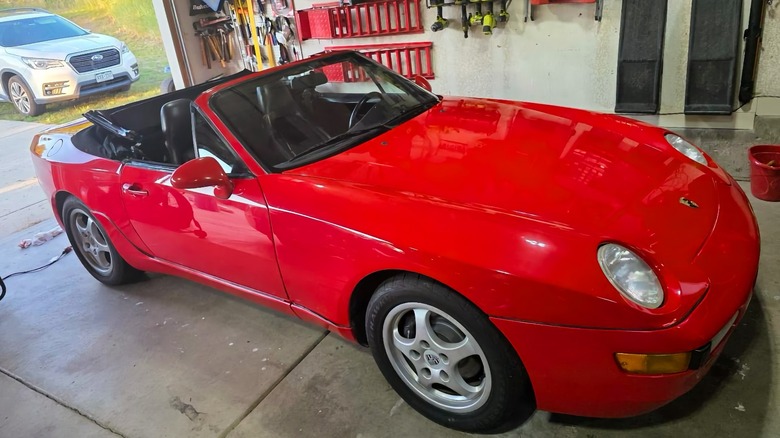
The three-liter engine in today's Nice Price or No Dice 968 is the largest four-cylinder Porsche ever offered to the public. It only did so for a very short run, making this one of the rarest of the 924/944/968 line. Let's see if its price tag is fitting for that legacy.
The idea of a pickup truck as a daily-driving multitasker rather than just a plain-Jane workhorse dates back to the 1950s, with the introduction of the Chevy Cameo Carrier halfway through that decade. Today, pickup trucks offer comfort and convenience features that rival those of most luxury cars. Naturally, that all adds complexity, cost, and weight, which made the more modestly equipped 1977 GMC Sierra Grande 2500 standard cab truck we looked at on Tuesday something of a breath of fresh air.
With low miles and a factory-new presentation, our candidate GMC was also positioned as a show truck. Unfortunately for its seller, few of you were interested in showing up with the $21,500 asking price for the truck. That was made clear in the massive 90% 'No Dice' loss it suffered in the voting.
To the fore
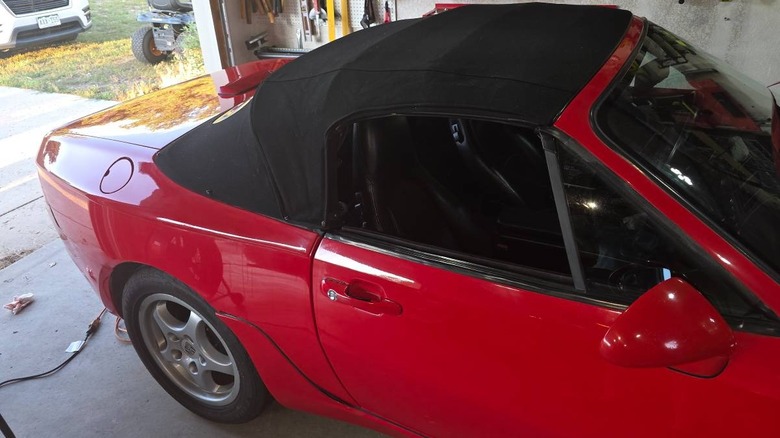
There's something that yesterday's GMC and the 1994 Porsche 968 Cabriolet we are looking at today have in common. Both have the engine in the front, driving the rear wheels. That's pretty much where the similarities end, but while standard fare for a truck, it's an important delineation for the Porsche. This model marked the end of that layout in Porsche's sports car offerings when its run completed for the 1995 model year. After that, Porsche would only offer mid- and rear-engine sports cars, relegating the front-engine layout to its crossovers and the Panamera sedan.
Introduced in 1991, the 968 was the realization of the full potential that could be wrung out of the platform first introduced in the 1970s as the 924. In the 1980s, that evolved into the more brutish and thus more desirable 944, which then sired the 968, a model with about 80% new or revamped parts, but still maintaining the familial resemblance. Upon its introduction, the 968 was hailed as the best-handling sports car Porsche had ever built. At the time, it was also known for having the biggest displacement four-cylinder engine offered by any manufacturer.
Big Bertha
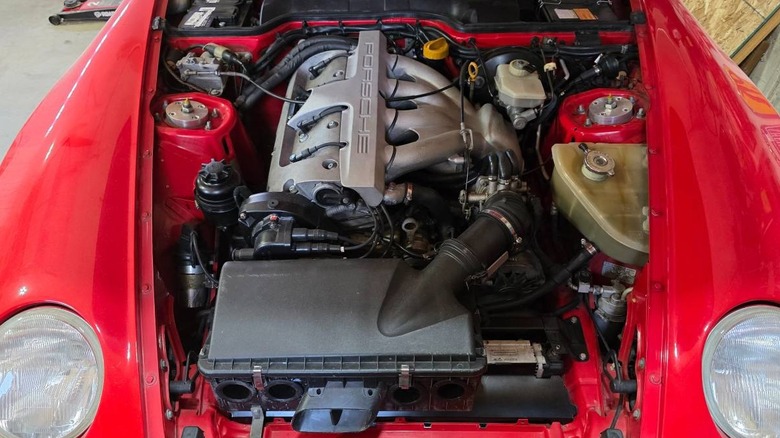
That engine is a 2990cc DOHC mill, which, thanks to Porsche's Variocam variable cam timing, produces 240 horsepower and 225 pound-feet of torque across a broad rev range. Such a big four requires some help to stay smooth, and thus the M44 has a pair of balance shafts to prevent it from rocking out. Backing up the big four is a Getrag six-speed manual transaxle.
According to the seller, the belts for the balancers, along with the timing belt, were replaced just two years ago. That's a plus, as it's an expensive proposition. Other work undertaken on the car's behalf includes a rebuild of the fuel system, from pump to injectors, new pads and rotors for the brakes, fresh plugs and ignition leads, and new fluids throughout. The seller even went to the trouble of pulling the intake and walnut-blasting the carbon off the valve tops.
Another update the seller touts is the "Koni shock conversion," which replaced the sealed front factory struts with replaceable Koni inserts. All in all, it seems like a lot of money and consideration have gone into the care and feeding of this 968.
Receipts
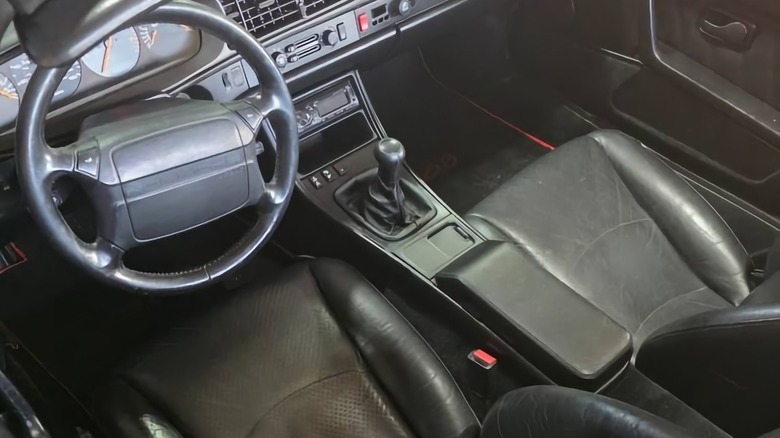
Everything done to the car is supported by receipts, or so the seller says. That includes the work done replacing the convertible top, which looks to be in great shape, with clear plastic in the back window. The mechanism to power the top has also been mended to work as it should.
All this work is to be expected on any classic sports car of this age, and considering this 968 has done 147,000 miles, it's impressive that it's been curated to such a degree. The paintwork looks to be in great shape, and the seller says everything on the car, including the often finicky pop-up headlamps, is working as it should.
On the downside, there's a tear in the dash cap and what is described as a minor oil weep from the lower balance shaft cover. The seller claims to have gone to the trouble to buy a tube of sealant to fix the latter, but says that "life got in the way" before they could do so. That should be a minor job for the next owner. A clean title will ensure that the effort is done in good conscience.
An appreciative purchase?
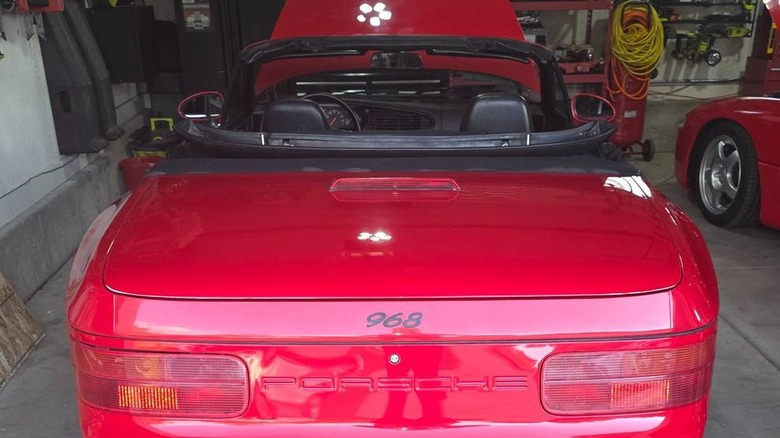
As we discussed, the 968 had the shortest run of the 924/944/968 ranges. That means that parts for the model—the oddball headlamps, bumper caps, or tail lamp lenses, say—are going to be harder to find should replacements be needed, and hence far pricier than for the more common 944.
Despite that, there's something to be said for owning the rarer model. You will see fewer of them at Porsche meet-ups, and believe me, if you own a Porsche, you will congregate with your brethren. Then there's the Porsche Tax, which has seen the 911 go from just expensive to holy-cow expensive in just a few years' time. The 968 remains an accessible model and a proper inroad to Porsche ownership for those who know what they're getting into.
The question, then, is what do we make of this one's $18,000 asking price? Does that feel fair, given the car's presentation and past curation? Or do the high miles and the model's relative obscurity work against that price tag?
You decide!
Denver, Colorado, Craigslist, or go here if the ad disappears.
Hat tip to Ben G. for the hookup!
Help me out with Nice Price or No Dice. Hit me up at robemslie@gmail.com and send a fixed-price tip. Remember to include your commenter handle.