

These Are 5 Of The Fastest Military Aircraft Ever Built
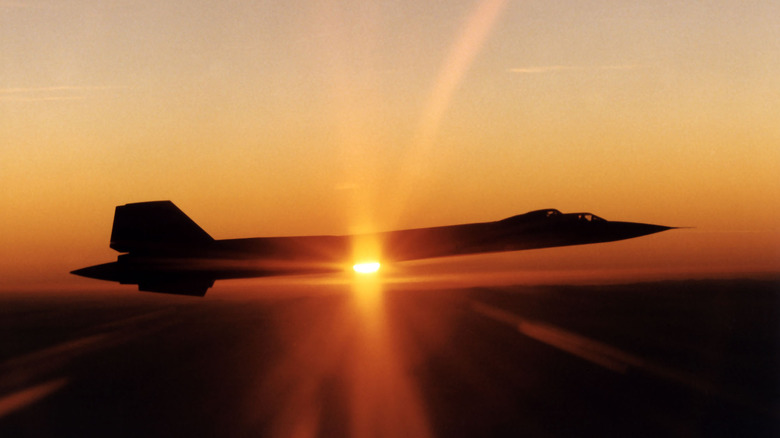
Speed has long been one of the more fascinating aspects of military aviation, with engineers pushing the boundaries of what's possible at the very edge of what physics allows. Interestingly, the real icons of speed are not modern machines but Cold War-era aircraft, which seemingly prioritized sheer pace over everything else.
There are many to choose from. This list highlights some of the most extraordinary speed machines, from design icons like the SR-71 Blackbirdto the North American XB-70 Valkyrie, a bomber transformed into a high-speed research platform for supersonic travel, while also covering Soviet defense legends such as the MiG-25 and MiG-31 aircraft. Many of these aircraft were capable of cracking Mach 3 — that's three times the speed of sound — and in some instances, even more than that. For the record, that's notably faster than the fastest jets a civilian could ever own.
While this list covers five of the fastest military aircraft ever developed and focuses on their headline figures, the aircraft themselves are so much more important than the numbers. They come from a time of technological ambition, each with a fascinating story behind its creation and purpose.
North American X-15
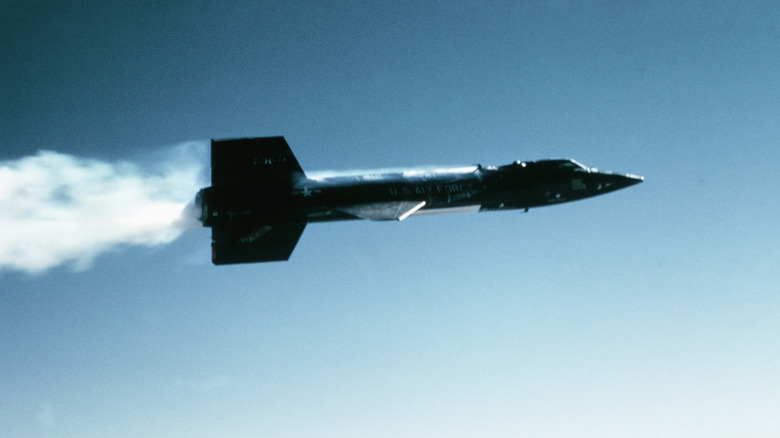
The X-15 is an unusual entry, being an experimental fighter jet, rather than one designed for actual service. Despite having been developed in the late 1950s and into the 1960s, it still ranks at the very top of the charts today among military aircraft, with a mind-boggling top speed of Mach 6.72, or 4,520 mph.
Powered by an XLR-99 Pioneer rocket motor, which was rated at 50,000 pounds of thrust, the X-15 was certainly equipped with the grunt required to achieve incredible feats. In fact, at the time, the XLR-99 was the most powerful engine of its kind ever be used in a manned aircraft and helped the X-15 to reach heights no other manned aircraft had reached before.
It reached altitude of 354,200 feet, around 67 miles high. Given the risks surrounding atmospheric pressures in these environments, pilots had to wear full-pressure spacesuits. Of the 12 pilots who flew the X-15, eight received their astronaut wings, demonstrating how the X-15 carefully trod the line between flights within the atmosphere and early space exploration. Among those pilots was the one and only Neil Armstrong, one of the historical figures Jalopnik readers would ride shotgun with.
Despite taking its last flight in 1968, flight number 199, the X-15 remains a technological marvel that still impresses today. Remarkable military aircraft have come and gone, but none have ever threatened the incredible top speed record held by this literal hypersonic rocket with wings.
Lockheed SR-71 Blackbird
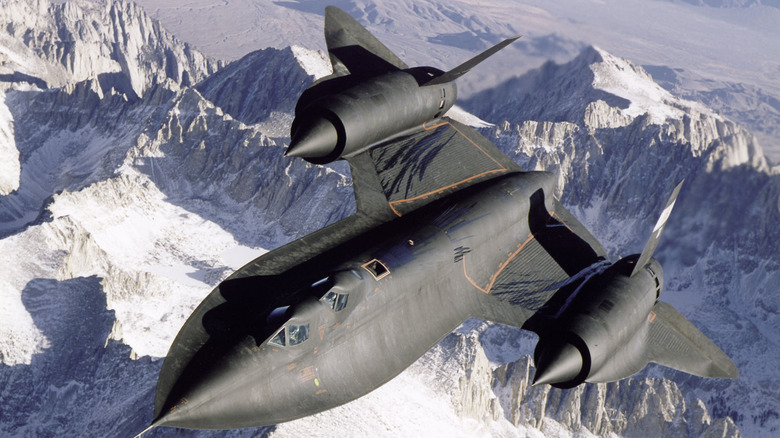
The SR-71 is one of the most iconic aircraft in U.S. history, and one of the very few planes actually fast enough to outrun the Earth's rotation. While its top speed is impressive at Mach 3.3, or around 2,500 mph, it cannot compete with the speed of the aforementioned X-15.
Chiefly, that's because the SR-71 draws its motivation from jet engines, rather than a rocket. Specifically, Lockheed's creation is powered by 2 Pratt & Whitney J58 jet engines, each producing 32,500 pounds of thrust. So, while rocket power is clearly superior for outright pace, the SR-71 is certainly no slouch. In fact, it still holds the record for the fastest-ever jet-powered military aircraft, despite development dating back to the 1960s.
Its final ever flight perfectly demonstrated the SR-71's speed and ability. In March of 1990, an SR-71 managed to clock an average speed of 2,124 mph when traveling from Los Angeles to Washington, D.C. in just 1 hour 4 minutes and 20 seconds. Upon landing, the SR-71 was handed over to the Smithsonian, and Lockheed's record-breaker has been grounded ever since, after an impressive 24 years and 2,800 hours of active service for the U.S. Air Force.
Mikoyan-Gurevich MiG25 'Foxbat'
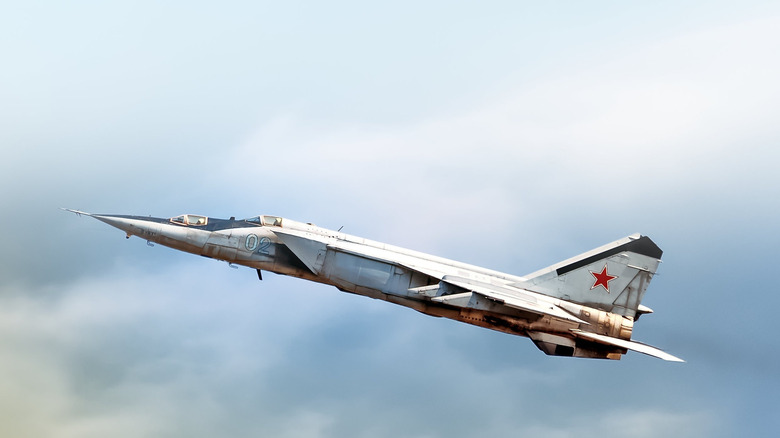
This next entry brings us to Russian, or USSR, territory. Like the previous examples, the MiG25 dates back to the 1960s. It's an interceptor, meaning its primary purpose was to 'meet and greet' intruders.
It emerged as a solution to a unique and troubling set of problems that the Soviet Union faced in the late 1950s. American spy planes and bombers could operate at impressively high altitudes, and the Soviets' air defenses were simply not equipped with the tools required to intercept aircraft like the XB-70 bomber and the U-2 surveillance aircraft. It boasted an operational top speed of Mach 2.83, which, as a mass-produced military aircraft, was only ever bested by the SR-71. Given the opportunity, the MiG-25 could reach Mach 3.2, but doing so risked irreparable damage to its engines, hence the lower operational limit.
It was designed to perform with an operational altitude of around 88,500 feet. In 1977, a modified example reached altitudes north of 123,500 feet in a record-breaking flight, demonstrating that the 'Foxbat' was truly a force to be reckoned with. In 1976, a Soviet Lieutenant defected and hand-delivered a MiG25 to Japan, where the West finally had a chance to get intimate with the MiG's design. Around this time, the 'Foxbat' was retired, in time for the MiG31 'Foxhound' to be sworn in as a direct replacement.
XB-70 Valkyrie
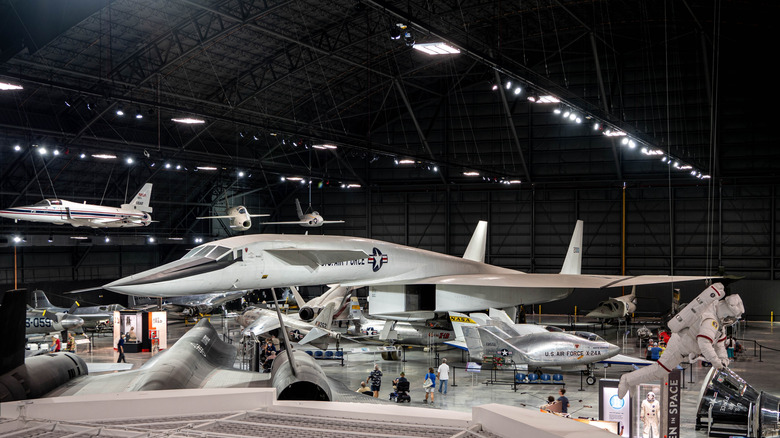
Before we visit that replacement, though, the XB-70 must be covered, slotting in nicely between the two MiG aircraft with a maximum speed of Mach 3.1, or 2,056 mph. Only 2 XB-70s were ever produced, and interestingly, they ended up serving a different purpose than originally intended.
It was designed in the 1950s to serve as a high-altitude strategic bomber, capable of soaring at around 70,000 feet at speeds of Mach 3. At such heights and speed, it would prove remarkably difficult to defend against. However, the arrival of new surface-to-air missile systems in the early 1960s and the development of intercontinental ballistic missiles rendered the XB-70 outdated almost overnight. At this point, just 2 XB-70s were under construction, and instead of becoming bombers as intended, they wound up serving as testbeds for supersonic transport, or SST.
Early flights in the first XB-70 were successful, although it became unstable at speeds above Mach 2.5. A slight adjustment to the aerodynamics of the second plane worked a treat, and in total, 9 flights were completed by the second XB-70 at speeds north of Mach 3.
That second XB-70 sadly crashed in 1966, leaving just the first to remain. From 1969, it retired to museum life, but the research conducted using these two planes was invaluable. We of course did end up with supersonic transport, and while it's been off the cards for some time now, there is potentially room for supersonic flight to return if sonic booms can be quiet enough for commercial travel.
Mikoyan MiG31 'Foxhound'
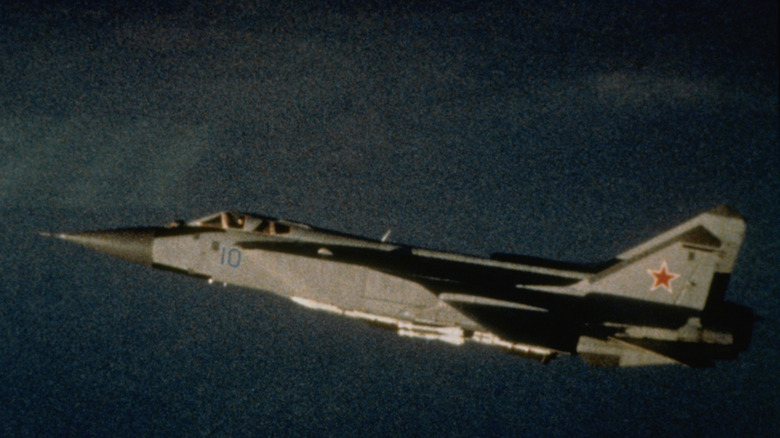
The MiG-31 technically had the same capability as its predecessor to crack Mach 3, but given the damage that came with it, they were limited in achieving such feats. A pair of Soloviev D-30F6 afterburning turbofan engines provides 34,000 pounds of thrust each, helping propel the Soviet creation to Mach 2.83.
The MiG-31 is no slight aircraft. Designed from the outset to carry advanced radar equipment and long-range missiles, it's actually one of the heaviest fighter-interceptors ever built, with a maximum take-off weight sitting at around 46 tons. The radar system in question allowed the MiG31 to locate up to 10 targets up to 120 miles away, and actively engage up to 4 at any given time, regardless of where they are in respect to the 'Foxhound' itself.
Production ran from the late 1970s up until 1994, with around 500 aircraft being built in total. Having entered the Soviet Air Defense Forces in 1981, the MiG-31 has been in service with Russian forces ever since, and continues to do so now, despite more than 40 years having passed since its arrival. Extensive upgrade programs have ensured it remains operational, with current models expected to continue service for some years yet. While fourth in this list, the MiG-31 remains the fastest military aircraft currently in service anywhere in the world.