

Monthly New Car Payments Hit A Record $777 As Cars Become More And More Unaffordable

Good morning! It's Tuesday, July 7, 2026, and this is The Morning Shift, your daily roundup of the top automotive headlines from around the world, in one place. This is where you'll find the most important stories that are shaping the way Americans drive and get around.
In this morning's edition, new car financing payments hit a record high for the third quarter in a row, Toyota is investing billions in its Texas plant to bring Tacoma production stateside, Mercedes-Benz plans to build the "Baby G" in Hungary — not Austria — and, would you look at that, Ford is recalling another 110,000 vehicles for a few different reasons.
Oh, and if you want a recap of the latest auto news delivered to your inbox each weekday morning because life is busy and you can't always head to our website, you can sign up for Jalopnik's free The Morning Shift newsletter right here.
1st Gear: How the hell can anyone afford their car payments?
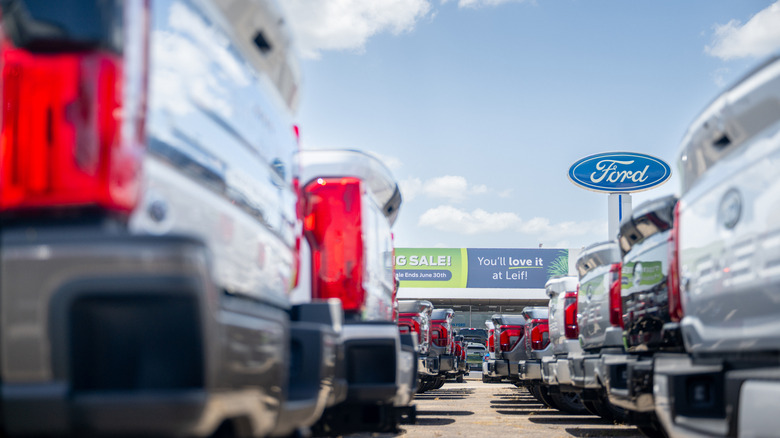
How are your bills looking this month? Bad? Yeah, mine too. Now, imagine if you had a car payment on top of them. You'd really be screaming, because vehicle buyers are paying more than ever before to finance their purchases as average monthly payments hit a record $777 in the second quarter of 2026. That's the third consecutive quarter of increases, according to data from Edmunds.
You can thank the ever-rising cost of new vehicles, which we've recently reported to be nearly $52,000, for the increase. Add in rising insurance costs and the fact that just about everything else costs more, too, and there are some very extreme affordability concerns for the average consumer. Because of that, they're financing more than ever, with the average amount financed for a new-vehicle purchase hitting a record $44,156. This feels pretty damn unsustainable. From Automotive News:
he steep trends also make it more advantageous for dealers to bring up finances earlier in the buying process. It could prevent consumers from getting emotionally attached to vehicles they can't afford, Jessica Caldwell, Edmunds' head of insights, said.
[...]
Consumer loan terms longer than 72 and 84 months are increasing as well. In the second quarter, 23.9 percent of buyers signed on for loans of 84 months or longer, a record, compared to 22.9% in the first quarter, according to Edmunds.
While this isn't a significant problem for buyers who hold on to cars for a longer period of time, those who trade vehicles in every three to four years will potentially find themselves with a "much riskier proposition" because they would likely be underwater, Caldwell said.
Compounding these issues are the facts that automaker incentives are incredibly hard to come by, and it doesn't look like interest rates are going to drop anytime soon. It's likely that the consumer trends that Edmunds is observing are going to stay in place for a while.
I'm not much of a financing whiz, but, for the life of me, I cannot understand how some people afford the cars they drive. It really does boggle my mind.
2nd Gear: Toyota brings Tacoma production to U.S. with $3.6 billion plant expansion
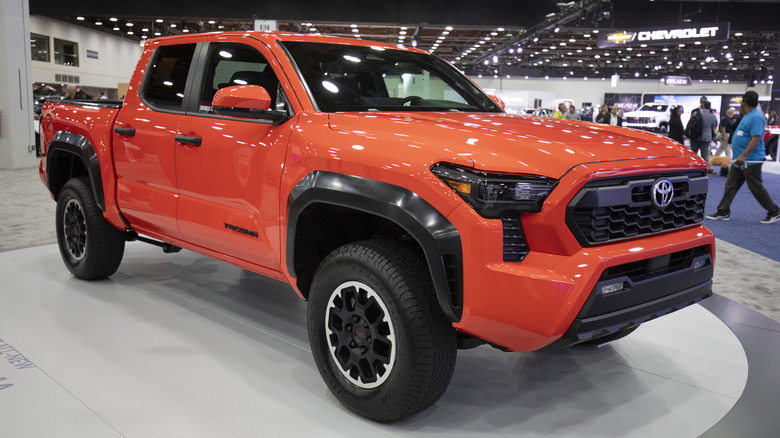
Toyota is making a massive $3.6 billion investment at its plant in San Antonio, Texas, as part of a plan to move Tacoma production from Mexico to the U.S. The Japanese automaker plans to build a second production line where it currently builds the Tundra and Sequoia and add about 2,000 new jobs by 2030.
The move is part of a wider $10 billion U.S. manufacturing pledge that Toyota made in 2025 that is meant to run through the next decade, and it comes as talks between the U.S. and Mexico to renew a North American free trade agreement have all but collapsed. President Trump, someone Toyota Chairman Akio Toyoda deeply admires, has pressed the automaker to invest more in the U.S. From Bloomberg:
"Toyota's decision to shift part of Tacoma production from Mexico to Texas appears strategically sound if current US trade policies and tariff levels remain in place," Yoshida said. "The key question is how Toyota will utilize the capacity left behind in Mexico. Any backfill product would likely need to target markets outside the US and offer sufficient scale to maintain plant profitability."
The world's largest automaker is on track to potentially overtake General Motors Co. in terms of US new car sales volume later this year. Toyota sold a record 274,638 Tacomas in the US last year, up 42% from its 2024 total. Demand has continued to pick up this year, with sales rising almost 10% through June.
[...]
The Tacoma, or "Taco" to truck enthusiasts, is the best-selling midsize pickup in the US and has been made at two plants in Mexico. Its unclear what product will backfill the lost production at the factory near Tijuana, which last year built some 166,653 Tacoma models. A company spokesman said Toyota had nothing further to share at this time.
The other plant that makes Tacomas, which is located in central Mexico, will continue to export them to the US, the spokesman said.
By moving some production of its best-selling truck to Texas, Toyota will shield itself from the impact of tariffs on Mexican imports. Autos shipped from Mexico are subject to US duties as high as 25%, which has hit Toyota and other automakers' bottom lines and upended decades of cross-border production planning.
The enlargement of the San Antonio plant, which is nearly twice as big as it was anticipated to be, will double the plant size to about 5 million square feet. It'll also bring Toyota's total spending at the site to $8.3 billion since it broke ground there 23 years ago.
It's currently running near its full capacity of around 200,000 vehicles per year, and the new expansion will add another 150,000 vehicles annually over a four-year ramp-up period.
3rd Gear: Mercedes Baby G will be Hungarian
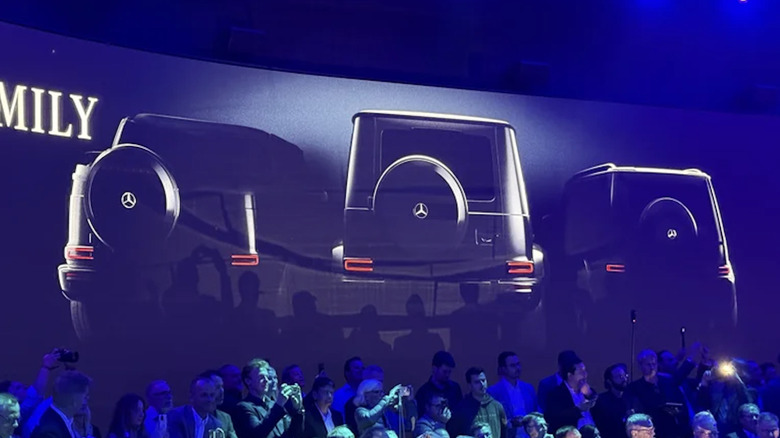
I know you all like talking about manufacturing plant logistics, so why don't we stick with that for another gear? Mercedes-Benz says it plans to build the upcoming "Baby" G-Wagen at its plant in Kecskemet, Hungary — not in Graz, Austria, where the full-size G is hand-built by Magna Steyr. I'm sure this'll bum some folks out, but it does make sense. The Hungary plant is set to play a key role as a manufacturing hub for MB as it accelerates a cost-cutting program that is threatening German factory jobs.
The Baby G, which is set to debut sometime next year, is based on the automaker's compact MMA architecture, which underpins the new CLA and GLB. The decision to go with Hungary for production leaves the company's Rastatt factory in Germany (which currently builds the CLA) without a new vehicle program. From Automotive News:
The move underscores Mercedes' broader strategy of shifting production from Germany to lower-cost locations in Eastern Europe. Until now, the automaker had confirmed only the electric C-Class and its derivatives, including AMG performance variants, for Kecskemet.
Following a €1 billion expansion, the Hungarian plant will become Mercedes' largest manufacturing site in Europe, with annual capacity increasing to between 300,000 and 400,000 vehicles.
Hungary will account for about 30 percent of Mercedes' European production, up from roughly 15 percent, according to a person familiar with the company's manufacturing plans.
Germany's three Mercedes plants — Sindelfingen, Rastatt and Bremen — will retain a combined capacity of roughly 900,000 vehicles, about 100,000 fewer than before. Current output is closer to 200,000 units per plant.
The investment will add about 3,000 jobs, bringing total employment at Kecskemet to about 7,500 people. The factory already builds the combustion-powered A-Class and the electric GLB, while production of the electric C-Class is also planned.
People familiar with the plans said the successor to the A-Class is also expected to be built in Hungary.
There's also a U.S. component to all of this, because Mercedes wants to bring more production Stateside as President Trump ramps up tariffs on new vehicles imported from Europe.
Mercedes is considering shifting GLC production for North America from Bremen to Vance, Alabama. If that happens, European GLC production is expected to move to Hungary. The GLC is Mercedes' bestselling vehicle globally.
Together with other initiatives, the production changes are intended to help Mercedes reduce manufacturing costs by 10 percent between 2024 and 2027.
The decision comes as CEO Ola Kallenius pushes a new cost-cutting program in Germany. In a message to employees, Kallenius announced a "Germany productivity offensive," warning that assigning new products to German factories further weakens the company's relative cost position.
Mercedes says it plans to introduce something like 40 new models by 2027, but executives — including Kallenius — are under pressure to make sure those launches actually translate into profitability rather than more investments that go nowhere. Some may argue that introducing a smaller G-Wagen dilutes the brand, but the company is clearly willing to bet that whatever is lost in brand prestige will be made up for with a boatload of sales.
4th Gear: Throw a couple more Ford recalls on the pile
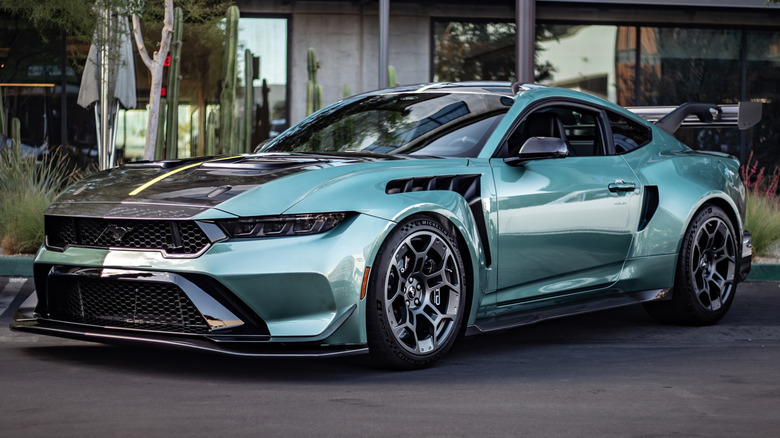
It wouldn't be a Morning Shift without a Ford recall, would it? That's why the company is recalling 110,626 Mustangs (gas and electric!) in two separate recalls because of an issue with the windshield wipers in the gas cars and a rear differential pinion shaft issue in the Mach-Es, according to the National Highway Traffic Safety Administration. From Reuters:
Ford will recall 67,842 Mustang and Mustang GTD vehicles because in certain cold temperature conditions, the windshield wipers may function only at their high-speed setting and the washing system may fail to function properly, NHTSA said.
Separately, Ford is recalling 42,784 Mustang Mach-E vehicles because the rear differential pinion shaft may fracture, resulting in loss of drive power or unintended movement if the vehicle is parked without the parking brake applied.
Dealers will repair or replace the damaged parts free of charge, NHTSA added.
These two represent the 55th and 56th recalls of 2026 for Ford, and so far, a total of 12,194,717 vehicles have been impacted. I believe, with a little bit of moxie, we can crack 20 million before the year is through.
Reverse: Actual winners
 History.com
I'll talk about what happened last night soon, but for now, how about we look back on so actual winners. I was lucky enough to be at the Canyon of Heroes parade for the 2019 World Cup team in New York, and it was a hell of an experience. Perhaps one day their skill can rub off on the men's team, but that isn't happening anytime soon. If you want to learn more about this team's run, head over to History.com.
The Fuel Up
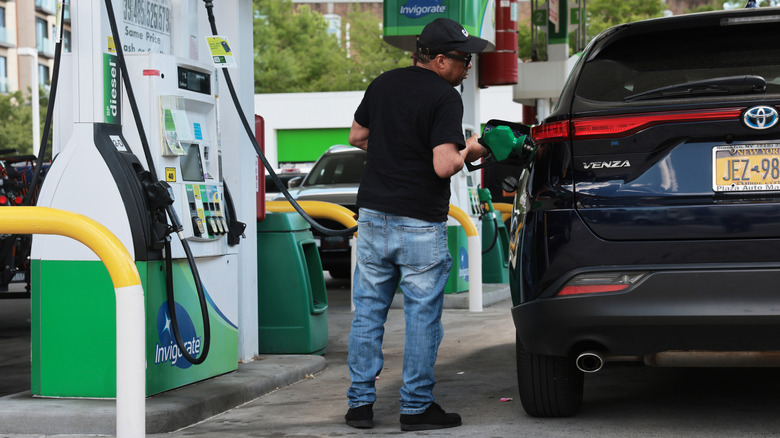
Folks, we've cracked the $3.70s once again. It's been a long time coming, but we're back. Of course, prices are still quite elevated from where they're supposed to be — up 72 cents from when the U.S. and Israel's war with Iran broke out at the end of February, but we'll take what we can get. WTI Crude Oil futures and Brent Crude prices are also down ever-so-slightly, sitting at $69.90 and $73.60, respectively, at the time of publication.
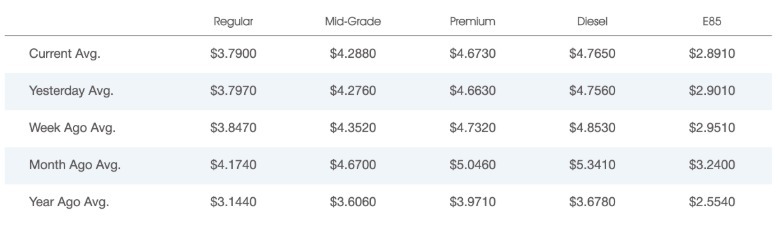
Here's where national average prices stand right now, according to AAA:
 AAA
AAA
What this all means is that the average price of a gallon of regular gas dropped another cent overnight, so it's currently sitting at $3.79, according to AAA. We're now down 77 cents from the 2026 record that was set back on May 21, when gas hit $4.56 per gallon.
On the radio: John Denver - Take Me Home, Country Roads
Like so many folks around this country, I bought into what Team U.S.A. was selling in this World Cup. I really thought, "Why not us?" Well, a not-that-good Belgium team smacked us up and down the pitch, and I didn't much care for it. Now, I'm all in on that Norwegian lunatic Erling Haaland until the Women's World Cup next Summer. Go get 'em.