

This Was The Fastest Recorded Speed On A Public Road For Almost 80 Years
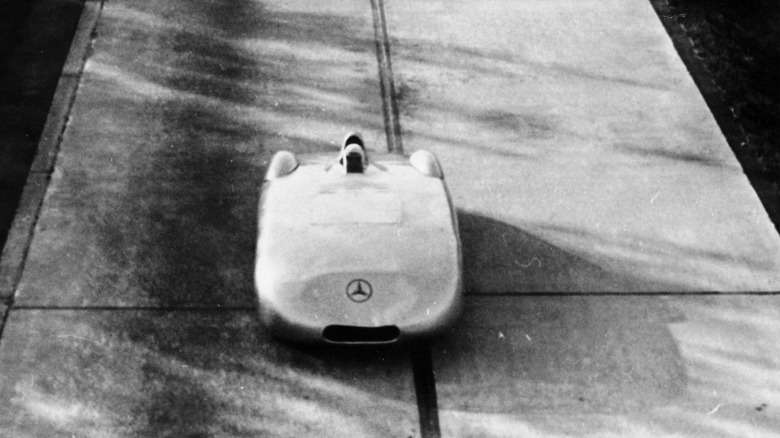
Even with all the power and modern technology available in modern supercars, 269 miles per hour is an almost-impossible speed to reach in an automobile on public roads today. And nearly ninety years ago, it was an engineering feat of astonishing proportions.
In 1938, Mercedes-Benz built an enclosed streamlined version of its Grand Prix racing car, the W125, for champion racing driver Rudolf Caracciola to go absolutely flat out. That W125 had already won half of the 1936 Grand Prix season races, but the closed-wheel bodywork and a bubble cockpit made it all the more slippery. Mercedes used early wind tunnels, developed for zeppelins, to shape the car for top speed. A massive twin-supercharged V12 replaced the racing car's inline eight-cylinder engine and made it even faster.
This effort by Mercedes and Caracciola was inspired by the Chancellor of Germany, Adolf Hitler. The Nazi party head spun up his sportswashing propaganda wing to prove the nation's return to strength and technical prowess under his watch. Hitler and his right hand man, Josef Goebbels, conceived of the idea of German Record Week, a top-speed competition to show how great the nation's newly-developed Autobahn network was. The competition was set during the Grand Prix off-season, allowing major world championship contenders Mercedes and Auto Union to compete for high-speed glory. The government-sponsored event took place on the newly-finished section of Autobahn between Frankfurt and Darnstadt.
While the 1937 Rekordwoche competition had been taken by Auto Union and its celebrity driver Bernd Rosemeyer, Mercedes showed up to the fight in 1938 with a fresh contender and even more speed. Heavy revisions were made to the W125, and the world land speed record was within sight. So confident was Mercedes that it requested the event be moved up from the fall to January so it could tout victory on the stand of the International Automobile and Motorcycle Exhibition that year.
Setting the record straight
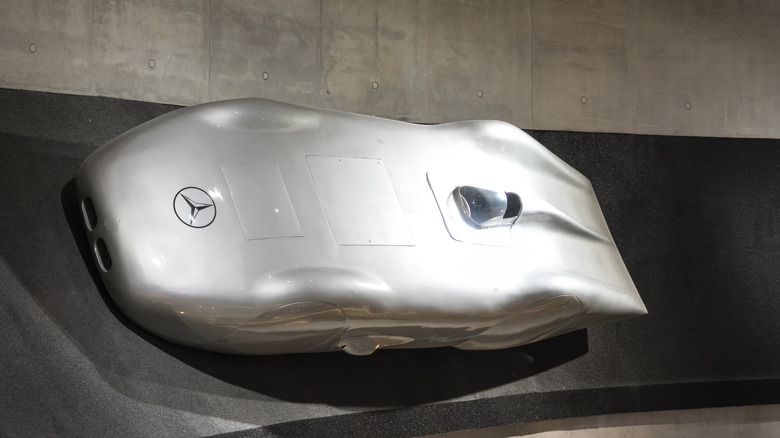
The backbone of this record attempt was the car's 5.6-liter V12 engine, with a pair of roots-style superchargers. The engine was by far the heaviest part of the car, having been formed from steel cylinders with welded-on steel cooling fins. According to Mercedes, the engine was capable of an incredibly impressive 765 horsepower and could spin in excess of 5,800 RPM.
To find extra speed for the short top-speed runs, Mercedes determined it best to eliminate cooling ducts for the engine. Where the engine was traditionally air-cooled, Mercedes instead enclosed the cylinders in jackets and routed water across the fins. Without a traditional radiator system, Mercedes filled a water tank with ice to protect the engine from overheating during the short high-speed runs.
Not only did Mercedes bring out their A-game for the 1938 record run, but Auto Union also brought a heavily updated and streamlined V16-powered Type C. In early practice for the event, Rosemeyer stepped behind the wheel of the Type C and allegedly knocked up an impressive 267 MPH run before official timing. When the official event got underway, Caracciola put up an immediate response with a 268.9 mile per hour run, a new world record. Rosemeyer rolled up to the line confident his Auto Union would win out on speed. The world will never know if he could, though, because Rosemeyer lost control and his car took flight, smashing into a bridge embankment where he was thrown from the car and immediately killed.
Some contend that Rosemeyer's deadly run was fast enough to have taken the record back again, but officials couldn't corroborate, as the run would remain perpetually incomplete. Rudolf and his Mercedes would remain the fastest thing to ever hit a public road.
Finally beating the record
These sleek speed machines were the product of an evil propaganda machine. Regardless of the talent of the drivers involved, the incredible efforts by these automakers and their respective engineers, and the usefulness of Germany's high-speed autobahn system, these feats served only to propagate the claimed superiority of the Nazi regime. That these records stood for several decades after Hitler's death only makes their toppling all the more impressive.
A Koenigsegg Agera RS driven by factory driver Niklas Lilja has recorded a 2-way avg speed of 444.6 km/h (277.9 mph). A new world record! pic.twitter.com/FXUjKpTW1q
— Koenigsegg (@koenigsegg) November 4, 2017
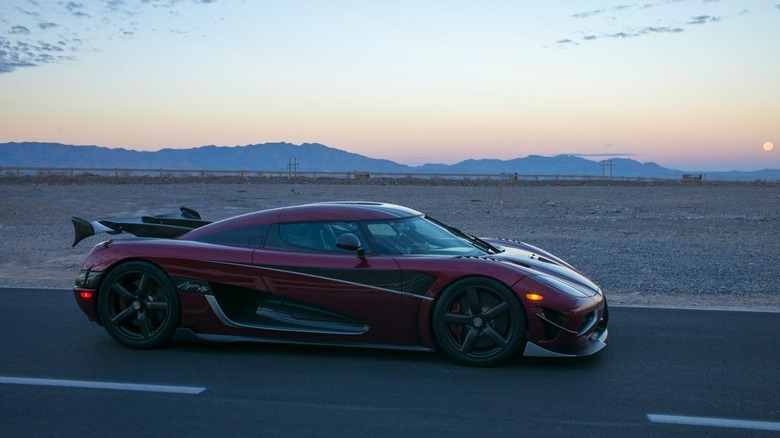
In late 2017, when Koenigsegg took a 1,200-horsepower Agera RS out to a long straight stretch of highway in Nevada as part of an effort to break a bunch of speed and acceleration records, the Swedish hypercar maker finally took down the old Mercedes. With a two-way average of 277.87 miles per hour, from a street-legal production car, Caracciola's old record finally fell to test driver Niklas Lilja. On the return run of the 11-mile Nevada highway, Lilja saw as high as 284.6 miles per hour.
Like the Autobahn run, this Nevada highway was chosen because it was long, straight, and flat. This car didn't need a dedicated race course or a wide open salt flat to set its record, just a regular normal stretch of US Interstate. And the only propaganda machine Koenigsegg was feeding with its world record speed run was that Koenigsegg is cool.