

How Does Rivian's Warranty Compare To Tesla's?
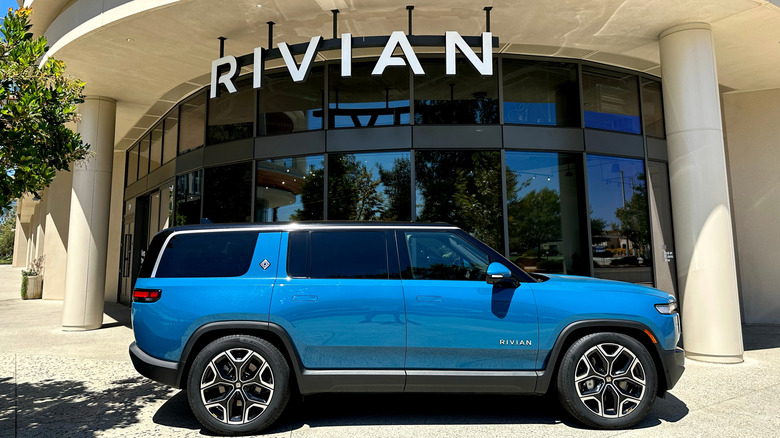
Warranties are there for peace of mind. Although Tesla and Rivian are some of the car brands that offer the longest warranty packages, it's not always smooth sailing when it comes to getting something fixed under warranty. Stories range from egregious warranty denials to absolute comedy like Tesla denying warranty coverage for a brand-new but leaky Cybertruck. To understand why that's the case, it's important that you know what sort of warranties these companies offer and the many asterisks that come with them.
Comparing the warranties of Tesla and Rivian reveals that both EV-makers offer fairly similar coverage in the United States and Canada. For instance, Tesla's Basic Limited Warranty is identical to Rivian's Comprehensive Warranty at 4 years or 50,000 miles (whichever comes first), with the only exception being 2022-to-2024 Rivian R1 models in the Quad-motor Large-battery configuration, for which coverage stands at 5 years/60,000 miles. Both Rivian and Tesla will repair or replace defective parts as long as the coverage exists. Just make sure you don't modify, crash, or drive them into the sea. Within the fine print that may void your limited warranty are environmental damages or "acts of god," including everything from storms, floods, and hail damage to tree sap, bird droppings, and stone chips.
What's interesting is that Rivian offers a 1-year or 12,000-mile Adjustment Warranty, which covers wheel alignment, tire balancing, and brake pad/lining replacement, among other things. Tesla, on the other hand, explicitly states that its warranties don't cover any of these services. Although both companies offer limited warranties for their SRS systems (airbags and seatbelts), Rivian's 8-year/100,000-mile coverage is more reassuring than Tesla's 5-year/60,000-mile warranty. As for the corrosion warranties on offer, Tesla's 12-year/unlimited-mile coverage beats Rivian's 8-year/unlimited-mile package.
Comparing their battery warranties
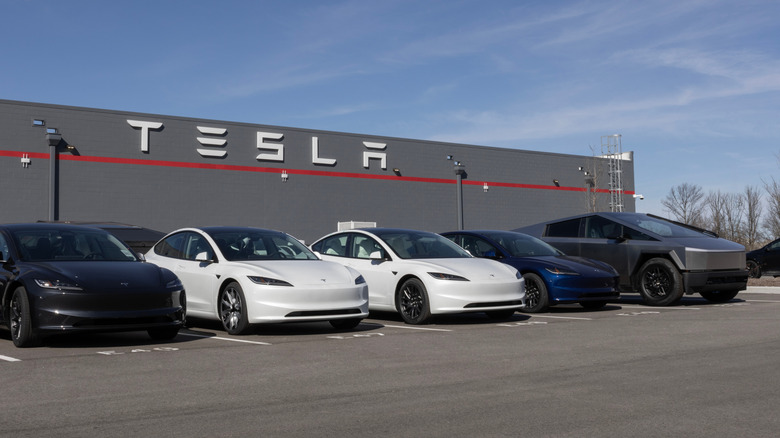
Tesla and Rivian offer broadly similar warranties for their battery packs and drivetrain units, with both guaranteeing a minimum battery capacity of 70% during the warranty period. On the duration front, both brands offer 8 years across the board. Rivian's mileage limits vary between 120,000 and 175,000 miles, depending on the vehicle, model year, and configuration. Similarly, Tesla covers Model 3s and Ys for up to 120,000 miles, while the Model S, X, and Cybertruck battery warranties push the limit to 150,000 miles. Of course, just like the basic warranties, these battery and drivetrain warranties also carry the disclaimer "whichever comes first."
However, even if you manage to replace the battery, both companies adopt similar language to tell you that the replacement battery will be in a condition that matches the vehicle's age and mileage. The corporate jargon is such that it could be new, remanufactured, or refurbished, and the replacement only needs to satisfy the 70% minimum-capacity guarantee until the original warranty expires. In other words, it won't reset the warranty clock, which highlights the importance of maintaining your EV battery to maximize its lifespan.
Both automakers also comply with California's Zero-Emission Vehicle (ZEV) warranty requirements, which cover certain propulsion-related components that aren't typically included in the standard battery and drivetrain warranties. The Rivian R2's warranty guide explicitly mentions ZEV, though we couldn't find a separately detailed ZEV section in the R1's guide. Tesla, meanwhile, applies its ZEV Limited Warranties to all 2026 and later model-year vehicles, the details of which are available here. The takeaway? We wouldn't be picking sides based solely on the warranty.