

I Am Unmoved By The Autonomous Nürburgring Lap Record
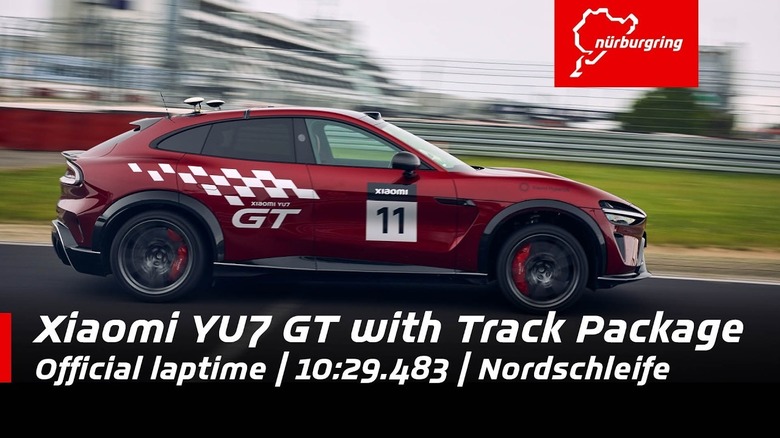
Xiaomi is no stranger to setting lap records at the Nürburgring. Last year, the Chinese megacorporation put the automotive world on notice when it sent a modified version of its SU7 Ultra sedan around the 'Ring in just 6:22.09 — beating out the Mercedes-AMG One hypercar by 7 entire seconds. It also holds the crossover record thanks to the 7:2.755 lap time laid down by the YU7 GT. Well, the company is back at the track — looking to do something a bit different... and far less interesting this time around.
Sure, Xiaomi set another lap record around the Nürburgring, with a YU7 GT again taking a spin around the over-12-mile-long, but it did it without a driver behind the wheel. And that means Xiaomi now holds the record for the fastest autonomous lap of the Nürburgring — clocking in a lap time of 10:29.483, according to a release from the track. While some may find this neat, I, for one, could not care less. First of all, this is technically also the slowest autonomous Nürburgring lap time ever recorded, because it's the only autonomous Nürburgring lap time ever recorded. Second of all, why the hell does this matter? Who is this for? Who does this help? Why is this entertaining? Who is going to be inspired by this?
Who cares, man?
I guess you could look at this as a technological exercise, but to what end? What are we — and Xiaomi — learning from this? What sort of practical things can be learned from watching a driverless YU7 get up to 130 mph and then miss every apex for 12-and-a-bit miles? People always talk about how safety is a main factor when it comes to the implementation of autonomous vehicles, but, in many ways, speed is sort of the antithesis of safety. Resources could be much better spent on actual vehicle safety than this bizarre exercise.
While Nürburgring lap times have always been mostly about bragging rights, there is certainly a motorsports component to them, and part of the fun of motorsport is the human element. Look at Formula 1, if it were all down to the cars, then Mercedes would win every race by a lap, but that's not the case. There are interpersonal battles, team decisions, and human interactions happening up and down the grid that help to decide the outcome of every race.
The human element of driving — especially in a track setting like this — is what's most important here. Think back to that old "Top Gear" segment where Jeremy had to get a diesel Jaguar around the 'Ring in under 10 minutes. It wasn't a question of whether it was possible for the Jag to do it. We knew it could, because driver extraordinaire and legend of the 'Ring, Sabine Schmitz, already showed us it could be done. However, it was still compelling because we wanted to see if Jeremy could do it.
Humans are what make cars and motorsport interesting. I'm sure the folks who worked on this project are mighty proud of it, and their accomplishment is certainly impressive, but I can't help but feel almost nothing about it other than the cold, uneasy feeling that we're slowly losing another element of the human touch.