

This Building Used To House Saturn V Rockets For Moon Missions, Now Mars Is The Target
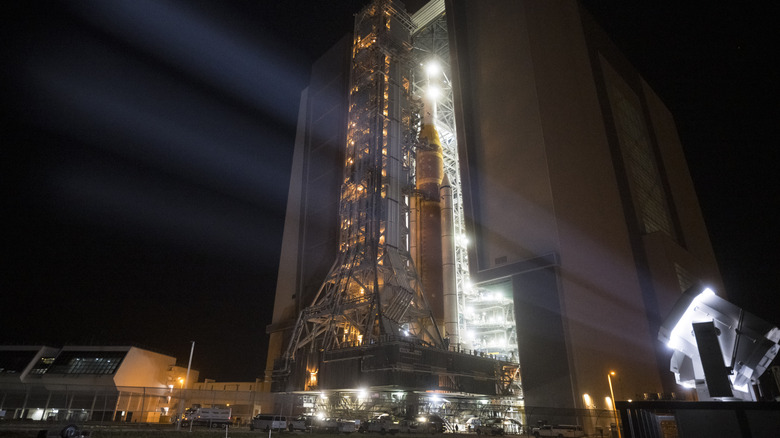
Ever wonder how the National Aeronautics and Space Administration's towering rockets get from parts to pad? It's a process. On the one hand, you've got the massive barge NASA uses to ferry core stages and rocket components about on American waterways. Then you've got the space administration's 6.6-million-pound Crawler-Transporter 2 and its ability to move completed rocket systems at an astonishing 1 mile per hour. That makes it the heaviest self-propelled ground vehicle in the world — an achievement in of itself. But those rockets — including the Space Launch System used in the recent Artemis II mission around the moon – had to be built somewhere before they could be transported. And the place they were made in has broken quite a few records of its own.
The location in question is NASA's Vehicle Assembly Building (VAB), a monolithic structure in the otherwise-swampy landscape surrounding Kennedy Space Center in Eastern Florida. The VAB is recorded as the tallest single-story building in the world and one of the largest buildings by volume. It seems like a strange claim to fame, but there's a good reason for the cavernous Floridian edifice. In short, the VAB was used for the creation of some of history's most impressive rocket systems, from the Saturn V to the SLS. And now, the VAB will continue its work as NASA plans its return to the moon – and, ultimately, mankind's first visit to Mars.
Over 60 years of building big, bad rockets
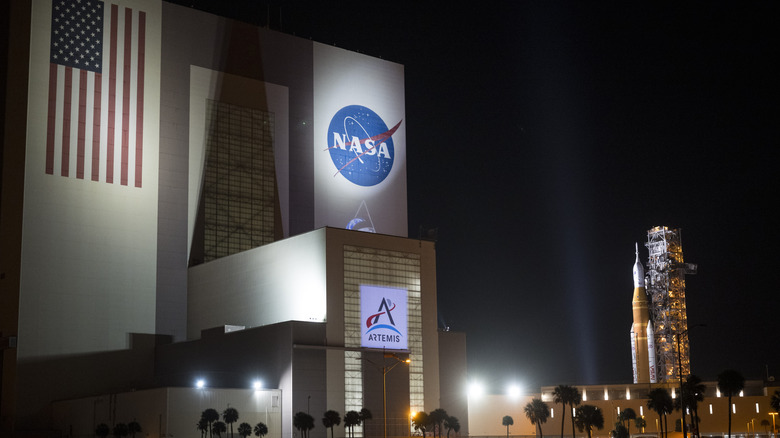
The VAB has been in the business of building rockets for quite some time. The last of the mighty single-story structure's support beams went into place in 1965, but the interior work platforms weren't finished until the following year. Since its initial construction, the assembly building has hosted the Apollo, Skylab, Space Shuttle, and now the Space Launch System and Orion spacecraft. And constructing one of the world's largest structures by volume is easier said than done.
It took 98,590 tons of steel to create the frame and 65,000 cubic yards of concrete to complete the monstrous, boxy building. It's got something of a basement, too; under the visible portion of the VAB, a support base plunges 164 feet into the bedrock beneath using 4,225 individual steel pilings. Four "high bays" reside inside the massive exterior, each accessible through doors measuring 456 feet in height. Those doors continue the trend of breaking records, as NASA says they're the "largest in the world" – and they apparently take 45 minutes to open.
To give you an idea of just how monstrous the VAB really is, the Statue of Liberty is 151 feet and 1 inch tall, or 305 feet and 1 inch tall counting its mighty pedestal. The VAB, on the other hand, is 525 feet tall. You could fit nearly three and half of New York's famed statue (without its pedestal) stacked on top of one another in the VAB.
NASA's VAB has been a huge part of getting to the moon, and now Mars
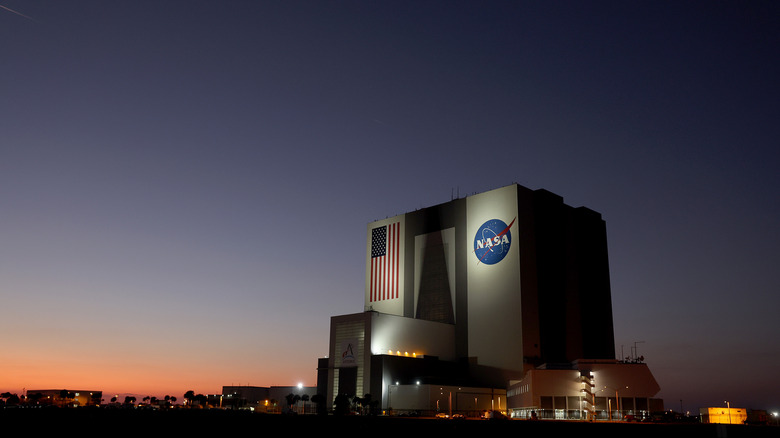
The imposing NASA structure needs all of its 130 million cubic feet of space for the creation of groundbreaking rocket systems. This includes the iconic Saturn V, the instantly-recognizable Heavy Lift Vehicle that took Apollo astronauts to the lunar surface. NASA assembled that 363-foot rocket system in the VAB before slowly moving it to the launch site. More recently, the giant single-story building and its four high bays hosted the SLS.
And things aren't stopping there. SLS components for the Artemis III mission have already traveled to the VAB in anticipation of a 2027 launch. If that wasn't enough to raise the blood pressure of die-hard nerds and fair-weather space exploration fans alike, the SLS will support Orion, the "next-generation spacecraft" that NASA claims will land humans on Mars. The Space Launch System is the super heavy-lift rocket system that recently launched the Artemis II astronauts on a voyage to the moon for the first time in 50 years. NASA says that the Artemis missions, and the VAB-built SLS, is vital to the eventual crewed missions to the Martian surface.
The space administration is currently working on a plan to send astronauts to Mars in a two-year mission using the next generation of advanced propulsion systems previously hosted by the VAB. The Mars missions also depend on the sort of testing NASA is looking to conduct on the lunar surface following a successful Artemis IV landing. And none of these plans would be possible without the meticulous assembly at NASA's rocket-building behemoth.