

Does It Pay To Switch To Cheaper E85 Even Though Mileage Drops?
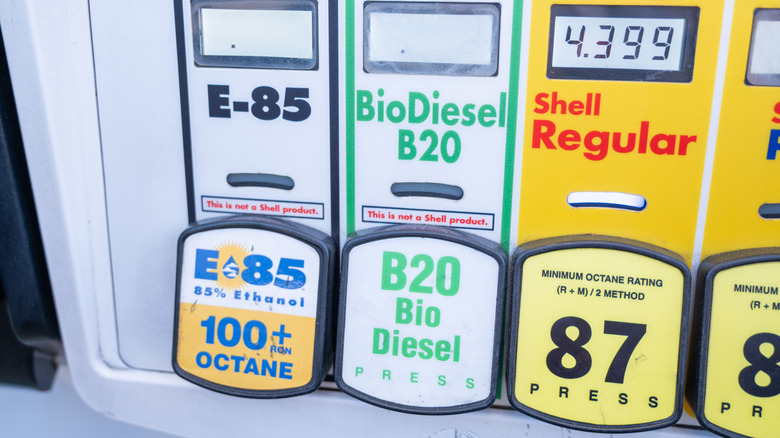
Most gas stations sell regular 87 with 10% ethanol blended in — a type of alcohol primarily sourced from corn. Speaking of corn juice, there is also the E85 flex fuel.
Although E85 has its pros, including being typically cheaper than gasoline, one of its most talked-about disadvantages is how it negatively affects fuel economy. And since gas prices are soaring, you might be wondering if the cheaper E85 makes sense despite the mileage drop and whether the math actually works out. The quick and simple answer is yes, but only if the E85 discount is large enough to offset the drop in fuel economy.
Let's use a 2026 Chevrolet Trax – which comes with a 1.2-liter flex-fuel-compatible engine, to better understand the concept. We'll plug in its fuel economy numbers as per the EPA and do a bit of math using the gas price statistics from AAA. As of this writing, AAA reports the national average for regular gasoline at $4.07 and E85 at $3.14, which means the latter is about 23% cheaper than regular gas. According to the EPA, the 2026 Chevy Trax gets 30 mpg combined when on regular pump gas, while that number becomes 22 mpg when E85 is used, translating to a roughly 27% drop in gas mileage. In other words, it'll cost you $13.57 to drive 100 miles in the Trax using regular gas and $14.27 on E85.
Understanding the mileage drop
A gallon of ethanol has less energy content than a gallon of pure gasoline, with the U.S. Energy Information Administration estimating the delta to be around 33%. A gallon of regular gas has approximately 114,100 BTUs worth of energy, and E85 has about 81,800 BTUs, which means you'd need about 1.39 gallons of E85 to replace the energy you'd get from one gallon of regular gasoline. Ergo, more fuel is required to deliver the same amount of energy and, therefore, travel the same distance. In our Chevy Trax example, the EPA reckons it can travel 396 miles on a full tank of regular gas — that drops to 290 miles on E85.
As mentioned previously, the math changes if you live someplace where the E85's cost delta is much higher than the drop in efficiency. According to E85 Prices, some states have price spreads of over 30%, with one Chevron gas station in California (Cherry Avenue, Fontana) selling E85 for $2.15 when E10 is around $5.89 per gallon — a spread of roughly 63%.
But the E85 discussion isn't just about gas mileage. Engines can be adapted to utilize E85's higher-octane rating, which is the fuel's ability to resist knock, thereby allowing OEMs to run higher compression ratios and boost pressures to extract more power. This is how the Dodge Demon 170 manages 1,025 horsepower and 945 pound-feet of torque, compared to 900 hp and 810 lb-ft on regular pump gas. Of course, you shouldn't simply pour E85 into a vehicle that's not designed for it, since this can cause significant engine damage.