

Why It's Expensive To Insure EVs (And Why It's Getting Cheaper)
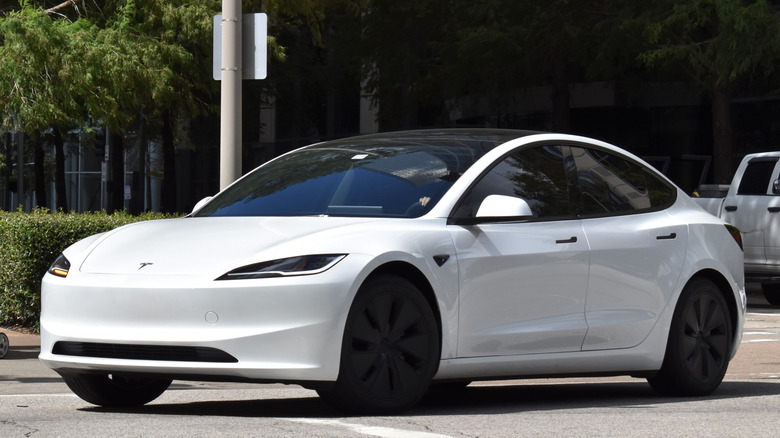
If you have paid even the slightest attention to the developments, you already know that rising gas prices caused by the war in Iran are driving global demand for electric vehicles (EVs). While this might seem convenient, any savings from going electric could potentially be offset by huge insurance premiums. An analysis by Insurify has shown that, on average, insurance for electric cars costs $3,159 per year — an extra $941 over gasoline models, which average $2,218. This reaffirms something we've known for a while, but the question of why electric car insurance is so expensive remains.
One reason is that EVs have more expensive repair costs than gasoline cars, and much of that has to do with the batteries, which are the most expensive component. This, along with their higher purchase prices, means EVs are more expensive to repair or replace in the event of a claim. Previously, Jalopnik reported on BMW i3 owners paying too much for battery replacement out of warranty, with some owners confronting bills ranging from $30,000 to $71,000.
An additional factor for EVs being more expensive to insure than their gasoline counterparts comes down to their performance. EVs can generally accelerate more quickly and abruptly than their gasoline counterparts due to their instant torque delivery – some of the quickest EVs can reach 60 mph in under 2 seconds. Such insane speed increases the risk of being involved in a severe accident, so insurers raise premiums to cover those astronomically expensive repair bills.
EVs are starting to narrow the cost gap to gasoline-powered cars

That said, EVs may not stay a lot more expensive to insure than internal combustion-engined (ICE) cars for long. While Insurify's analysis showed EV owners are paying 42% more for car insurance than owners of gasoline cars, the vehicles included in that study had a median age of 11.5 years. When it comes to 2024 model-year and newer vehicles, though, the cost difference narrows to 18%. Insurify confirms that insurance costs for electric cars are, in fact, now falling faster than the average for gasoline cars in the same period. It found that average insurance costs for newer EVs have fallen by 11.1% over the last year, as compared to a decrease of 7.7% for ICE cars.
The site attributes this to the use of advanced driver assistance systems on the newer cars. These features help improve safety, reduce accident rates, injuries, insurance claims, and repair costs for contemporary vehicles. Currently, there's a shortage of qualified EV technicians, which has resulted in servicing and repairing damaged electric cars taking longer compared to gas-powered vehicles, especially since EVs have various components and systems that require specialized attention. Therefore, it is plausible to assume that the gap will narrow further if and when expertise in EVs and battery technology improves and more people make the switch to electric cars.
The price gap between EV and gasoline cars insurance is wider in some states than others

Your state and location can significantly impact the cost of your car insurance, too, and, when comparing insurance costs for EVs and gas-powered cars, nowhere is the gap more stark than in Massachusetts. Insurify's data suggests that, on average, insuring an electric car in the Bay State costs 54% than an ICE model — $3,560 per year compared to $2,318. It's a similar case with New York, where the cost difference is up to 45%. Completing the top five states with the widest insurance cost gap for EVs versus gas-powered cars are Rhode Island (39%), Oregon (36%), and New Jersey (36%).
At the opposite end of the scale, Montana and West Virginia are the states with the lowest insurance cost difference between EVs and ICE cars. As a matter of fact, in these two states, gas-run cars are 4% more expensive to insure than EVs. In West Virginia, for example, the average cost of insuring an EV stands at $2,062, while gas-engined cars cost $2,148. Meanwhile, Nebraska (-1%), Wisconsin (1%), and Ohio (2%) also have relatively narrow cost differences.