

Can You Make Sea Foam Motor Treatment At Home?
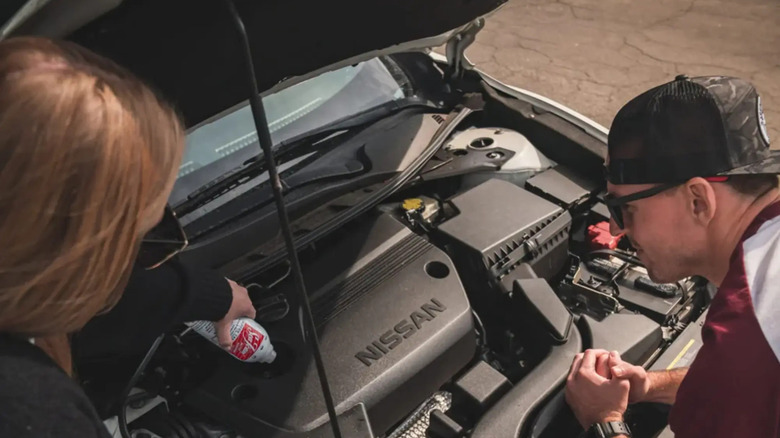
Think you're ready to dive into the world of questionable home brews? Let's start with what you need to know about Sea Foam Motor Treatment first. This additive is generally mixed with both fuel and oil in hopes of removing old residue from a car's most important systems. Marketing materials from Sea Foam specifically promise that the treatment can "prevent common engine problems."
Since Sea Foam is readily available for a little over $12, grabbing a bottle to test those claims isn't exactly an expensive proposition. Still, it's always nice to save a few bucks, and the additive's low cost hasn't stopped enterprising enthusiasts from attempting to reproduce the formula themselves. Luckily, these attempts seem to have worked out all right — but that doesn't necessarily mean you should drop everything to make something similar at home.
One such attempt from Gregory Hildstrom of Hildstrom Systems sought to recreate the product by reverse-engineering the listed ingredients and experimenting with homemade blend of diesel, naphtha, and isopropyl alcohol. A 4-2-1 ratio was eventually settled upon for the recipe, which is a ratio that others have arrived at while creating their own Sea Foam home brews. After completing his solution, Hildstrom reported slight running improvements after the solution was tested across two Land Rovers and two motorbikes, with the most notable difference appearing in older high-mileage engines.
A closer look at the home brew
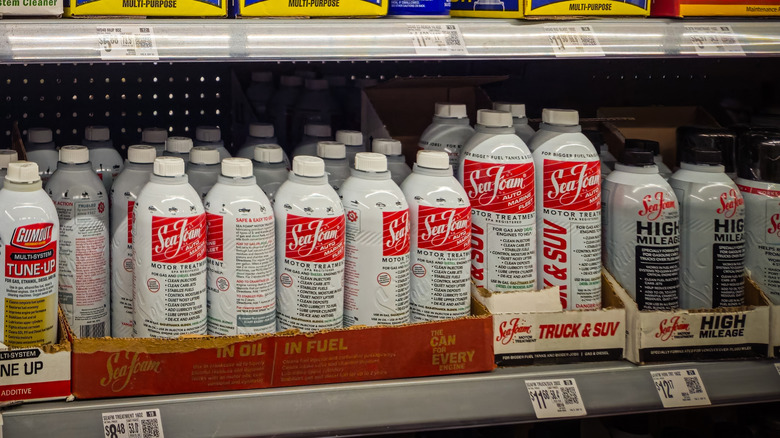
These homemade treatments aren't just guesswork. In fact, Sea Foam made things quite a bit easier by publishing the product's MSDS – Material Safety Data Sheet — online. This document doesn't list out every ingredient, but it does contain details on various chemicals used in the additive, helping to kick-start the creation of enthusiast recipes. What's more, Sea Foam technicians emphasized the simplicity of the product in a FAQ posted to their website, explaining that it's simply "a blend of three petroleum cleaning and lubricating oils."
Hildstrom's home brew write-up explains that he tried a 45-35-20 mixture first, but that the 4-2-1 recipe yielded better results. He also noted that this final recipe was easier to mix than prior efforts, but still fell within the ratios outlined by the MSDS. It might not have been a perfect match to the original, but Hildstrom writes that the mixture still had both a "similar composition" to Sea Foam and a "very close" ratio of ingredients.
Now for the interesting part — Hildstrom points to the official product coming in at $10 per pint, or $0.62 per ounce. The home brew, on the other hand, cost him just $1.36 per pint to make, which is about $0.09 per ounce. Of course, he wasn't able to prove its exact efficiency or capability, and other knockoffs aren't clear about whether homemade solutions could cause problems later down the line. So, for the safety of your vehicle and its critical components, it might still be best to stick with what you find on store shelves.