

The 5 Golden Rules For Buying A Used EV
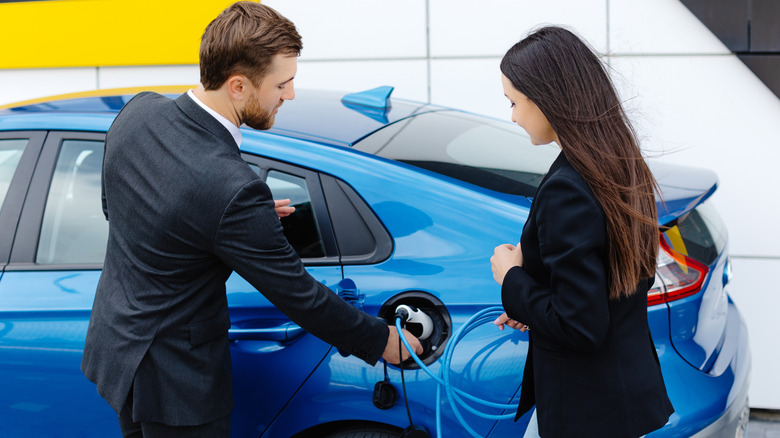
Two years ago, I came across a 2012 Nissan Leaf at an auction, put in a low-ball bid, and won. I was curious about EVs, and for me, the best way to learn is hands-on. Compared to what's on the road today, the first-gen Leaf would be Windows 95 if it were an operating system. However, it's hard to argue with buying a running, driving 12-year-old car for a staggering 4.5% of its original $38,100 MSRP (which included an $850 destination charge).
That $1,700 I spent opened my eyes to EV ownership, which I had previously only experienced through research or the occasional Tesla rental. Admittedly, my Leaf is far from perfect. Fully charged, the range is now about 73 miles, which is laughable in 2026. But the car serves as the family's backup vehicle and is surprisingly functional when the back seats are folded. It's also the kind of car that you don't care if it gets a scratch or ding — not quite an EV beater, but close.
Above all, this Leaf has served as my EV training wheels. Should I opt for another used EV in the future, I'll be much better prepared. I've boiled down my experiences and subsequent education into five areas — call them golden rules, if you'd like. These cover pre-purchase inspections (including battery health), insurance costs, charging requirements, warranty coverage, and depreciation. My Jalopnik colleague Collin Woodward has his own take in 5 EV buying tips I had to learn the hard way.
Get a pre-purchase inspection from an expert

Investing any kind of money into a used car should be accompanied by a pre-purchase inspection (PPI) — even more so with an EV. No matter your experience looking at conventionally powered used cars, electric vehicles are a brave new world. Factors like battery health, charging system functionality, and thermal management come into play.
As the engine and transmission are critical to regular cars, the high-voltage battery pack is crucial to an EV. A professional inspection can provide insights into battery degradation. Why does that matter? With traction batteries degrading at an average of 2.3% annually, a buyer of a 5-year-old EV could find the manufacturer's original promised range cut by 10% or more. A PPI report may also provide information about the frequency of high-voltage fast charging, which can accelerate degradation.
The typical neighborhood garage may be able to inspect the basics like suspension, brakes, tires, and body condition, but assessing anything connected to propulsion and charging requires an expert touch. Some independent shops may be able to provide this service, but an authorized dealer may be the best route. Expect to pay $200–$400.
Obtain insurance quotes first

Having learned from past mistakes, I usually get insurance quotes before putting something different in the driveway. I didn't do this with the Leaf, but I was fortunate; a decent liability-only policy can be under $40. As it turns out, this Nissan was the cheapest EV to insure when new. However, I wouldn't gamble on guessing insurance rates for a higher-priced EV that requires collision and comprehensive coverage.
High repair costs can make some EVs more expensive to insure, so it's better to find out before signing the paperwork. A 2023 Policygenius survey found that EVs cost about $44 more per month to insure than gas-powered cars. For example, the monthly premium for a Tesla Model Y is $248 compared to $167 for a Toyota RAV4; a 48% difference. The disparity may stem from the fact that some insurers would rather write off damaged Teslas than repair them. The study also points out the wide range of EV premiums across major insurers, with monthly rates ranging from $111 to $472. The average is $206. These all-over-the-place rates reinforce the need to get multiple insurance quotes.
Verify charging requirements
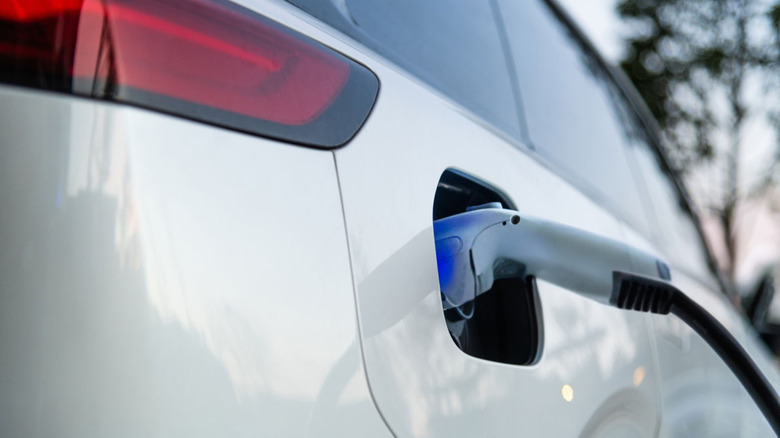
Determining where and how you can charge an EV should be top of mind when car shopping. That's because of all the different charging ports and standards. Tesla's North American Charging Standard (NACS) is being adopted by other manufacturers, but it's not the only option. The Combined Charging Standard (CCS) is used in EVs like the Ford Mustang Mach-E, and many General Motors (GM) products (some 2026 GM models come with a NACS port).
There's also the older CHAdeMO (CHArge de MOve) standard, which was used on first- and second-generation Leafs, among other models. Plus, many EVs have a standalone J1772 port, or one that's integrated into the CCS setup. NACS, CCS, and CHAdeMO standards are used for DC fast (Level 3) charging, while J1772 supports 120-volt (Level 1) or 240-volt (Level 2) charging. Adapters can create some cross-platform functionality, but compatibility varies.
Why does all this matter? Because if you're foregoing gas station convenience for the ability to plug in, you have to know where you can charge. In my case, I can charge at home or at a nearby grocery store that has a CHAdeMO station. I opted not to have a 240-volt charger installed at home because the Leaf isn't a daily driver. Have a charging plan in mind based on the EV you're buying. Is Level 1 sufficient, or would adding Level 2 capability be a better solution? For public charging, consider where it will be most convenient. Do you want to charge near home, work, or along a regular route? You'll also need apps that sync with the different charging networks.
Confirm warranty coverage
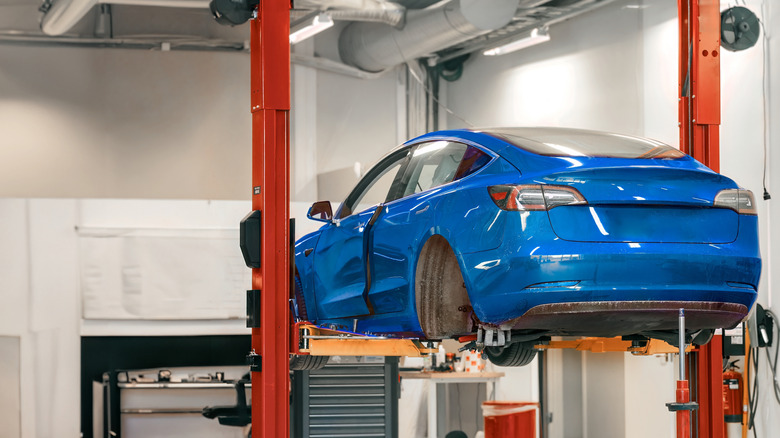
While replacing an engine or transmission in a conventional car isn't cheap, replacing a high-voltage battery in an EV can be much more expensive. Smaller packs in a Leaf or Chevy Bolt might be under $10,000, but larger batteries can run $20,000 or more. Given the potential risk of that size, a used EV buyer will have to decide whether they want a car with some remaining factory warranty coverage on the battery.
Coverage varies somewhat by manufacturer, but it typically runs from 8 to 10 years or 100,000–150,000 miles, whichever comes first. Tesla offers 8 years, but the mileage range varies by model (up to 150,000 miles). Ford and General Motors offer 8 years/100,000 miles, while Hyundai extends coverage to 10 years/100,000 miles. Coverage includes the high-voltage battery and may be extended to connected EV drivetrain components, depending on the manufacturer.
For many brands, 70% is the battery capacity threshold. If the battery drops below this benchmark during the warranty period, then the manufacturer may repair or replace the battery. It's always a good idea to verify with the manufacturer which remaining coverage applies and which portion of the warranty continues with subsequent owners. Just call the automaker's customer service department with the car's vehicle identification number (VIN).
Be ready for depreciation uncertainty

Admittedly, I got lucky with my auction bid. Equivalent EVs were selling on Facebook Marketplace at around $3,000 and at dealers for around $5,000. Two years later, and used EV pricing is still a wild ride. So, you'll need to hold on, especially if you're planning to buy one with the hope that it retains some value later. An iSeeCars study shows that EVs consistently lose 10%–15% more in value than the industry average for conventional automobiles.
But that's just a starting point. Automotive News reports that 800,000 off-lease EVs will hit the market over the next two years, introducing more price uncertainty. Many of these cars were leased when federal tax credits helped subsidize costs. Half of these vehicles will be returned with residual values below market value, according to the article.
Manufacturers will have to eat the difference. The big unknown is whether this situation will further drive down EV prices once those lease returns enter the used car market. Automakers could dump the cars to get them off their books, or slowly release supply to moderate the impact. However, that latter approach means sitting on thousands of cars that continue to lose value every month. At the moment, the crystal ball is very foggy. A used EV bargain now could become anything but in the next year or two.