

2026 Aston Martin DB12 S Turns Up The Volume
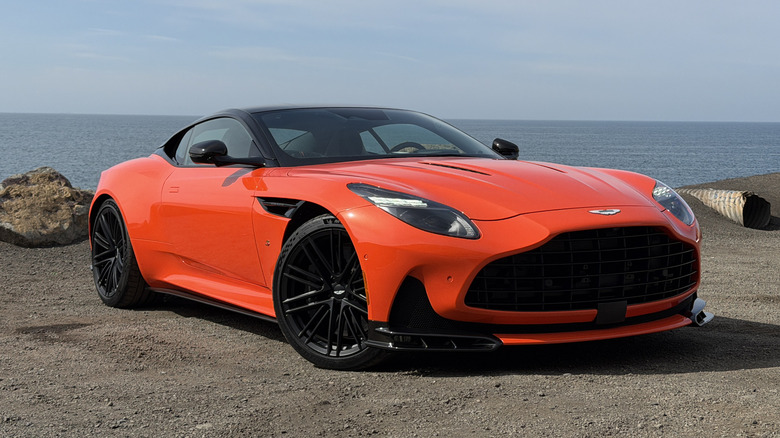
I've been living in Los Angeles for nearly six years, and ever since my first week here my favorite thing to do is go for a drive along the Pacific Coast Highway through Malibu. Even if the sky is grey and I'm in a boring car, cruising that winding route with the ocean by my side is always freeing. It clears my mind, improves my mood and sparks my creativity, with a bonus of being host to some of the best driving roads in the country. Some cars are much better than others at a weekend drive on PCH, though, and being behind the wheel of a bright orange Aston Martin DB12 S on a sunny day, it's hard to think of something greater.
The formula here is the same as in the DBX S and Vantage S: Aston made a bunch of little tweaks to the DB12's powertrain, chassis and styling that result in a car that's a bit shoutier and more engaging. On the canyon roads above PCH it's not quite as sharp or sporty as its Vantage S sibling, but the DB12 S makes up for that in increased grand touring ability, and perhaps an even greater visual punch — at least when you've got a color scheme as absurd as the one on my test car.
Full disclosure: Aston Martin gave me the keys to a DB12 S for an afternoon so I could drive it from Westlake Village to Malibu and back.
Plenty of power
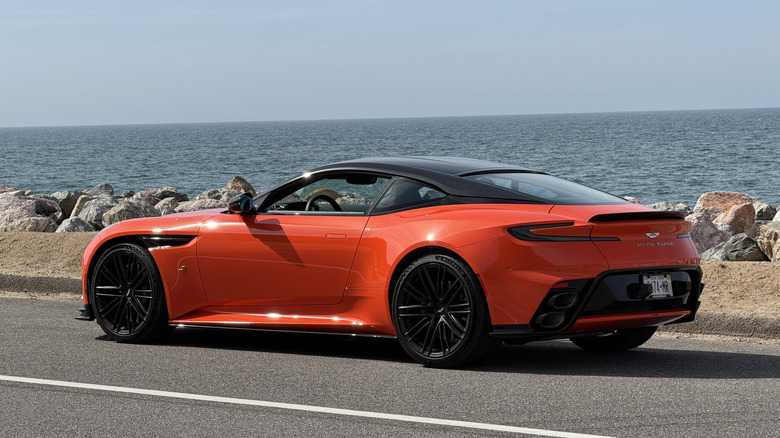
Under the DB12's very long hood is the same Mercedes-AMG–derived twin-turbo 4.0-liter V8 that's in every other Aston save for the Vanquish. It's now got 690 horsepower, an increase of 20 horses over a standard DB12 and 19 more than the Vantage S, with torque staying the same at 590 pound-feet. (The ridiculously good DBX S has them both beat with 717 hp and 664 lb-ft.) Aston says the DB12 S will hit 60 mph in 3.4 seconds, a tenth quicker than the DB12 but a tenth slower than the Vantage S, and 100 mph arrives in 7.0 seconds.
This isn't really a "numbers" car, though. It feels both quick and fast, of course, but not noticeably more so than a normal DB12. Much more important is how Aston increased the accelerator's responsiveness, giving it a specific drive-by-wire throttle mapping and a more progressive feel to the pedal. Combined with shift times that have been reduced by more than 50% and other shift calibration changes, the powertrain is definitely more reactive to driver inputs and more satisfying to wring out.
 Daniel Golson/Jalopnik
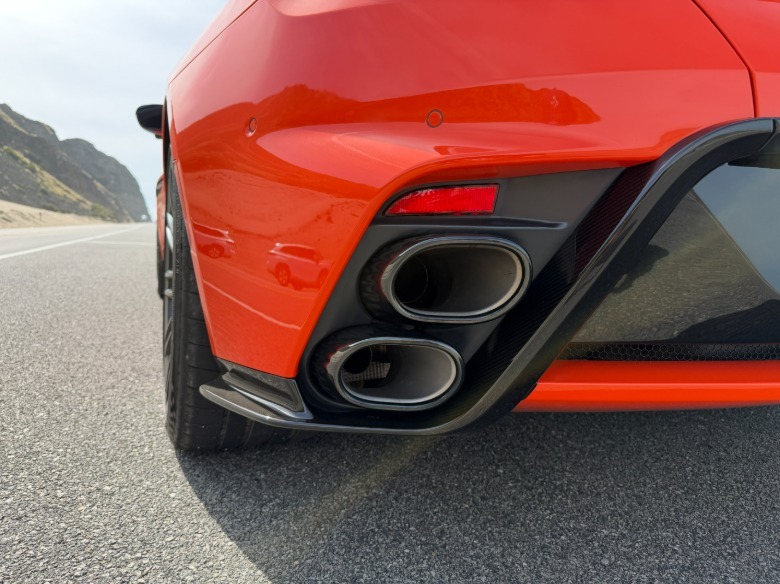
What really ups the drama is the new exhaust setup fitted to the S. Instead of the DB12's fairly subtle pair of round pipes, the DB12 S gets two rectangular exhaust tips stacked on top of each other in each corner of the bumper. This active stainless steel system has a much deeper bass than the base car's, and it sounds awesome. It's got a more hearty bellow tone than the Vantage, and it'll make plenty of barks and pops and bangs. Sadly my test car doesn't have the optional titanium exhaust, which saves 26 pounds of weight and increases not only overall volume but the bass, mid and treble.
S is for sharper
Even though Aston slashed gearshift times, the 8-speed automatic transmission is my biggest problem with the DB12 S. Its programming is pretty good, but it's not as eager to downshift on its own as I'd like. Redline comes at you really fast in second gear, so even in fairly slow corners you have to go into third, which then feels a bit sluggish. Don't get me wrong, this car will blast out of a corner, the gearing just isn't as suited for canyon carving as in the Vantage. This isn't so much of a problem on roads made up of longer sweepers, like on Mulholland.
The DB12 already was a big upgrade over the DB11 in terms of handling dynamics, and the S takes the chassis a little further. Its rear anti-roll bar is 7% stiffer, the steering and electronic rear differential have been recalibrated, the Bilstein DTX dampers have better pitch and roll control, and the camber, castor and toe have been changed. Turn-in is more precise, the car rotates more easily around tight turns, and the handling feels a little more balanced and neutral overall. This isn't an outright sports car, but it's fun, and it feels more agile than you'd expect given the car's size. Buyers of the DB12 S will be more than pleased when they decide to go for a weekend rip in the canyons.
 Daniel Golson/Jalopnik
They'll be pleased when they have to step on the brakes, too. Large carbon-ceramic brakes are standard, which allowed Aston's engineers to more finely tune the suspension setup. New software makes the car more stable when trail braking, and the rear-axle torque vectoring is more predictable and consistent. There's no annoying sounds or fade from the brakes even after a day of pretty hard driving, and they're easy to modulate around town.
The default drive mode is GT, with Sport and Sport+ each adding more layers of performance and sporty character. Aston made the differences between the drive modes more stark, and it does feel very intense in Sport+. In their softer settings, the Bilstein DPX dampers provide a fairly smooth ride fitting of a big luxury coupe, and it doesn't get too choppy or rough even in the stiffer setting. It's quiet inside at freeway speeds, the seats are very comfortable, and the interior feels really high quality. Gliding along PCH on a sunny day, making use of that more-responsive gas pedal and louder exhaust every so often, the DB12 S feels right at home. It's much calmer when cruising than the Vantage, which is basically always "on" — its base drive mode is Sport.
It deserves a spec like this
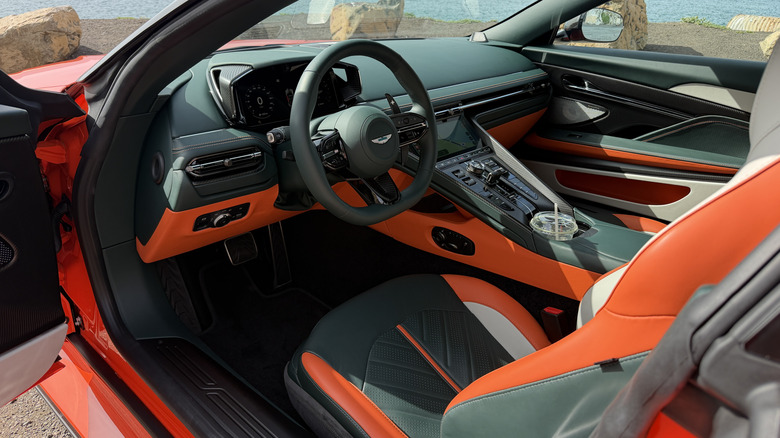
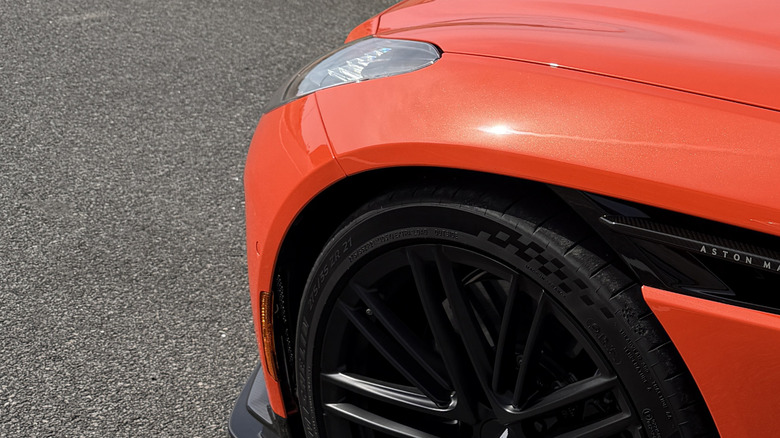
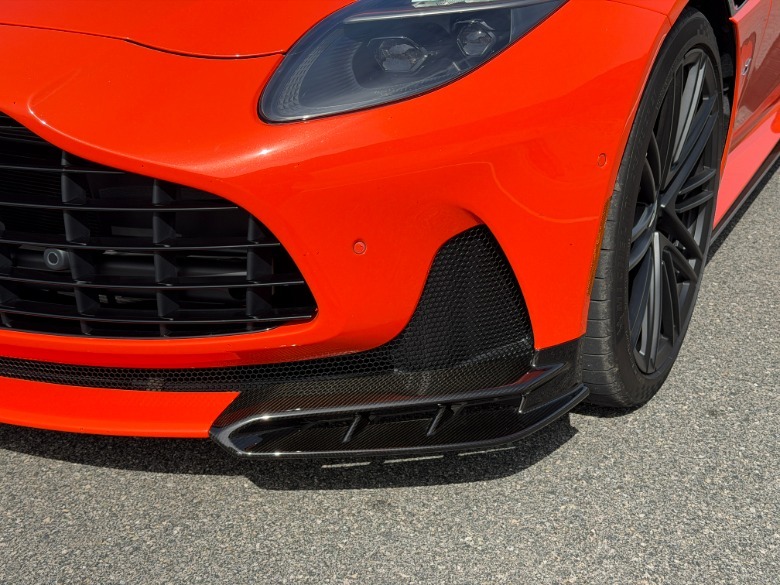
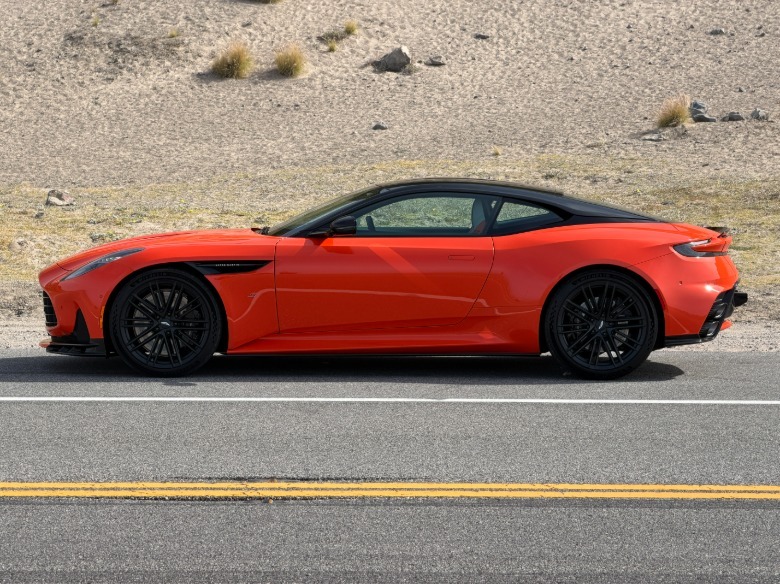
Not much visually distinguishes the DB12 S from the base car, but the DB12 is already a phenomenal thing to behold. There's a more complex front splitter, new hood vents that extract more air from the engine, a lower side skirt, a redesigned diffuser holding the stacked exhaust, and a fixed spoiler. All of those changes are apparently functional, improving aerodynamics or reducing lift. You also get enamel S badges on the front fenders, and unique embroidery and logos inside that are both embossed and debossed.
And man, can we talk about this spec for a moment? The exterior color is called Synapse Orange, and it costs $9,700. For how good it looks in the sunlight, and for how many looks I get in it, I'd say it's worth it. This car also has $16,000 in twill carbon-fiber trim on the lower parts of the exterior and $13,300's worth on the upper parts, with the carbon roof being another $6,700. The gloss black grille is a comparative bargain at $800, but the center of the rear diffuser being matched to the body color? That'll be $7,200.
 Daniel Golson/Jalopnik
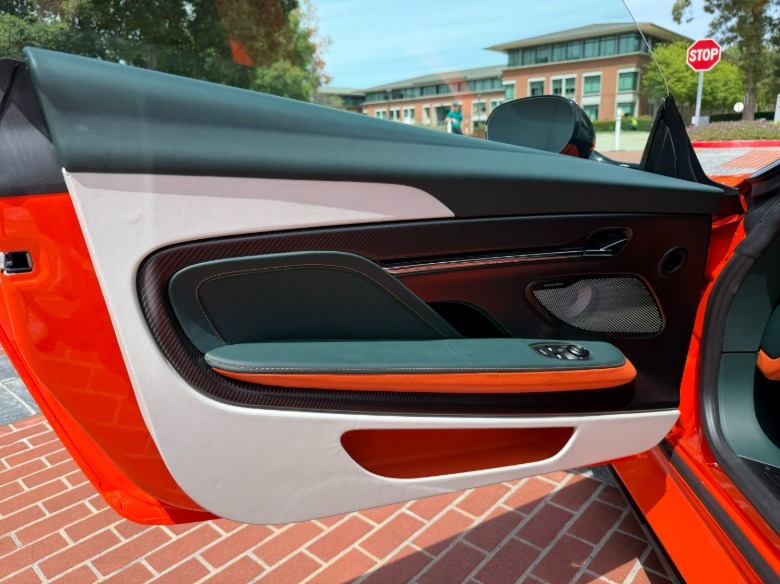
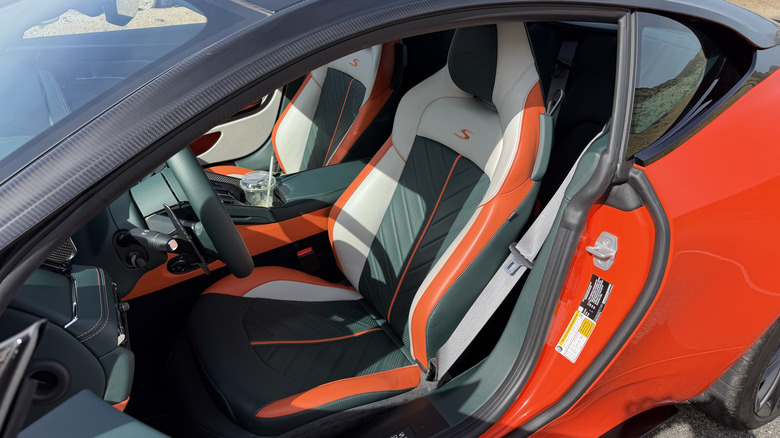
Inside is where Aston's PR team really went wild with the spec. Going for a tri-tone leather scheme adds $11,200 to the sticker, with the three colors here being Californian Poppy, Forest Green and Light Argento Metallic. The Poppy sections added $6,400 to the sticker, and the Obsidian Black carpets another $2,400. Aston Martin's latest interior designs look fine in darker colors or more muted tones, but an outrageous scheme like this is so much better, and the S-specific color split is very cool. I don't mind the carbon-fiber trim inside ($10,800), as the pieces are thin and well-sculpted, though wood trim would look even cooler.
Worth the upgrade
As with the other S models, it feels like an easy choice to go with the DB12 S over a regular DB12 because it's not much more expensive in the grand scheme of things — the DB12 S starts at $272,000 before any added charges, which is just $10,000 more than the base car. Those carbon-ceramic brakes cost $14,400 on a normal DB12, so those being standard alone make the S a bargain. You do have to give up $4,000 for destination and $1,000 for a gas-guzzler tax, and the window sticker also shows an "import costs" line that's a whopping $23,100. With all of the options included, my test car comes out to a cool $400,300.
That's a lot of dough, but it's about in line with its main competitor, the Bentley Continental GT. The Bentley is probably the better overall car, and maybe even sportier than the Aston. Its gorgeous looks are out-gorgeous'd by the DB12, though, especially in such a superhero-like color scheme. The Aston has more flair and sense of occasion than almost any other front-engine GT, and that certainly counts for something. A more reasonable DB12 S spec, without all of the unnecessary carbon fiber, would probably be around $325,000, a much easier pill to swallow.
 Daniel Golson/Jalopnik
Pitting the DB12 S against the Vantage S — I drove both within a couple months of each other on almost the exact same route — the two cars feel like they're for different people and purposes despite being so similar under the skin. The Vantage is more exciting all of the time, a real focused sports car, while the DB12 has the drama and breadth of ability you want from a GT. I don't think they'd be out of place in a garage together, either. The Vantage is much cheaper, starting at under $200k, but for the people buying Aston Martins, I don't think it really matters whether or not the DB12 S is "worth" the extra 70-ish grand over its sibling.
What matters is how the DB12 S makes you feel when you see it (and are seen in it), the excited shiver up your spine when you rev the engine, the smile it elicits when you whip around a corner. With this new variant, Aston Martin turned up the volume — in terms of visual impact, driver engagement, and of course literal volume — to great effect. On a perfect day driving on the perfect road, the DB12 S feels special, and that's why you want a car like this.