

2027 BMW 7 Series Gets A Facelift That Would Make Any Beverly Hills Plastic Surgeon Jealous
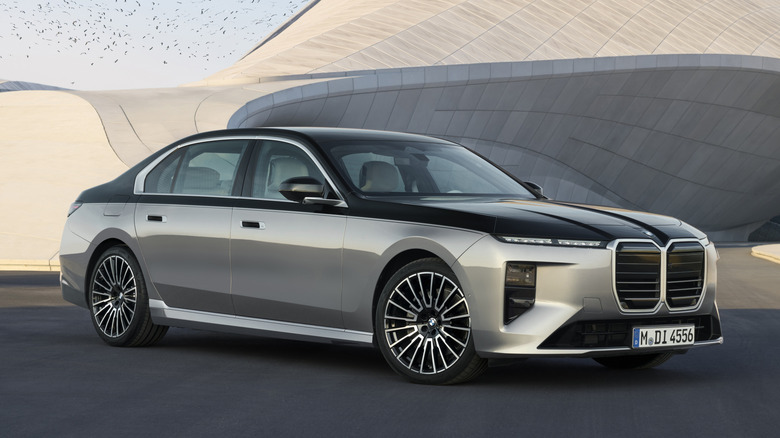
People had a lot of feelings about the G70-generation BMW 7 Series' face (and overall design) when it was revealed in 2022, perhaps even stronger feelings than even for the E65 in 2001. Its looks are controversial, sure, and it's the most technology-forward 7 yet, but the G70's polarizing attributes have only been a good thing: For basically the first time since the Bangle-era car went out of production, this generation of 7 Series has seen sales increases in the U.S., helped in part by the electric i7 model.
That's not just because BMW's customers have been Stockholm Syndrome'd into liking the recent big grilles and weirder styling, but because the current seventh-generation 7 Series is really freaking good. But BMW is already zooming into the future with its new Neue Klasse platform, which has so far spawned the iX3 crossover and i3 sedan. Some of the automaker's model that aren't quite ready for a next-gen redesign yet are getting facelifts that, while not using the Neue Klasse platform, are gaining new styling and other improvements from the Neue Klasse cars.
The first of said facelifts to be revealed is the 7 Series. BMW has given the front end a total overhaul, and while it still has split headlights and huge kidney grilles, it's a very successful redesign that I think looks badass (and I already liked how this 7er looked). But more importantly, the 2027 7 Series has a redesigned interior with BMW's new Panoramic iDrive, and the i7 EV gets new battery chemistry and motors, among a host of other improvements throughout the lineup. BMW says this is the most extensive model update it's ever done, which is the same thing Mercedes-Benz said about its new facelifted S-Class, the 7 Series' biggest competitor.
That's more like it
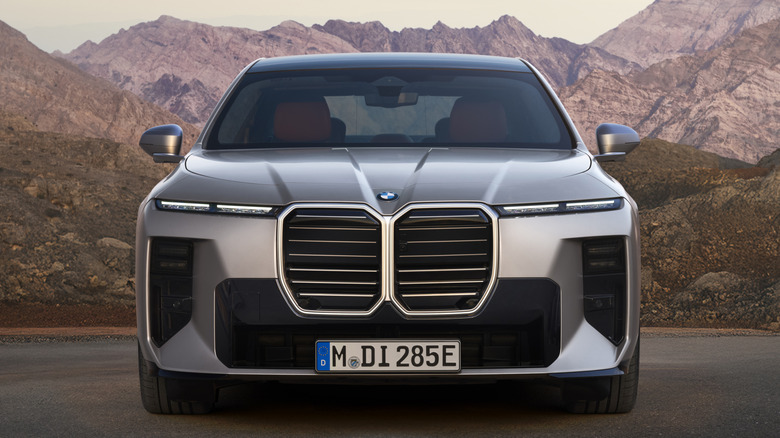
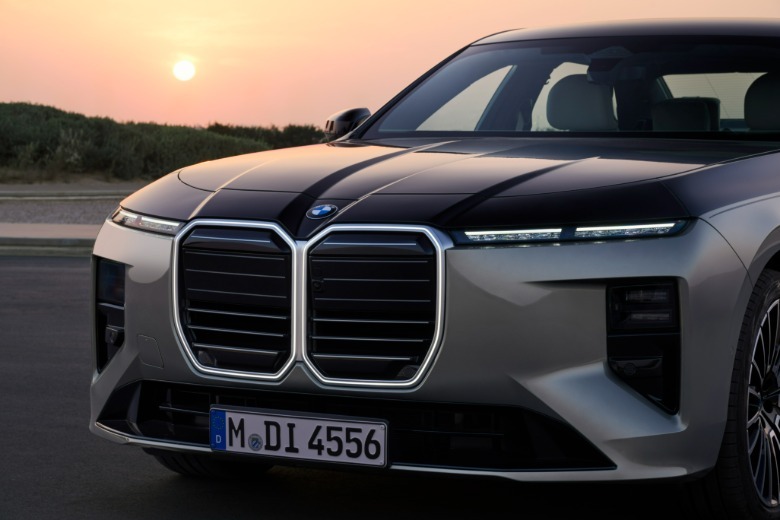
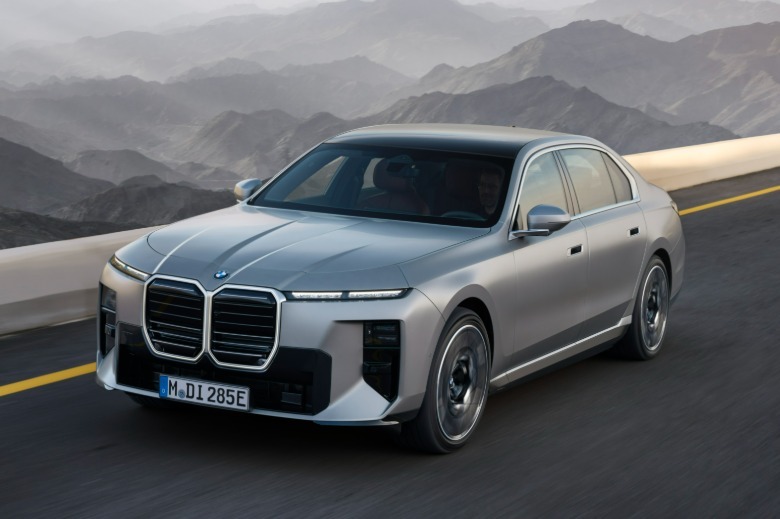
Right, let's start with the front end. The 7 Series' kidneys are now taller, narrower, and shaped more like old BMWs' grilles, with more subtle horizontal vanes within. While the chrome surround of the kidneys still meet in the center, luckily the ambient lighting surrounding the kidneys are now fully separated, a big improvement over the blank space of the outgoing model. The upper LED running lights are thinner and connect to the grille surround, and the headlights below are now smaller and more vertically oriented, and thus less noticeable at a glance. Those eyebrow lights are available with 12 diamond-cut crystal glass segments per light, that sparkle in the sun and are backlit by LEDs.
 BMW
BMW
The front bumpers are also simpler and more angular in design, whether you go for the normal styling (the two-tone car in these photos) or one of the M Sport packages (the silver car) that gives it a blockier look with larger intakes and headlight surrounds. Flowing off the kidneys are more prominent hood bulges that I think look quite cool. It's all very Robocop, but definitely cleaner and more cohesive before. Cameras, radar sensors and washer nozzles are all hidden in the kidneys. In addition to welcome animations, you can get a Ceremonial Light Carpet that uses 194,000 pixels integrated in the door sills to project animated graphics on the ground.
You can get dual-finish paint
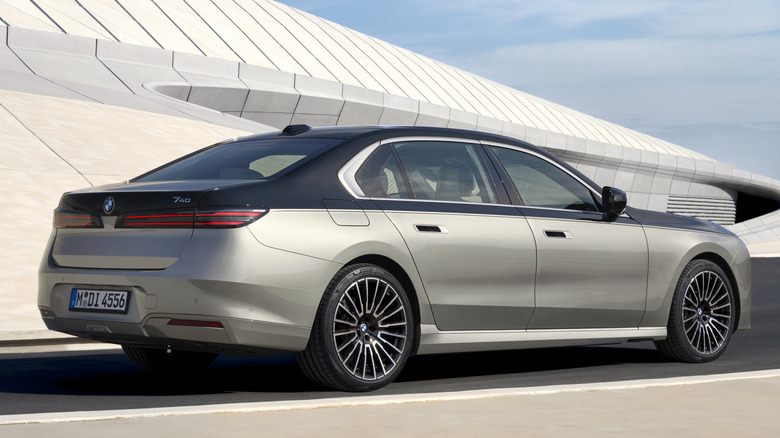
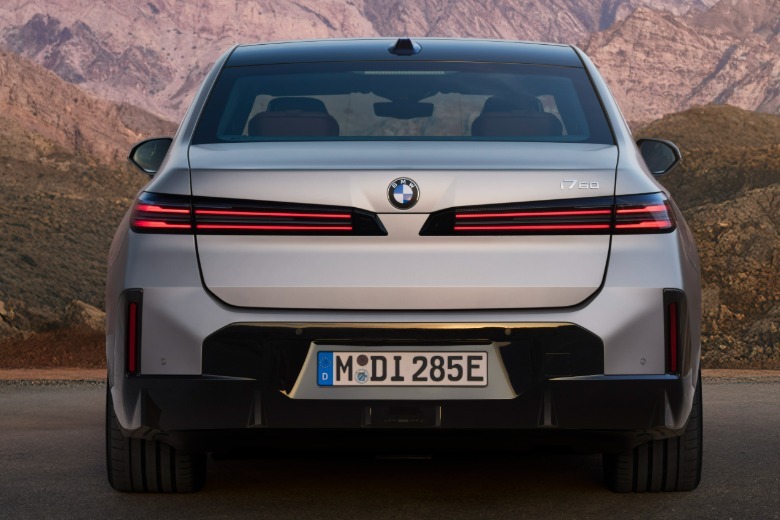
From the front fenders all the way to the rear quarter panels, the 7 Series' body surfacing and greenhouse are exactly the same as before, aside from tweaked side skirts. Okay, there are also new side mirrors and redesigned recessed door handles, but would you have noticed if I didn't say anything? The rear end has undergone big changes, though. Slimmer taillights now stretch nearly to the center of the trunk, with a new twin-line design that incorporates chrome strips and smoked glass. Hidden in the black sections of the lights are the backup camera, its washer nozzle and the lock button for the trunk. The rear bumper designs are new and nicer, as well.
 BMW
BMW
BMW already offered two-tone paint on the G70 7 Series, but both colors were the same finish, which is still too boring. The new Individual Dual-Finish paint combines matte and metallic paints with "no noticeable transition point" where they meet, and a hand-drawn coach line between them. Here's what BMW says about the paint:
BMW Individual Dual-Finish paintwork represents the pinnacle of what is currently possible in painting techniques. Experts have spent two-and-a-half years developing this innovative technology, which can only be used at BMW Group Plant Dingolfing and is only available for the BMW 7 Series. More than 20 specially trained employees are involved in a complex process in which the car is prepared manually for each of the 12 steps in the painting process. Among the tasks they carry out are taping the car by hand and sanding down the body to prepare it for the manual painting process. These jobs alone account for nearly half of the work time. Each car ordered with a BMW Individual Dual-Finish will spend more than 75 hours – i.e. over three full days – in the paint shop. This is almost six times longer than for a conventional paint finish.
Overhauled inside too
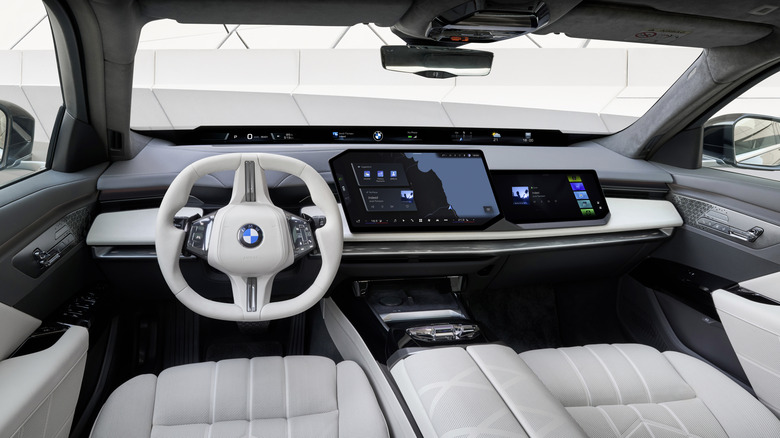
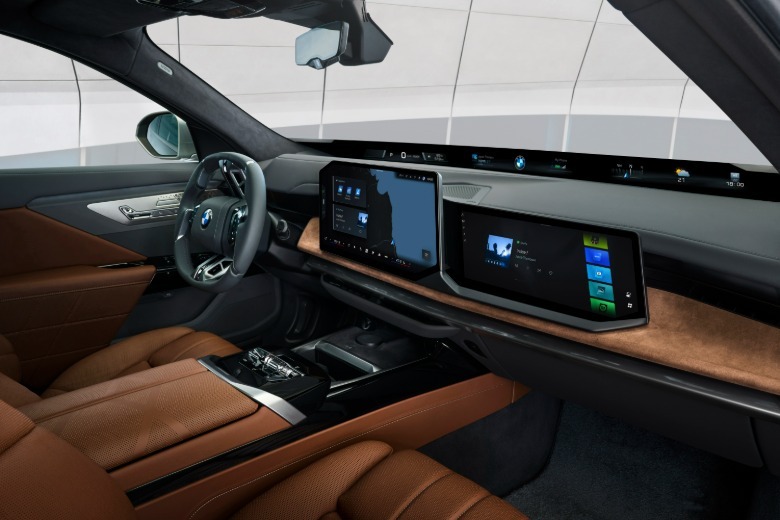
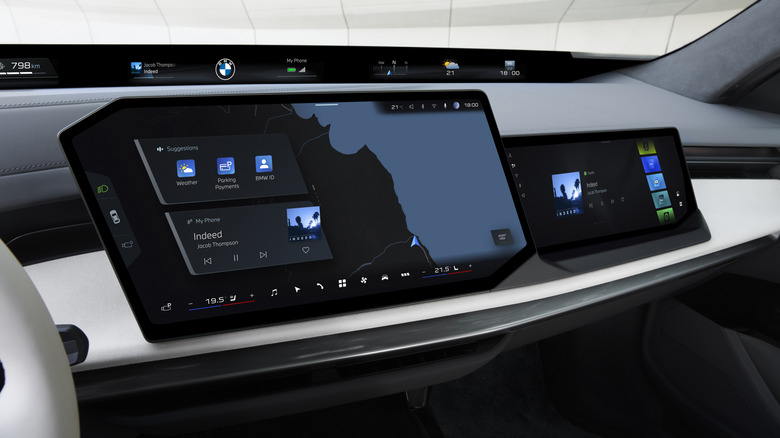
The Neue Klasse cars debuted the Panoramic iDrive system running BMW's Operating System X, which uses a projected Panoramic Vision display spanning the entire base of the windshield instead of using a gauge cluster, and a 17.9-inch central touchscreen with a rhombus-shaped "free-cut" design. BMW has given the 7 Series a totally new dashboard that gets both of those items, and as standard it's got the first iteration we've seen of a passenger display for this new system, a 14.6-inch unit that also has a free-cut design. Other new design features include a funky steering wheel with spokes at 12 and 6 (there are five different designs in total), a reworked center console that has a crystal shifter, and new door panels with better-organized controls, like the crystal units for the seat adjustment.
 BMW
BMW
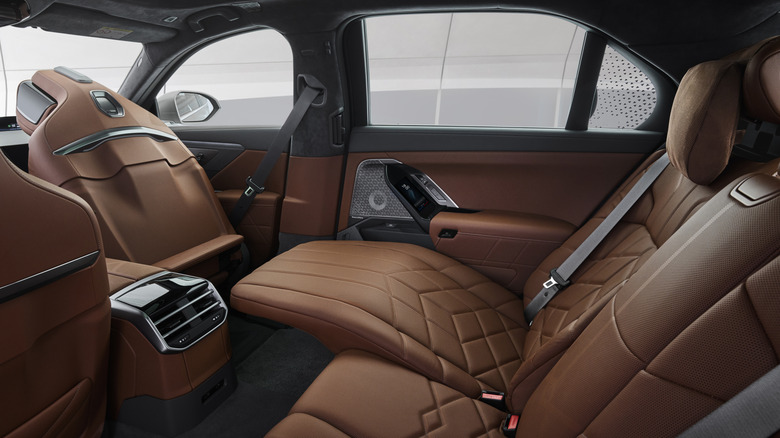
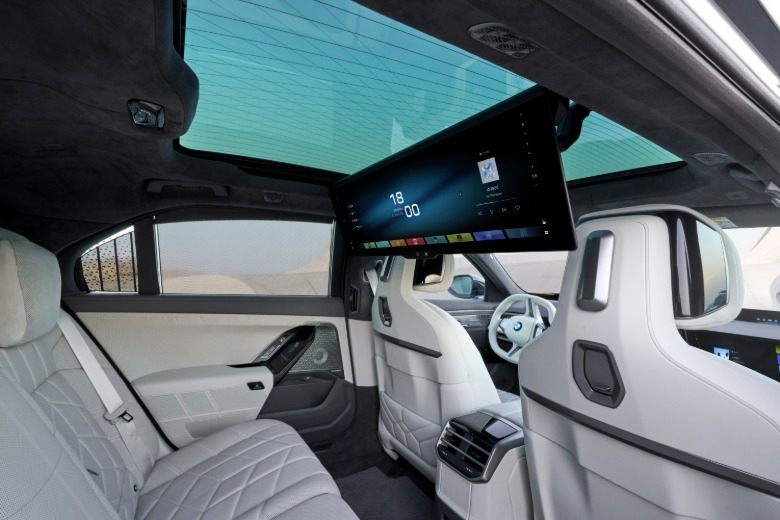
BMW didn't change much about the 7 Series' back seat, but it didn't need much changing. The optional 31.3-inch 8K Theater Screen that flips down from the ceiling now has a camera so you can make Zoom calls, and an HDMI port to easily plug in computers or gaming consoles. The also-optional 36-speaker Bowers & Wilkins Diamond surround sound system now has Dolby Atmos integration and surround speakers built into the headrests, and the touchscreen control displays in the rear door panels have been updated. The front seats come standard with ventilation and nine massage settings, which the rear seats can also get, but you really want the Executive Lounge package that adds an integrated leg rest for the right-rear passenger, a heated armrest and other niceties.
 BMW
BMW
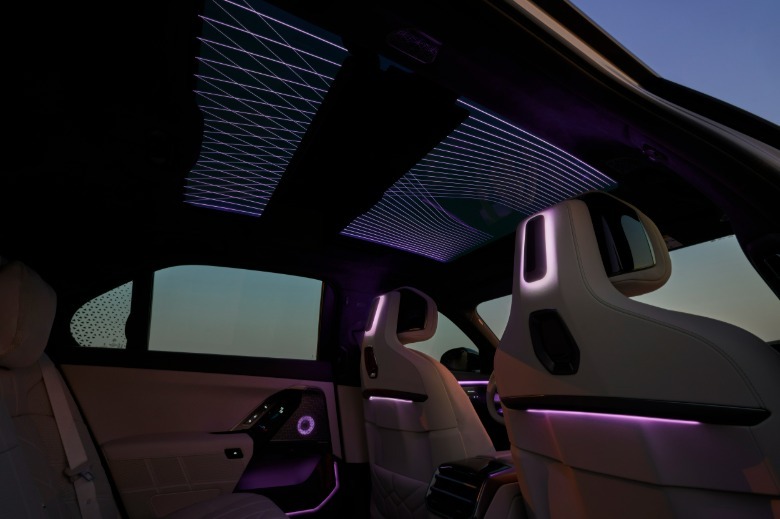
There's a ton of different ambient lighting effects. A strip that runs the width of the dashboard "in daylight illuminates with a delicate alabaster structure, whereas in darkness it produces a moderately dynamic light effect," and its color and brightness corresponds to the time of day. The front seatbacks have new integrated sconce-like lights, the rear doors' speaker covers are illuminated from the inside, and you can get a Panoramic Skylounge roof that has over 40 LEDs embedded in the glass. Vegan upholstery is standard, but you can get a bunch of leather options in different color schemes, plus the cashmere option is still on offer. There's a few new wood trim options, too.
Four models at launch, more to come
At launch the 7 Series will be offered in gas-powered 740 guise, which uses a turbocharged inline-6 with 394 horsepower and can be had with either rear- or all-wheel drive. A plug-in-hybrid 740e xDrive model is coming in early 2027 with 483 hp and 516 pound-feet of torque, and BMW says a V8-powered M Performance model will arrive down the line, likely a replacement for the current V8-powered 760i. This facelift is really all about the electric i7, though, which now features BMW's sixth-generation electric drive technology.
Its battery pack uses the Neue Klasse's cylindrical cell design, which increases volumetric energy density by 20%. Though the external dimensions remain the same, the usable capacity has increased by more than 10% to 112.5 kWh, and BMW estimates an EPA range of more than 350 miles, about 40 miles more than the current i7. An NACS charge port is now fitted, and the i7's DC fast-charging capabilities have increased from 195 kW to 250 kW, so it now needs 28 minutes to go from 10% to 80%. BMW also improved the regenerative braking, so the i7 can now come to a complete stop with one-pedal driving, and there's an adaptive recuperation setting that automatically adjusts the level of regen based on vehicles around you, traffic lights, route guidance and other data.
 BMW
BMW
The base i7 50 xDrive will have 449 hp and 487 lb-ft, reaching 60 mph in 5.3 seconds, but if that's not enough the i7 60 xDrive has 536 hp and 549 lb-ft, with a 4.6-second 0-60 time. The electric motors are new, with more sound isolation, smoother throttle response, and better efficiency. Speaking about the motors, BMW says:
Thanks to a variety of BMW EfficientDynamics measures, such as the use of silicon carbide semiconductor components for the power electronics (SiC inverters) and friction optimized wheel bearings, overall vehicle efficiency has also been increased by up to seven percent. Along with the new high-voltage battery with the latest Gen6 cylindrical cells and the overhauled charging technology, the updated BMW eDrive technology aboard the BMW i7 also comprises the highly integrated drive units at the front and rear axles.
These have been optimized through the integration of an SiC inverter and bring together the electric motor, power electronics and transmission within a single, compact housing. The electric motors in the BMW i7 work according to the principle of an electrically excited synchronous motor, where it is a precisely controllable electrical feed that sets the rotor in motion rather than fixed permanent magnets. This allows the use of critical rare earth metals (required for magnetic components) to be avoided altogether in the manufacture of the rotor
On sale this year
What else is new? Well, basically all of the computer stuff you can't see:
The new BMW 7 Series benefits from the completely new E/E architecture developed for the Neue Klasse as the basis for a "software-defined vehicle" (SDV). This makes the vehicle more intelligent and efficient overall, with greater capabilities. The centralized high-performance computers together boast 20 times more processing power than the current generation of models. This means the vehicle is prepared for upcoming software and function updates, including interactive AI features. The zonal wiring harness architecture reduces harness weight by around 30 percent while saving around 2,000 feet of wiring. As well as enabling shorter, thinner wiring, it uses digital smart eFuses for intelligent power distribution and makes a significant contribution to improving the vehicle's overall energy efficiency. The new electronics architecture underpins a more advanced software architecture that will keep all future BMW models fully up to date via software updates.
The automatic doors have new sensors and smoother operation, there's a new digital rear-view mirror, you can get a 3D head-up display, the AI virtual assistant is supposedly way better and can do many different new things, there's a lot more entertainment apps, the digital key has new functionality, BMW fitted even more sound-deadening solutions, and the available Adaptive Chassis Control suspension system with 48-volt active anti-roll bars has been improved.
 BMW
BMW
There are also lots of enhancements for the driver-assist systems, though BMW has discontinued its Level 3 system in favor of better Level 2 setups. It calls the latest safety systems BMW Symbiotic Drive, as they're designed to work unobtrusively in the background, with a safe experience that offers maximum benefit instead of the highest possible level of automation in every situation. For instance, the driver accelerating, braking or steering won't deactivate the highway assist systems. The car uses eye tracking and looks at driver inputs to determine if the driver is attentive, only intervening if it senses they're distracted (or worse).
BMW says the 2027 7 Series will enter production in July of this year, with U.S. deliveries to start soon after. The 740 will start at $101,350 including destination, only $500 more than the pre-facelift. All-wheel drive adds on $3,000 to that. The i7, meanwhile, will cost $107,550 for the 50 xDrive ($500 more than the current rear-drive 50) and $126,250 for the 60 xDrive (also only $500 more).