

What's The Difference Between Honda B-Series And K-Series Engines?
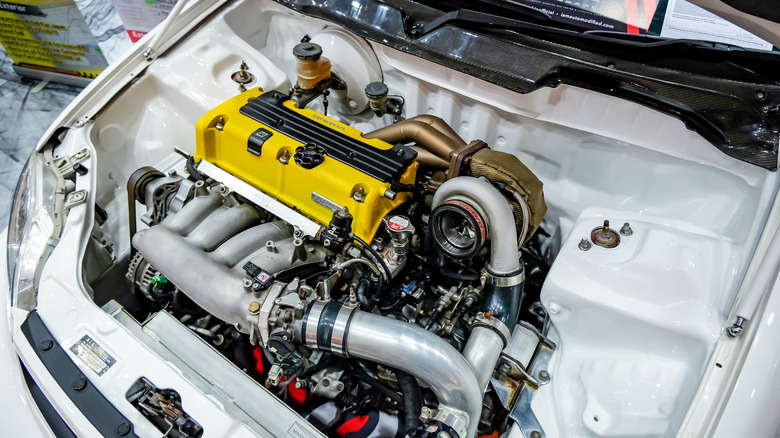
How do Honda's B-Series and K-Series engines compare? This question is a topic of intense debate among enthusiasts. The B-Series was the undisputed JDM king of the '90s small cars, putting VTEC on the map and becoming a main player in the original "The Fast & The Furious" movie. On the other hand, you have the K-series, a sophisticated powerhouse that led Honda into the modern era. Both engines are four-cylinder masterpieces of Japanese engineering, but they represent different philosophies of performance.
The B-Series is the nostalgic side of Honda's golden era. Introduced in the late 1980s, it has powered legendary JDM cars like the Integra Type R and Civic Del Sol. It also had a counter-clockwise-rotating engine — a quirky Honda trait of the time — and a belt-driven camshaft. This engine is famous for its simplicity and plug-and-play compatibility with older chassis. Meanwhile, the K-Series arrived in the early 2000s and was the literal opposite of the B-Series. It had a clockwise-rotating engine featuring a chain-driven camshaft.
The choice between the two engines usually comes down to your budget and affinity for fabrication. A B-Series engine is expensive, but the swap is quite easy for an EG or EK Honda Civic thanks to a shared chassis, a compatible wiring harness, and minimal fabrication requirements. A K-Series is easier to find, but it's much harder to plug into older engine bays. However, it has a higher tolerance for power without cracking the block open, making it a popular swap. Modders have even made a K24-powered Ferrari. The "better engine" boils down to whether you want a lightweight high-rpm legend that defined the JDM craze or a modern platform that dominates the JDM class on the drag strip.
Under the valve covers
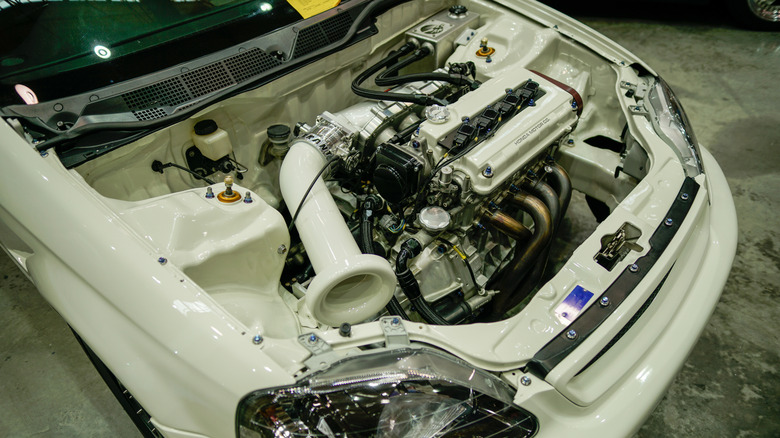
Peel back the layers, and the differences between the B and K-Series go further than cosmetics. The B-Series (B16, B18, B20) engine features a dual overhead cam with a rubber timing belt. It uses a VTEC setup that's binary in nature — either on or off. This creates that iconic VTEC "kick" at around 5,000 rpm. It is a compact, lightweight engine that favors naturally aspirated builds. However, its displacement is somewhat limited. Ranging from 1.6 liters to 2.0 liters, the block design is heavily constrained by its small bore spacing and short deck height, making the 2.0-liter cap a practical limit before you step into high-cost extreme modification territory.
The K-Series (K20, K24) is quite different from the B-Series. Even the K-Series K20 and K24 are different. What sets it apart is i-VTEC, which allows the K-Series to change the intake cam timing on the fly. This results in much better performance without sacrificing fuel efficiency. The K-Series also has a better cylinder head design. Compared to the B-Series, the intake and exhaust ports are swapped, with the intake at the front side of the ca. This proivdes a more direct cold air path and better airflow efficiency.
Then there's the matter of displacement. While the B-Series effectively tops out at 2.0 liters, the K-Series makes 2.4-liter levels of power accessible via the K24. And that engine is found in pretty much everything, from the Honda CRV to the Acura TSX. This is such a great benefit because the advantage of higher displacement is access to massive torque with a few simple upgrades.
The swap conundrum
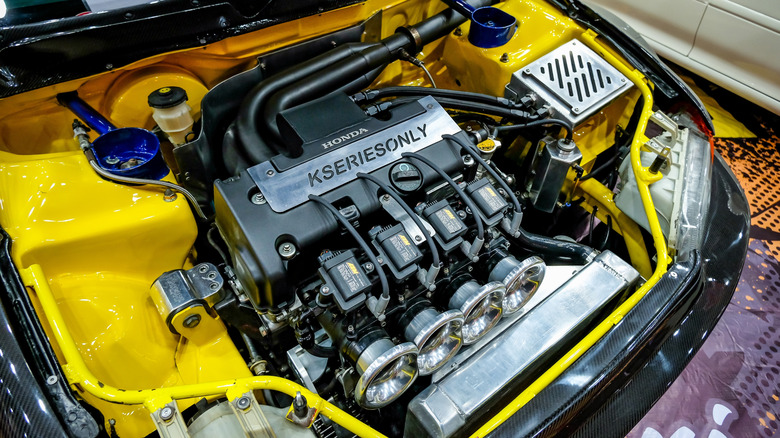
If the K-Series is so cool, why not just K-swap everything? While the K-Series will give you serious horsepower for your money, the B-Series still is a preferred choice when it comes to the ease of swapping and old-school charm. If you own a '90s Honda Civic or Acura Integra, a B-Series swap isn't much more than a weekend job. You can use your stock subframe and stock fuel pump, and you'll be able to close your hood without any clearance issues. Its lightweight nature preserves the weight balance of the car. For a vehicle you want to enjoy without having to figure out electrical wiring harnesses, the B-Series is a logical choice.
A K-Series swap requires a more invasive surgery. Because the engine sits differently and rotates the opposite way, you need specialized mounts, and custom axles. You also have to deal with the transmission. The K-Series uses a cable-actuated shifter, whereas the B-Series uses both cable-actuated and mechanical linkage. This means you'll need to figure out the routing for the shifter cables, or you might have to cut into the floor of your classic Honda to mount a shifter box. Furthermore, K-Series engines are taller than B-Series engines thanks to a taller deck height. Because of this, the valve cover might poke through the hood.
Ultimately, the B-Series vs K-Series debate is completely dependent on what you are looking for. If you want a lightweight, screaming canyon carver that reminds you of the golden era of Japanese tuning, the B-Series will make you happy. If you are looking to build a 500-horsepower turbo monster or want a daily driver with modern reliability and torque, the K-Series is good for it.