

What Is An Atkinson Cycle Engine And Why Do Automakers Use It?
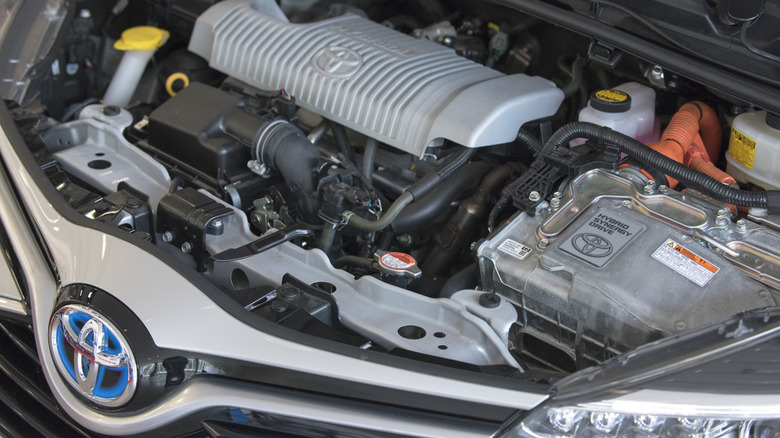
Gasoline engines usually run on the Otto cycle, the standard four-stroke and two-stroke combustion process that has been powering humanity for a while now. Although engines typically rely on the "suck, squeeze, bang, and blow" logic, there are subtle variations around the concept that often go unnoticed (or ignored) but unlock several key benefits. The Atkinson cycle is one of those variations. You have probably heard it mentioned in the context of hybrid Toyotas and Hondas. There are Miller-cycle engines as well, but that's a separate discussion.
Coming back to the Atkinson cycle, it all started when British engineer James Atkinson realized that the Otto four-stroke could be improved. More specifically, his modified cycle focused on increasing thermal efficiency. While Atkinson didn't instantly create the best engine of all time, the idea of achieving more while consuming significantly less fuel was worth pursuing. Mind you, this was all taking place in the late 1800s. Although Atkinson's execution — he used a multilink connecting rod for variable stroke lengths — was a royal failure, the underlying principle was not.
Put simply, in an Atkinson cycle engine, the intake valve only closes when the piston has completed 20-30% of its compression stroke. This pushes some of the intake charge back into the manifold. While Otto engines have identical compression and expansion ratios, Atkinson cycle engines have a much higher expansion ratios relative to their compression ratio.
Understanding the Atkinson cycle and why it's used
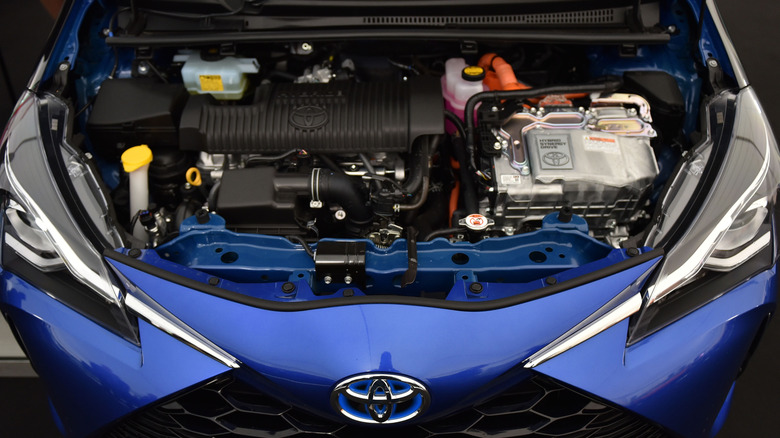
Imagine a 500 cc single-cylinder engine running the Atkinson cycle. Let's assume the engine uses approximately 300 cc of air and fuel (some of the mixture returns to the intake) and subsequently compresses it to 50 cc. This means the engine's compression ratio is around 6:1, but the expansion ratio becomes 10:1. Why? Because after combustion, the mixture expands from 50 cc to 500 cc. If the same engine were to run the Otto cycle, the compression ratio and expansion ratio would be 10:1.
As you can see, by running the Atkinson cycle, the engine is saving a bit of the intake charge for the next combustion cycle, which therefore improves overall fuel consumption and reduces emissions. However, this does mean the engine would exhibit lackluster performance, especially when it comes to torque output. That's why OEMs usually pair an Atkinson cycle engine with an electric motor.
Common misconceptions around hybrid engines aside, when you think about it, this is a combination that simply makes sense. The electric motor(s) can chime in during low-speed situations where the engine struggles. But when the torque demand is relatively small — like when coasting on a highway — the engine can power the wheels without relying on the battery or the electric motor. Modern hybrids are so good at this that you barely notice them switching between electricity and internal combustion. However, it's worth pointing out that the combustion cycle is not limited to hybrid powertrains; some modern engines are capable of switching between Otto and Atkinson in real time.