

The Extreme Tire Tech Required To Set Land Speed Records
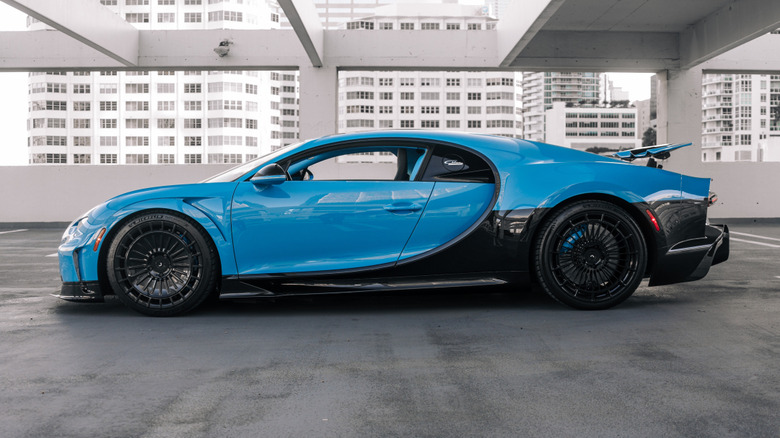
Back in August 2019, Andy Wallace, Bugatti's factory test driver, managed to break the 300 mph speed record by running a Bugatti Chiron Super Sport at 304.77 mph with reinforced Michelin tires. This was not the first Bugatti to claim a top-speed world record, as the modern era of speed-chasing hypercars began with the iconic 16.4 Bugatti Veyron setting a 253 mph speed record in 2005 – also on Michelin tires.
In all of these instances, although the car was indeed impressive, it was the tire that had to safely transfer all of that speed onto the road. In fact, tires are all that's holding Bugatti from going ever faster, and their limits are especially evident in even more extreme circumstances where land speed records push beyond 500 mph. A vehicle like the 503.33 mph Team Vesco Turbinator II relies on specialized Mickey Thompson tires engineered to survive enormous centrifugal forces and heat.
As Bugatti test driver Andy Wallace explained in an interview with The Drive, "You don't have to develop a tire to do 300 miles an hour because there are no cars that do 300 miles an hour. Well, there is now." That's why tire manufacturers had to use high-strength fiber, smooth treads, and microscopic inspections during development. And those are just a few examples of the extreme tire tech required to set land speed records.
Carbon fiber & aramid fiber reinforced tires
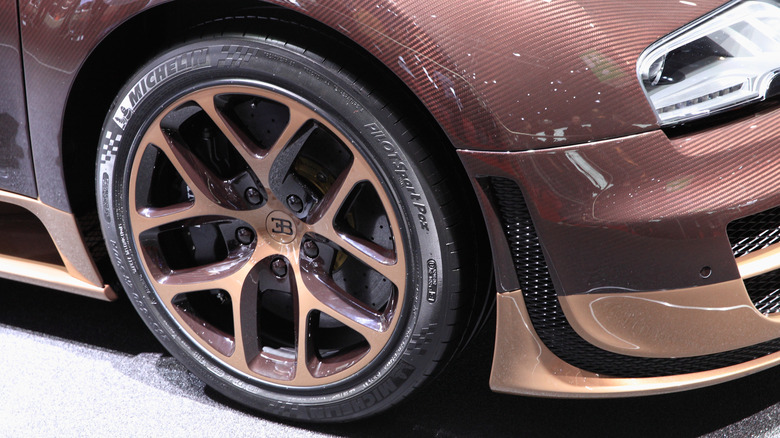
To understand the forces tires need to endure during 300-mph top speed runs, in that same interview with The Drive, Andy Wallace explained: "The loads involved at 300 miles an hour on the tires involve a tearing force of seven tons." This is why Bugatti chose to combine carbon fiber reinforced tires with high-strength aramid fibers inside the tire to prevent deformation. At 300 mph, even small tire deformations can lead to tire blowouts — something that proved exceptionally dangerous when Steve Torrence's dragster suffered a rear tire failure at over 300 mph. For the Chiron, Bugatti even tested its tires in the U.S. on specialized Space Shuttle rigs, simulating speeds of about 317 mph to ensure they could endure the extreme forces.
During the Bugatti Veyron's top-speed record run, Bugatti used specialized Michelin PAX tires that were chemically bonded onto the wheel. Although this has increased the durability of these tires, it has also led to Bugatti owners having to pay $42,000 for a replacement set. The reality is that most of us aren't doing 300 mph during school runs, so it's probably better to focus on the best bang-for-your-buck tires you can buy.
Smooth tread technology & nitrogen inflation
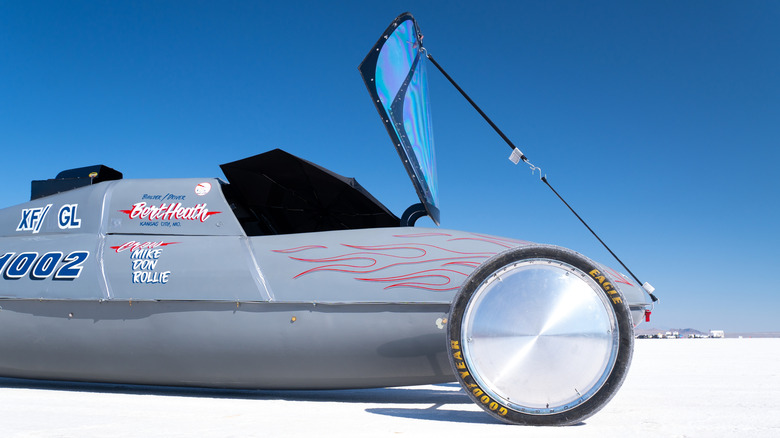
Buying tires from Costco comes with free extras, including the ability to have your tires inflated with nitrogen. This is also something that ties your Costco-supplied daily driver with the same high-performance principle used by Goodyear when it built the 8:00-25 "Blue Flame" tire, which was able to endure 622.4 mph at the Bonneville Salt Flats in 1970. The practical benefits of filling up tires with nitrogen are to keep tire pressure consistent, reduce wear, and improve performance, longevity, and safety.
Nitrogen wasn't the only thing helping these tires. High-speed land records carried out by Goodyear also included a specialized smooth tread surface designed to help with heat. In fact, Goodyear actually limited the top-speed of the Blue Flame to a "sensible" 700 mph. This is because previous attempts using Firestone tires ended up in blowouts that led the company to ultimately back out of motorsports altogether. Mounting specialty tires on a vehicle with 58,000 horsepower isn't the same as mounting them on a standard Corolla. However, technological advancements like these have even found their way into Costco, allowing everyday drivers to benefit from the same principles that underpinned a land rocket.
Extreme molecular & structural tire tech
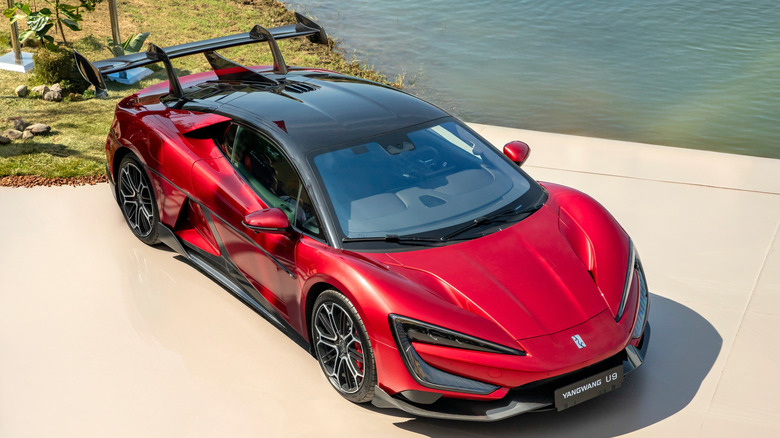
The Bugatti Chiron Super Sport lost its top-speed record in October 2025 when a Chinese hypercar, the Yangwang U9X, reached 308.31 mph on specialized GitiSport e.GTR2 Pro tires and became the new fastest car in the world. To make it happen, Giti utilized specialized molecular chain optimizations within the tire, meaning that reinforced compounds were used on a molecular level.
High-strength aramid fibers, a specialized tread wave structure, and optimized racing tire geometry were all key performance features enabling the tire to survive extreme speeds and forces. Understandably, these developments didn't happen overnight, as Giti first introduced the prototype of this tire in March 2024 and tested it in China in July 2024. The tire was also tested at German ATP Automotive Testing Papenburg proving grounds (ATP), and by June 2025, the tire managed to reach about 310 mph in controlled indoor conditions.
All these fancy-worded tire attributes have ultimately culminated at Germany's ATP proving grounds, where the U9X reached its record-breaking speeds after multiple runs. A mechanical engineer from the Engineering Explained YouTube channel suggested that the 3,000 horsepower Yangwang U9X could theoretically reach 400 mph — but, as always with such extreme speeds, finding tires capable of handling that is a whole other challenge.
Advanced X-ray testing & carbon wheels
Actually developing tires that can withstand insane speeds isn't just about building them and calling it quits. These tires have to undergo immense scrutiny, long testing cycles, and inspections at a microscopic level to ensure absolute structural integrity before attempting high speed runs. For instance, for the Chiron run, Bugatti used advanced X-ray imaging to detect the tiniest irregularities.
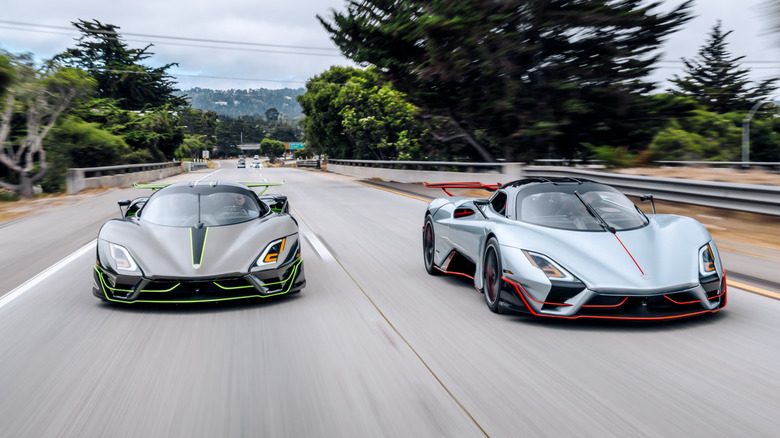
However, it's not all just about the tires. When the SSC Tuatara took another pass at the top-speed record, the car was using road-going Michelin Pilot Sport Cup 2 tires mounted on specially-designed hybrid carbon fiber wheels whereas the Chiron needed to rely on specially-made versions. The Tuatara is extremely lightweight at approximately 2,750 pounds dry, while the Chiron is closer to 4,400 pounds. With a lightweight car and lightweight wheels, the rotational mass of a tire rotating at insane speeds is lower, causing increased performance and allowing it to use less-advanced tires. According to a SSC CEO Jerod Shelby's interview with Motor Authority, "We felt confident we were well enough below the safety margin on the tire rating due to the weight of the car and the downforce."