

This Is The Only State That Doesn't Require Car Insurance

New Hampshire has used "Live Free or Die" as its slogan since the conclusion of the Second World War. With such a dramatic phrase tied to the state, it may not surprise you to learn that New Hampshire is also the only place where car insurance isn't mandated. While the issue has been debated, those who felt that the state requiring residents to purchase a product was an infringement of personal freedom won out, at least so far.
For some, this news may conjure up thoughts of relocating to New Hampshire. However, before you start contemplating a move, there's a huge caveat. You still need to be able to cover any damages you cause in the event of an accident. So, if you don't elect to buy car insurance coverage, the state's Motor Vehicle Financial Responsibility metric still needs to be met, and it isn't cheap. Essentially, you need $100,000 for every vehicle you register in New Hampshire, which covers liability for single and multi-person accidents, as well as damage to property.
You also need to prove to state authorities that you have the money by depositing it with the state treasurer. Either cash or securities are accepted and placed into an account. The Department of Safety will also need a record of this via a receipt. Only then can you legally drive in New Hampshire without standard car insurance. However, there are still some exceptions.
Even if you can meet the financial responsibility in New Hampshire, you may still be forced to get insurance
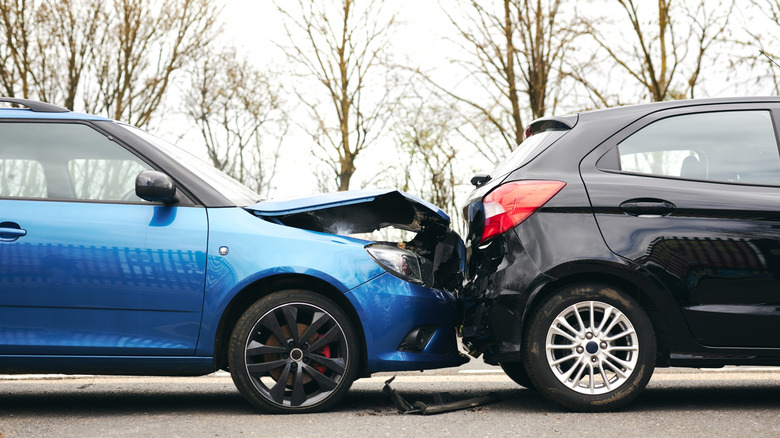
Let's say you can afford to set aside $100,000 to cover your car in New Hampshire — it doesn't automatically mean you can avoid a car insurance policy. Unless you purchase your vehicle outright, a lender will often call for full insurance coverage to protect their investment. This is true regardless of the state you reside in. Leasing a vehicle also typically requires a more comprehensive level of insurance.
Your driving history can also play a role in whether or not New Hampshire will require you to purchase an auto policy. For instance, a conviction of driving under the influence or a record of repeatedly breaking traffic laws are a couple of examples of the circumstances that can generate a file (SR-22) with the state, which requires you to provide proof that you have coverage.
Those with an SR-22 must maintain an auto insurance policy, regardless of financial holdings, to legally drive in the state. Habitual speeders may also be required to file an SR-22 with the Division of Motor Vehicles. So, those who exceed the posted speed limit in New Hampshire may not only be forced to get car insurance, but they may also need to fork over extra money if they continue to get caught, as insurance goes up dramatically when you get a speeding ticket.
Not all states require the same level of auto insurance
There are various levels of coverage in terms of car insurance, and local laws can vary, depending on the state. Liability coverage is universally mandated across all states (excluding New Hampshire if you meet the Motor Vehicle Financial Responsibility requirement). However, even liability is split into different types, with one concerning property damage and the other medical bills. While many states call for drivers to maintain a liability policy that covers both, Florida bucks that trend. Instead, the Sunshine State wants its motorists to have liability coverage for property damages only, but it does require personal injury protection (PIP), which takes care of medical costs and isn't dependent on which individual causes the accident.
In many places across America, if you cause an accident, the financial burden falls to you. But there are a handful of states that don't operate this way, such as Florida, Kentucky, New York, and Utah, to name a few. Instead of basing the claims on who is to blame, each motorist contacts their own insurance company and use a PIP policy. However, even though some states offer similar coverage requirements, don't expect the rates to be the same across the country, as New York and Idaho are among the most and least expensive states to insure a car.
Editor's note: Due to a glitch caused by a CMS update, this article was uploaded with substantial errors. We have fixed these issues, and we are in the process of working out any remaining kinks caused by the update.