

Bugatti F.K.P. Hommage One-Off Imagines The Veyron Facelift That Never Happened
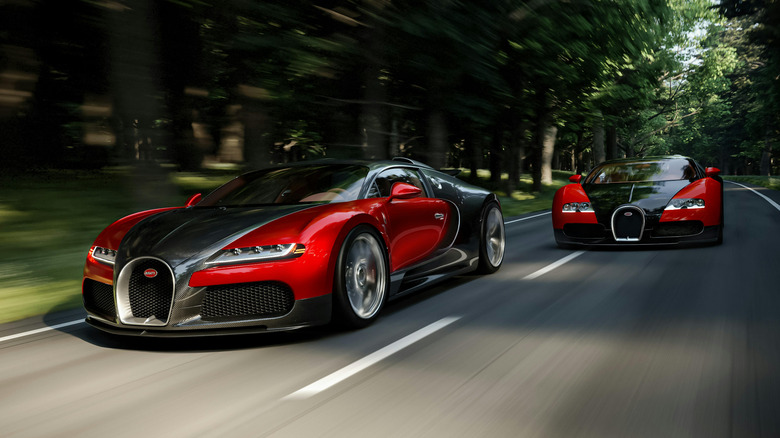
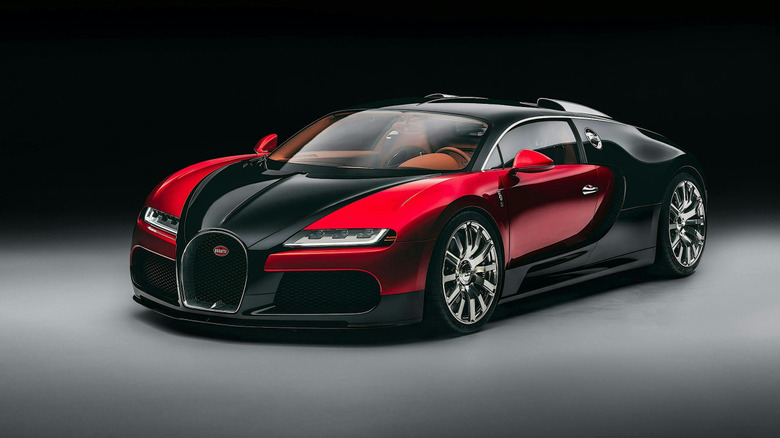
The next stop for Bugatti's monthslong Veyron 20th anniversary tour is Rétromobile in Paris, and the automaker will be marking the occasion with the reveal of a new one-off from its Programme Solitaire division, only the second one since the unveiling of the Brouillard last year. Named F.K.P. Hommage after Ferdinand Karl Piëch, the brainchild of the Veyron and its innovative engine, this new car's styling is naturally a direct homage to the Veyron's, also taking inspiration from the concepts that predated the production Veyron in the late 1990s and early 2000s and imagined design themes that never came to fruition in period.
Despite its Veyron looks, the F.K.P. Hommage uses the chassis and W16 engine from a Chiron Super Sport, the zenith of Piëch's powertrain. And the project had to be done now, instead of maybe waiting for the 25th anniversary, because the W16 is about to be sunsetted in favor of the Tourbillon's V16. Chief designer Frank Heyl says the Hommage was a challenge for Bugatti's design team that "had to be done with respect and dignity," and that the customer who commissioned it worked closely with the team, "refining every detail through multiple iterations to create what [Heyl] considers the ideal, definitive Veyron."
Exaggerated and enhanced
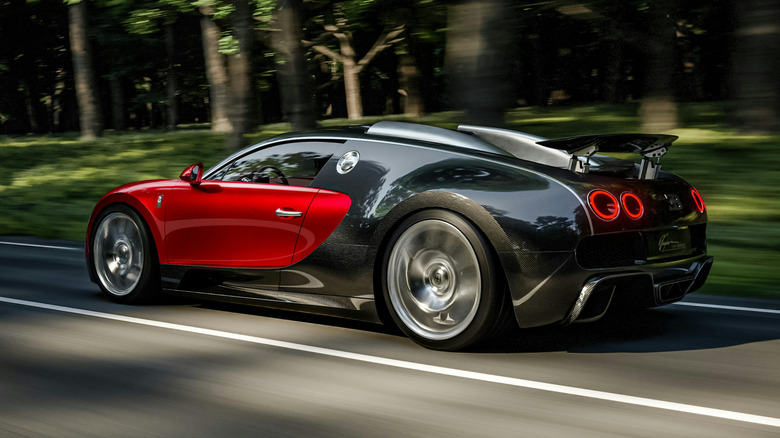
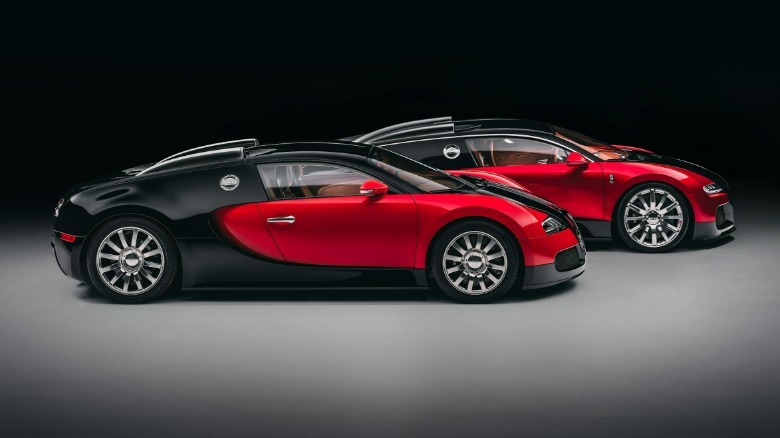
Heyl says the Hommage is almost identical in size and proportions to the original Veyron, coming in at about an inch and a half wider, but the team didn't just port over all the Veyron's body panels and styling onto a newer chassis. Every body panel, trim piece and detail was designed and created just for this car, down to the door handles. Some are very close to the original car's look, while others are exaggerated and enhanced. Place the F.K.P. Hommage next to a Veyron 16.4 — which Bugatti conveniently has done in many of the press images — and the new car is a more refined, a more dynamic, more intriguing.
Much of the Hommage's design was inspired by Heyl's sketches for a Veyron facelift that never happened, a project he was working on after joining the company in 2008. At the time, Piëch was already chasing after higher performance targets than the Veyron Super Sport would hit in 2010 — specifically he wanted to make a "megawatt" car, something with 1,341 horsepower. But Heyl says one day Piëch came into the office with a graph, showing that in order to hit his target of 450 kilometers per hour (280 mph), they'd need a car with 1,500 horsepower, better aero and less drag, all things unachievable with the Veyron platform. As those targets were so advanced, the megawatt facelift project was shelved in favor of starting development on the Chiron, and leaving the Super Sport and Grand Sport Vitesse as the final Veyron models.
 Bugatti
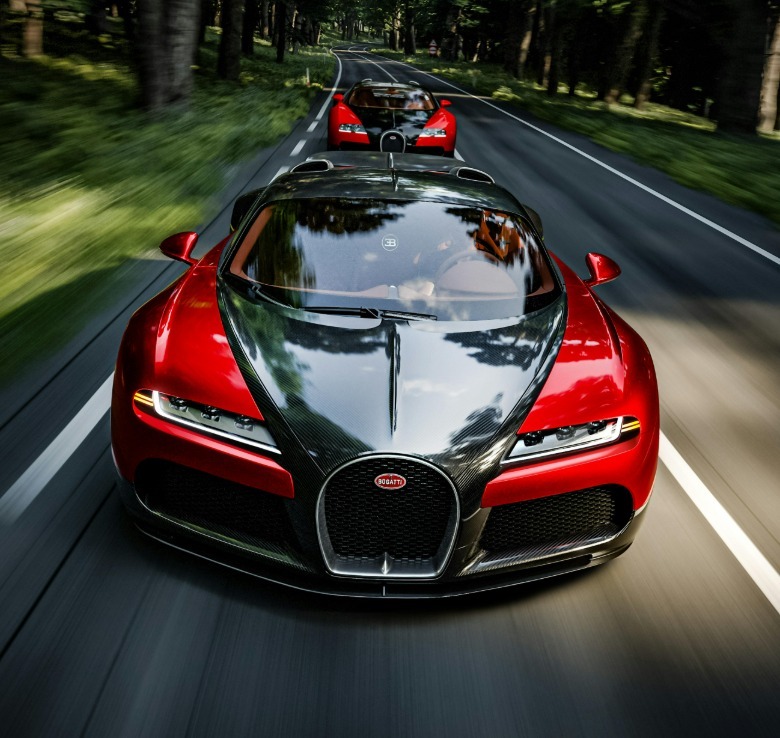
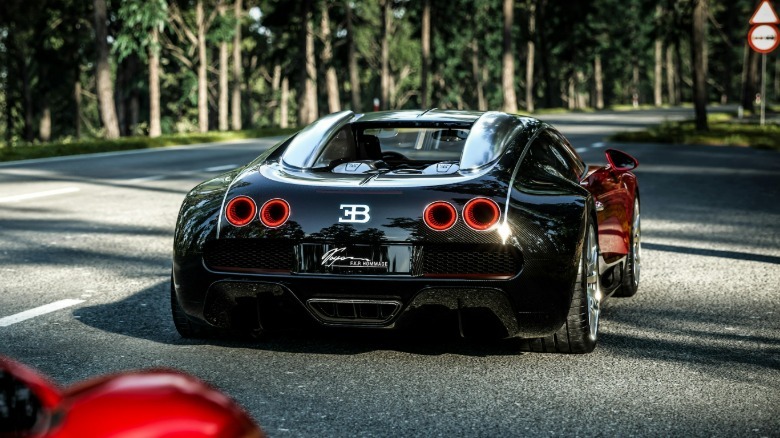
All of the Hommage's surfaces originate from the deep horseshoe grille, Heyl says, which was machined from a solid block of aluminum. L-shaped three-unit LED headlights and a section of bodywork right below them attach onto the curved nose section surrounding the grille in a more technical, three-dimensional way. Heyl says the headlights are pretty much what the facelift's would've looked like, just with newer tech in them. The bumper intakes are larger and the shape of them is more sculptural, and there's a more prominent splitter. It also has new active diffuser flaps at the front end. Because the fenders are more pronounced, the bodywork is shapelier and the separating lines of the hood curves a different direction, the flow of the two-tone paint is prettier. And speaking of that paint, it isn't really "red," per se — it's actually aluminum-based liquid metal silver paint with red pigment in the clear coat, which Heyl says allows the paint to show off the depth of surfaces. The other half is exposed carbon fiber with a 10% black pigment in its clear coat.
It uses normal tires
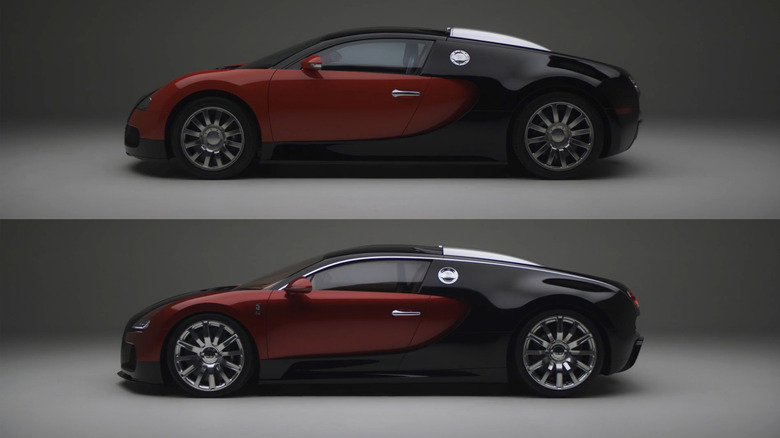
While the Veyron had specialized wheels that needed extremely specialized Michelin PAX tires, the F.K.P. Hommage has the same much more normal setup as a Chiron, with 20s in the front and 21s in the rear that crucially wear regularly sized tires you can just buy from Tire Rack. The design of the twelve-spoke wheels "Neo Macchiavelli" wheels are a more technical evolution of the original Veyron's wheels, and they better fill out the larger wheel arches, also giving the car a more aggressive stance. The Hommage's roofline is lower, the side intake is tightened up, the twin air intakes are leaned forward, even the re-adjustment of the fuel filler makes the Hommage that little bit more dynamic. But it retains the Veyron's laid-back, reclined posture, which was a big foil to all the other wedge-shaped, forward-leaning supercars.
 Bugatti
The three-dimensional taillights are also what Heyl would've done for the facelift, with the outboard ones being slightly bigger, and the air vent below them is taller and wider. The diffuser is also larger and more aggressive, with edges that flick out at an angle, and Heyl says the interplay of it and the reshaped rear wing is key to aerodynamic performance. Four exhaust pipes are visible through the central trapezoidal surround, and as with basically every Bugatti road car since the Veyron, the Hommage's W16 engine is exposed to the elements.
Bugatti's most bespoke interior ever
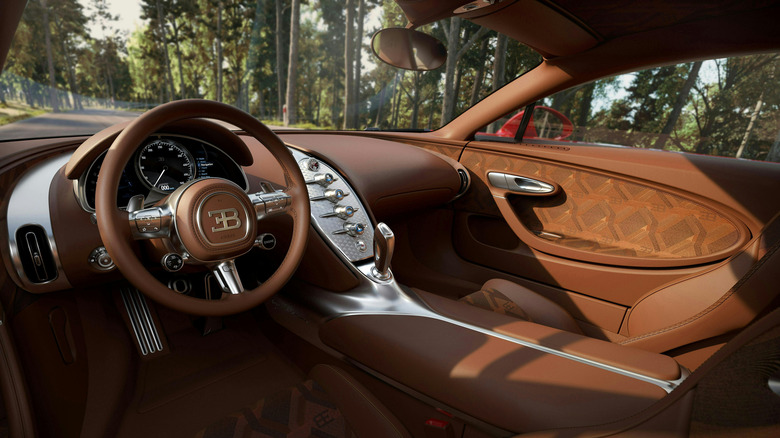
Where Bugatti's previous few-off and one-off creations like the Divo, Mistral, Centodieci and Brouillard shared the same dashboard design and other interior panels as the Chiron, the F.K.P. Hommage has a much more unique driver environment that specifically looked to the Veyron EB 18.4 concept from the 1999 Tokyo Motor Show. Heyl says the company went "to the greatest extent of complexity" to create it, though I'm sure the company is able to push things even beyond this.
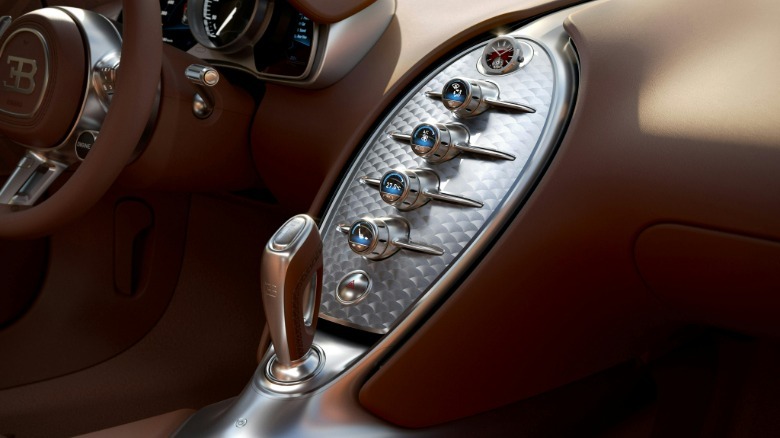
The shape of the "medallion" center console echoes the original car's, which itself is formed like Bugatti's horseshoe grille. Heyl says it only felt right to do this, as the Veyron's design was so distinct. It's finished in classic engine-turned aluminum, originally used on the straight-8 cylinder heads of Bugattis from a hundred years ago. The four small touchscreen control dials are taken from the Chiron, but the surrounding knobs and wing-like mounts are also specific to this car. The shape of the leather panels that wrap around the center panel create hidden air vents, while the medallion's metal housing flows both onto the center tunnel and armrest, and to become a piece of trim that wraps around the entire dashboard. Those metal bits were machined from solid aluminum blocks, too.
 Bugatti
Also unique to this car is the steering wheel, totally round unlike other modern Bugs and with a thin rim and nicely sculpted metal spokes. Even the buttons on the spokes were designed just for the Hommage. I think it looks really, really good. One thing I don't care about, though, is the timepiece that's integrated into the top of the medallion. It's an octagonal 41-mm Audemars Piguet Royal Oak Tourbillon, sitting in a self-winding gondola that is revolved and rotated a few times per hour at a specific diagonal angle, without needing a mechanical connection or electrical power. I mean, it's cool, you're just never gonna get me to care about a fancy clock. Get back to me when a Bugatti client gets a custom Swatch integrated into their dashboard.
More fabrics like this, please!
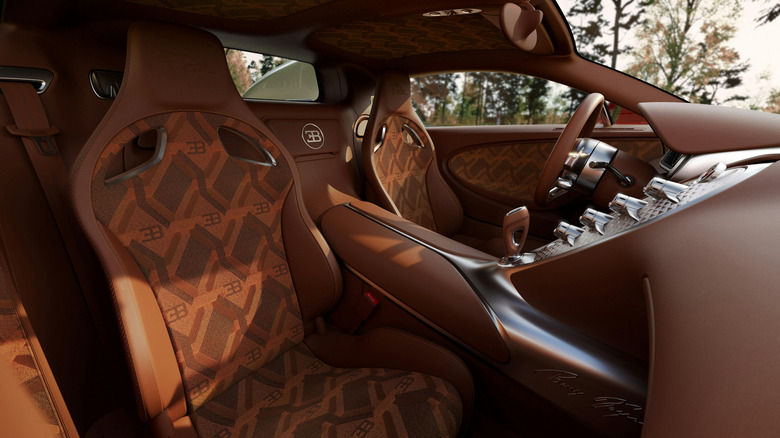
Most of the interior is covered in lovely peanut buttery brown leather, the exact same stuff used on Veyrons, but the main seat surface and door panels have modern "Car Couture" fabrics that were woven in Paris. The Hermès-like pattern looks extremely cool, and is so much more interesting than more quilted leather or Alcantara with boring stitching. That fabric is also placed in the headliner on a panel above each seat. The door panels are slightly reworked, losing the flip-open storage compartment of the Chiron. I guess this buyer doesn't wear sunglasses often. There's still no cupholders, though.
Stitched onto the headrests using a matching brown color is Piëch's signature, while the signature in metal along the leading edge of the center tunnel is that of the car's namesake, Pierre Veyron, a Grand Prix racer who won Le Mans for Bugatti in 1939. Unlike the Chiron, the Hommage doesn't have a prominent spine splitting the two occupants' areas, with a rear bulkhead much more akin to the Veyron.
There's still a year of development left
The Solitaire division is able to build up to two cars per year, through more projects may be getting worked on at the same time. There will be two years of total development for the F.K.P. Hommage, one of which is already complete. It may have the same 1,600 horsepower as Bugatti's other new models, but the project has required extensive reengineering, with Heyl specifically calling out the air box and cooling. "It doesn't make a difference if we make one car or 100," Heyl says, the effort put into the thermodynamics, performance, road testing, crash simulations and homologation is the same. Bugatti doesn't yet know what the Hommage's top speed will be, though.
Heyl describes the European customer of the Hommage as being a "connoisseur" who owns a matching red-and-black Veyron, among other Bugattis, and that he had an immediate understanding of what to do for the project. The car you see in these images is the non-functioning design model; Heyl says if the buyer wants, they'll get it too. Now that the car has been revealed, Bugatti can start on-road testing ahead of the Hommage's delivery next year. What Bugatti won't tell us is how much this whole thing costs, but you can bet it's a hell of a lot.
 Bugatti
"The Veyron was the first of its kind, and in the world of collectible automobiles, the first and last of a kind are always the most significant. It created an entirely new segment – the million-euro hypercar that could travel to the opera in the evening and break speed records by day," says Heyl. "When I first arrived at Bugatti, I was sketching developments of the Veyron, looking at how we could evolve the styling; ultimately these projects never came to fruition, but it feels almost as though Prof. Dr. Piëch could see we would have a need for them one day. If he was still here to see this 'next opportunity' made real, I'm sure he would agree that this is the most appropriate celebration of his vision that we could possibly create."