

Are Cheap Tire Pressure Gauges Accurate Enough To Trust?

We may receive a commission on purchases made from links.
Tire pressure gauges come in a variety of sizes, styles, and price points. Frequently using an accurate tire pressure gauge to maintain proper inflation is an easy way to make your tires last longer. The automotive engineers that designed your vehicle put a lot of thought into the ideal air pressure that your tires should hold. Proper tire inflation is important enough to drive regulations requiring a tire pressure monitoring system (TPMS) in passenger cars and light-duty trucks since 2007.
Even if your vehicle is equipped with pressure monitoring, the TPMS isn't always reliable enough to disregard checking your tires manually. You should have access to a tire pressure gauge that's accurate enough to trust — but it doesn't always have to be the most expensive model on the market. In a test performed and shared on YouTube, Project Farm compared the accuracy of 23 tire pressure gauges, with prices ranging from under $5 to over $35. Project Farm submitted the gauges to temperatures similar to those in vehicles and recorded their accuracy compared to a pair of calibrated digital pressure gauges.
While the cheapest gauges didn't have the best accuracy, the most expensive model only ranked in the 10th spot overall. Ultimately, the top three models in the test cost between $28 and $30 each, and the brands managing to make it that high were Jaco, Merlin, and SKS.
Inexpensive tire pressure gauges that are accurate enough to trust
Simply put, cheap tire pressure gauges shouldn't be trusted to properly maintain the pressure in your vehicle's tires. That said, if a $2 tire pressure gauge is all you have available to check pressure in a spare tire before trusting it with your life, it's still worth using. That gauge is probably more accurate than thumping your tires with a stick like a semi-truck driver – at least if you aren't an experienced trucker. Afterwards, go straight to the nearest source of a better gauge and verify its accuracy.
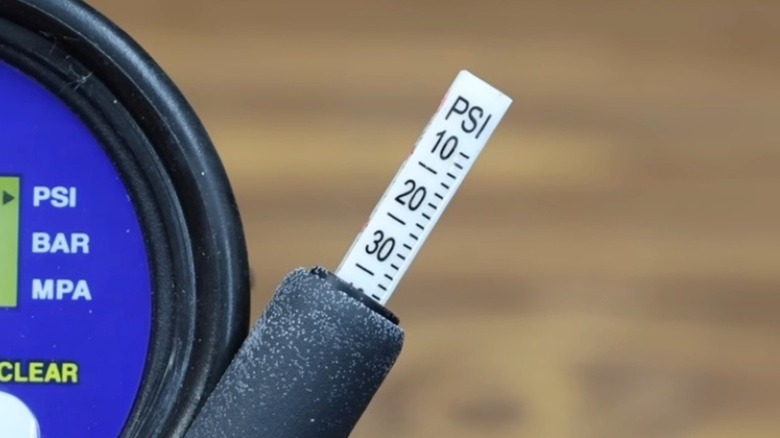
Accurate tire pressure gauges some in stick-type, dial, and digital styles. Stick-types (also known as pencil gauges) are simple to operate but sometimes hard to decipher. Dial gauges have a needle pointing to a number that indicates the pressure inside the tire. Digital gauges are the easiest to read, often featuring backlit LCD displays with numerical readouts. However, a digital gauge will fail when the battery dies.
The top three pressure gauges on Project Farm's list are digital models with prices ranging near $30. While they're not prohibitively expensive, the CZC Auto Tire Pressure Gauge – a pencil gauge available on Amazon with a typical price of $8.99 — finished close in fourth place. Its largest inaccuracy came during the cold temperature test where it measured 39 psi, which was 2.5% below an accurate 40 psi reading.
How much inaccuracy is acceptable?
The recommended pressure for vehicle tires depends on the model of the vehicle. While tire pressures of 32-35 psi are common, it's best to consult with your owner's manual or look for the prescribed values on the sticker of the driver's door frame. Do not use the psi value on the side of the tire. It's better to measure the tire pressure of cold tires, achieved after parking the vehicle for several hours, and the values can be different for front and back tires.
If we consider a tire meant to be inflated at 35 psi, 28 could be considered as the low end of normal – a difference of 7 psi. If we use the CZC Auto gauge above with its 2.5% deviation, we can be confident the tires are still at safe levels if the gauge reads 35 psi. Other gauges had a difference greater than 20% on Project Farm's test, and inaccuracies like that could lead to overinflation of the tire.
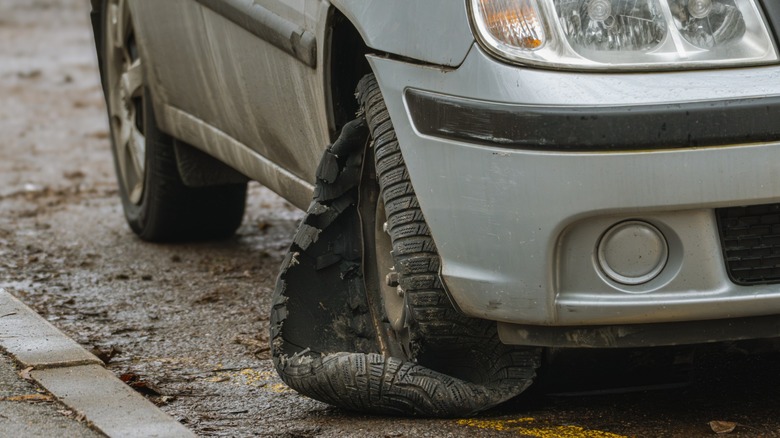
Overinflation is not a good condition for your tires. Tires are designed to have a relatively flat contact patch with the ground that distributes the vehicle's weight evenly across the tread. When overinflated, the center of the tread carries more weight than the outside portions, causing it to wear faster than the rest of the tire. Underinflation can be even worse by contributing to decreased fuel economy, poor handling, and increased risk of a blowout. Inaccurate gauges might allow you some leeway, but it's a bad idea to get too complacent with them.