

The Physics That Makes The Lexus LFA's Exhaust Note So Special
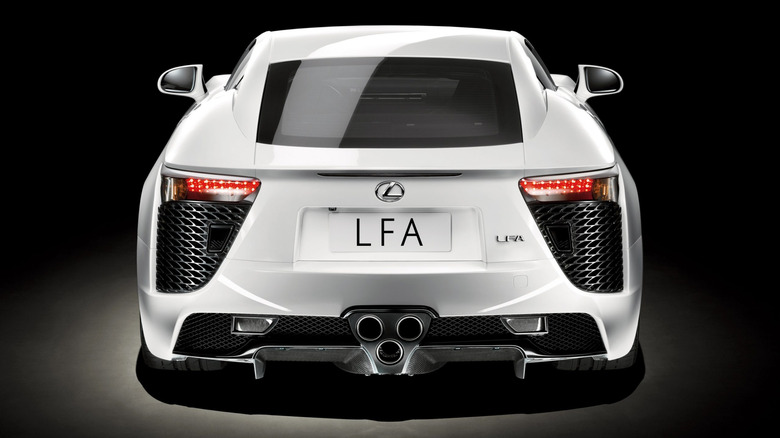
Much has been said about the now-legendary Lexus LFA, the brand's first supercar that has since been the halo model of Toyota's luxury arm. Despite having a bespoke 4.8-liter V10 engine made of aluminum, magnesium, and titanium alloys, its speed wasn't its greatest highlight despite producing 552 horsepower and 354 pound-feet of torque. Rather, its sonorous 9,000 rpm redline is what makes it truly special.
Lexus and Toyota engineers spent almost a decade and close to a billion dollars to create this supercar. The LFA was even possibly sold at a loss, as AutoEvolution states that each one costs $750,000 to build — a stark contrast to the car's $375,000 initial base price. Back then, it cost more than other Italian and Japanese exotics despite being no prettier or faster. It took more than a decade for Lexus to sell the last of the 500 LFAs since production ended in 2012. If you were lucky enough to have one, give yourself a pat on the back for snatching a future classic, since used car prices for it have gone through the roof, averaging upwards of $800,000-$900,000.
The money you spend on a Lexus LFA goes to its glorious exhaust note, which puts it among the best-sounding production cars. The physics of what makes the LFA sound special has to do with its V10 engine, Yamaha-tuned intake system, and custom exhaust with a titanium dual-stage rear silencer and a triple tailpipe design. It all contributes to what has become one of the most recognizable exhaust notes that never fails to turn heads.
Naturally aspirated 72-degree V10 engine

The 72-degree bank angle of the Lexus LFA's bespoke V10 engine is the source of its incredible exhaust note. Lexus was able to make the V10 as compact as a conventional V8 while being as light as a V6, but that specific bank angle enabled it to produce an even firing order of the cylinders while balancing the primary and secondary forces within the internals for unparalleled smoothness.
The unique bank angle and perfect firing order of the V10 are the primary sources of the Lexus LFA's F1-inspired exhaust sound. Moreover, the packaging provided room for a positive crankcase ventilation chamber and an oil cooler between each cylinder bank. Helping the cause are independent throttle body trumpets for each cylinder, 12-hole injectors, and precise management of the air and fuel that enabled the V10 to reach 9,000 rpm from idle in six-tenths of a second.
Symmetrical dual-intake system
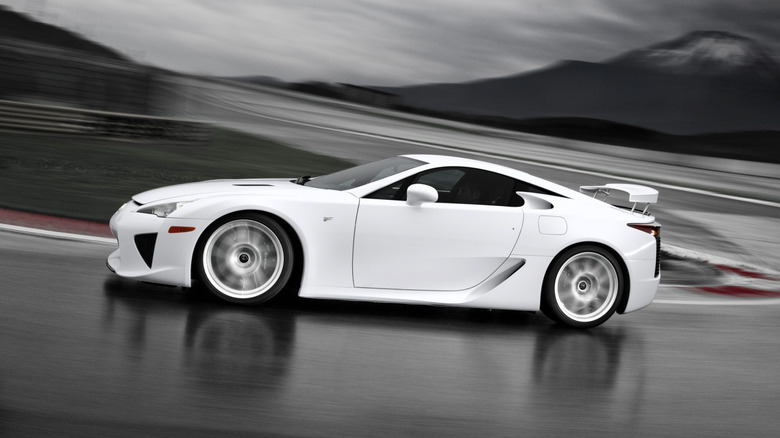
Japanese conglomerate Yamaha has often been cited for being the brains behind the Lexus LFA's hair-raising exhaust note, but that's just a myth. According to automotive exhaust expert Maisteer's YouTube video on why the Lexus LFA sounds like no other car, the Yamaha-tuned exhaust is nothing but an urban legend. He shares information from the book "LFA: The Roar of an Angel" by former Lexus engineer Tanahashi Haruhito, which reveals that Sango – a century-old Japanese company that has been supplying Toyota exhaust systems — was the one responsible for tuning the LFA's unforgettable exhaust sound. It apparently took the combined efforts of Sango, Yamaha, and Toyota to develop what the Lexus LFA should sound like.
Sure, the supercar's V10 was a collaboration between Toyota and Yamaha, but the engine's symmetrical dual-intake system featured a surge tank with tuned rigid walls and ribs inspired by musical instruments. The intake featured an always-open primary inlet port that functions at low to medium speeds, while a secondary port would open above 3,000 rpm to enhance engine breathing at higher revs. Furthermore, the tuned surge tank optimizes the acoustics of the airflow to generate that exhilarating exhaust sound.
Formant-optimized exhaust components
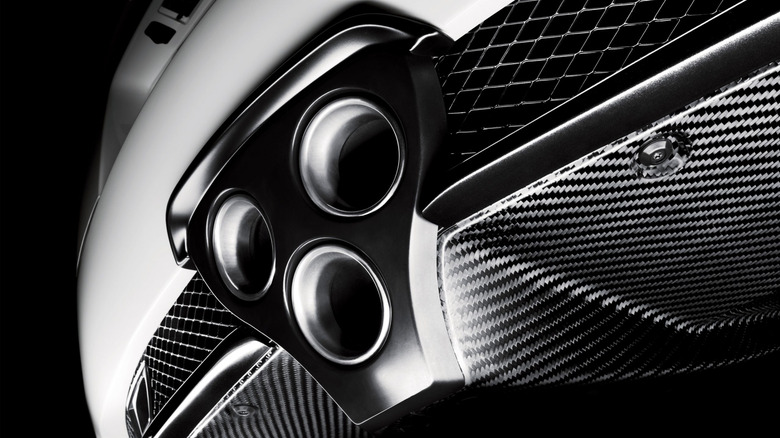
As it turns out, Sango has been researching exhaust systems based on formant analysis (which focuses on the tuning of the human voice), all in the name of striking the ideal harmonic balance. It applied this research to the LFA's V10 engine by giving it equal-length exhaust manifold covers, full dual pipes, and a titanium dual-stage rear silencer — all tuned specifically based on how we speak.
The titanium silencer with triple tailpipes is specifically important. Maisteer's video further explains that when the valve in the muffler opens at 3,000 rpm, the top tailpipes merge, helping to enhance the high-frequency sounds of the exhaust. On the other hand, the lower single tailpipe, which happens to be longer than the two pipes on top, is tuned to filter out low-frequency sounds as you bury the throttle. The result of this clever design and packaging is a supercar that genuinely sounds like a Formula 1 racing car, with an exhaust sound so good that we wouldn't mind spending hours listening to the LFA's engine scream.