

The Ford Taurus SHO's 60-Degree V8 Was Brilliant, And Completely Bizarre

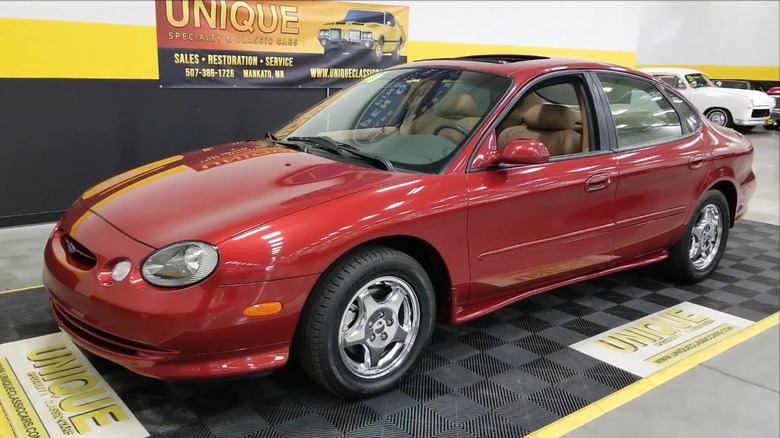
In the pantheon of weird, problem-ridden V8s, the Ford Taurus SHO 60-degree V8 stands tall. It may not rise to the same inept heights as the Triumph Stag (and almost Saab 99) V8, but the SHO V8 did combine stellar engineering, a horrible design choice, and an unacceptably high failure rate. Before we dive into the problems, though, a little Super High Output history (that's what SHO stands for, by the way): In 1989, the first-generation SHO wowed buyers with a Yamaha-designed 3.0-liter V6 that produced 220 horsepower and 200 lb-ft of torque. That was enough to send the SHO to 60 in 6.7 seconds, only 0.4 seconds behind the E28 BMW M5.
Through 1991, SHOs were manual-transmission-only because Ford correctly believed that if you wanted a performance car, you should learn to row your own gears. In 1993, second-gen Tauri gained an optional automatic transmission for SHO models. If you opted for said gearbox, first of all, shame on you, and second, that got you a 3.2-liter version of the Yamaha V6 with 215 lb-ft to make up for the slushbox's parasitic greed. For 1996, the Taurus SHO's third generation, Ford wanted something special: An SHO V8.
Ford and Yamaha decided to base this new V8 on the Contour's 2.5-liter Duratec V6, which was useful as a cost-saving measure since there could be plenty of parts and design sharing. Plus, Ford and Yamaha used an aluminum block and a structural aluminum oil pan, making the V8 lighter than the old iron-block SHO V6. Heads featured reverse-flow cooling, the coil-on-spark plug ignition system didn't require a distributor, and exhaust manifolds were made from high-silicon molybdenum. All this said, the 60-degree V angle carried over from the Contour's V6 made everything way more complex than it needed to be.
Ford and Yamaha are geniuses at making a terrible idea work
The most inherently balanced configuration for a V8 engine is with the pistons at a 90-degree angle — not the unbalanced 60 degrees of the SHO V8. In 90-degree cross-plane V8s, when a piston is at top dead center or bottom dead center, the crankshaft counterweight moves in the opposite direction to counteract the upward and downward forces. Then, 90 degrees later, it does the same for the other piston that shares a crankpin. It's as even and balanced as identical twins on a see-saw. In a 60-degree V8, the pistons and counterweights are no longer in sync, and you can't get even firing without adjustments. Now the see-saw twins are way out of sync, and the playground equipment is just hanging on for dear life.
To help make this unholy 60-degree V8 run as smoothly as physics would allow, Ford and Yamaha gave it split crankpins to put the pistons in the right location for even firing intervals. It's the same technique Lamborghini used in its 90-degree 5-liter V10. While this takes care of primary vibrations, Ford and Yamaha still had to add a balance shaft to eliminate secondary vibrations, kind of like an inline-four. It apparently worked, as road tests at the time remarked on the engine's smoothness. As a bonus, Taurus V8s can sound pretty good, too.
If any development time was saved by copying the Duratec 2.5-liter's design, it was likely undone not only by the 60-degree angle, but also by the complications in manufacturing. The block was designed by Cosworth and produced by Ford's Canadian Windsor engine plant. But rather than actually assemble the engines there, Ford shipped the blocks to Yamaha in Japan. After Yamaha put the engines together, they were shipped to Atlanta, Georgia, for installation into Taurus SHOs.
The SHO must go on (until it breaks)
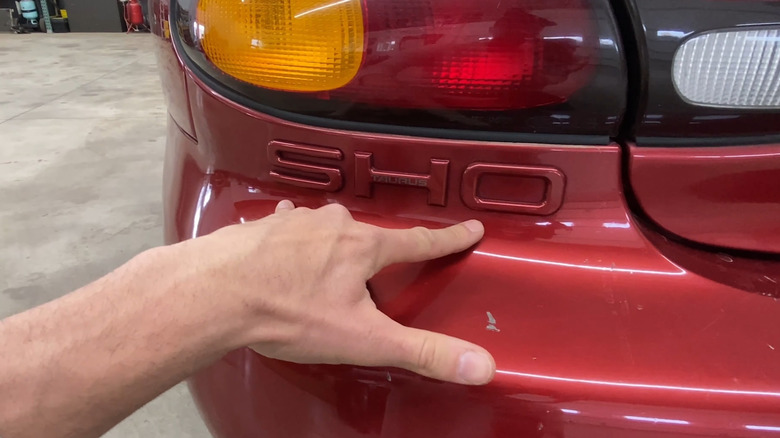
It wasn't just complexity that caused headaches; there were issues with the engine's camshaft sprockets failing before engines even hit 50,000 miles. Since the SHO V8 is an interference engine, where the valves and pistons both move into the same space, any changes in cam timing result in catastrophic failure. V8SHO.com documented a years-long legal battle against Ford regarding the failures, and some sources say that repair estimates exceeded $20,000.
After all the effort required to produce a narrow-angle V8, and the resulting problems, what did Ford get for its trouble? The third-gen Taurus's 3.4-liter 32-valve 60-degree V8 made 235 hp and 230 lb-ft. That's an increase of just 15 for both metrics over the previous-gen's 3.2-liter V6. Plus, in perhaps the greatest tragedy in this story, the third-gen Ford Taurus SHO was only available with a four-speed automatic. Motorweek recorded a ho-hum 7.3-second 0-60 a '97 SHO:
By 1999, the Ford Taurus SHO V8 was dead. The SHO eventually returned in 2010, with an EcoBoost twin-turbo V6 and all-wheel drive. Perhaps more surprisingly, the 60-degree V8 managed its own resurrection. In 2005, Volvo, then still owned by Ford, turned to Yamaha to manufacture a 60-degree V8 for the Volvo XC90 and S80. That engine also ended up in Noble M600s, where it was turbocharged up to 650 hp. Despite the similarities with the SHO V8, such as bore spacing, stroke, and that 60-degree V angle, they are completely different engines. Of course, since 60-degree V8s seem to loathe their own existence, Volvo's V8 suffers from reported balance shaft failures.