

5 Warning Signs That It's Time To Get Your Tires Balanced
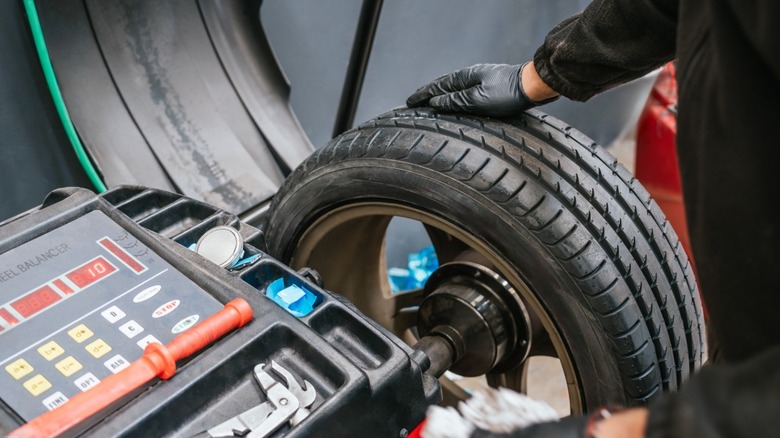
You know that tires need to be balanced. You're probably aware that techs balance them whenever you get new tires installed. But maybe you don't know how to tell if your tires are out of balance. That's okay. You're still doing better than those who assume their tires are balanced just because they have two on each side of the car.
There are several possible signs that tires need to be balanced. It can be a little tricky, because a lot of these signs could also be indications that there's something wrong with your suspension. It gets even trickier because sometimes your tires need to be replaced because they've been damaged from being out of balance for so long. So it's good to keep a close eye on the shape of your tires so that you can catch problems early on before they get worse.
One of these signs that overlaps with signs of other issues has to do with vibration. If your car is shaking when you hit high speeds, your tires might need balancing. The same is true if your steering wheel feels loose or "wobbly." Another sign is that your car pulls to one side or the other as it rolls down the road. Beyond paying attention to the way your car handles, you'll want to listen carefully for any odd noises. A constant humming or rhythmic thumping can indicate imbalanced tires. You'll also want to visually inspect your tires on a regular basis to look for uneven wear. Even a drop in gas mileage can be a sign you need to get your tires balanced. Each of these signs will likely take professional troubleshooting to find the cause.
Your car has a bad case of the shakes

Are your steering wheel, seat, or floorboard shaking as you drive along, even when the road isn't bumpy? Well, it's not because the car is shivering from the cold. There can be a number of reasons why your car is shaking. But one common cause of vibration is — you guessed it — tires that are out of balance. A tire that is out of balance does not roll smoothly. It's going to bounce a little bit. That's why you feel the shaking.
There are different ways in which your car can shake or vibrate. For example, maybe the shaking is persistent and continuous whenever the car is moving. Many times, though, the vibration doesn't start until you reach speeds over 50 miles per hour. The location of the vibration can help you figure out which tires aren't balanced. Vibration in the steering wheel usually means one of the tires up front is imbalanced. If you feel the vibration in your seat or floorboard, then you'll want to look at your rear wheels.
Another thing you might feel is a "wobble" in the steering wheel. Maybe your car doesn't turn as quickly or as sharply when you turn the wheel as it used to. The need for frequent course correction is another possible sign that you have an out-of-balance tire. Drivers often don't realize the connection between steering, suspension, and the state of their tires. But if your car's steering just doesn't feel right, it could very well be a tire problem, and balancing could be a simple fix.
You're hearing some strange noises

Some of you are attuned to your cars. You know exactly how they're supposed to sound, and you notice right away when they start making a noise that's out of place. We, on the other hand, are embarrassed to admit that we have sometimes turned down the stereo to better hear the strange noise our vehicle was making, only to realize that the stereo was, in fact, making it.
But if you do notice a strange noise, don't ignore it, or turn up the stereo so that you don't have to hear it. Noises often indicate that something's wrong, and sometimes that something is serious. But in some cases, that sound could just mean that your tires need to be balanced. Do you hear a rhythmic "whomp, whomp, whomp" or thumping that gets faster as the car speeds up? That could be an out-of-balance tire that is not making continuous contact with the road. Another noise it might make is a humming that gets louder as your car's speed increases. You can tell this isn't an engine noise because it gets louder as your car goes faster, regardless of whether the engine is actually accelerating, such as when you are coasting down a steep hill.
You especially want to listen for these noises when your tires have just been serviced. New noises could mean that the service techs forgot to balance one or more of your tires or balanced them incorrectly. You'll want to bring the car back as soon as you can to have them double-check their work. Multiple issues can cause noises, so you'll want to check out this guide on how to tell if that noise is from your tires or the wheel bearings.
You're doing the 'Tokyo Drift,' but you're not in a movie

Maybe your car isn't sliding across the road like it's being driven by Vin Diesel, but you do notice a definite drift to the left or right as you go down the road –yes, we know Vin Diesel only made a brief cameo in "Tokyo Drift," but "like it's being driven by Lucas Black" doesn't have the same ring to it. Maybe you even have to keep the steering wheel slightly turned to the right or left to avoid going off into the ditch or veering into oncoming traffic. Obviously, this is something that needs to be corrected since it's a safety issue.
One common reason for this drift is wheel misalignment. It could also be a tire that needs to be replaced, so you might check out your tires for excessive or uneven wear. It could also be an air pressure issue, so make sure that all of your tires are inflated to the correct PSI (here's where to find the correct PSI). But an unbalanced tire can also be a contributing factor to a car pulling to one side or the other.
Proper balancing is meant to prevent these kinds of problems. But simply rebalancing by itself may not fix a drift once it's become noticeable. The other causes we mentioned, like misalignment and uneven tread wear, may also need to be addressed at this point. Whatever the cause, your car is not supposed to pull to either side. Instead, it should track straight, so don't ignore a drift. And whatever you do, don't drive too fast or too furiously (yes, we know that's a different movie in the franchise).
Your tires aren't wearing evenly
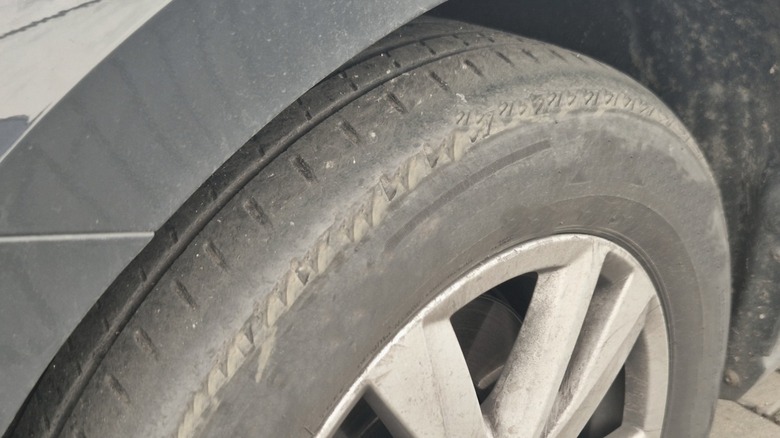
It will come as no surprise to you that the tread on your tires wears down over time. But just think, all of that rubber that used to be on your tires still exists somewhere. It's probably smeared across highways, streets, back alleys, and parking lots. Whatever the case, it's not on your tires anymore, which brings us to the next sign of tire imbalance, uneven tread wear, otherwise known as "feathering."
Tread should wear down evenly across the tire. If you notice that the tread is worn down much more on one side than the other, it could be imbalanced. The same is true if there are odd patches of wear or bald spots, called cupping or scalloping. Remember, an imbalanced (out-of-round) tire is not making consistent, continuous contact with the ground and often pulls to one side. This can cause uneven wear over time, especially since some parts of the tire are hitting the ground harder than others. Of course, if you notice a lot of uneven wear, you will need to replace the tire as well as get it balanced.
Feathered or cupped tires are safety hazards; there's no two ways about it. They don't stop as quickly, handle wet roads the way they should, or track straight. If left alone to get progressively worse, tires in these conditions could blow out on you while you're on the road. That's why it's good to recognize the signs of imbalanced tires early on, so all of that can be prevented. It's one of several things you can do to help your tires last longer.
Your car has become a gas guzzler (or more of a guzzler than usual)

You don't jam on the accelerator. You keep the car at a consistent speed, right around the speed limit. You don't let the car sit and idle. You leave the air conditioning off and roll down your windows, even when the temperature hits triple digits. You take your foot off the gas completely and coast when you're going downhill. You do everything you can to save on gas, even the stuff that probably doesn't work. But how much attention do you pay to your tires?
Keeping tires inflated to the right PSI can help with gas mileage. But making sure your tires are balanced is important to your car's fuel economy, too. Balanced tires roll much more efficiently than ones that aren't balanced. Your car's engine has to work harder to compensate for all of that bouncing around, which means it needs to use more gas. If you notice a sudden drop in your car's gas mileage, unbalanced tires might be the cause — by the way, here's a more detailed explanation of how tire tread affects gas mileage.
Aside from inflating your tires when they are low, getting them balanced is probably the simplest tire fix you can do to prevent much more serious problems. The key is to know the telltale signs of tires that aren't properly balanced. So give your tires a good visual inspection every few days, checking the tread for wear. And pay attention to how your car is handling, as well as listen for any odd noises. Doing those things will help your tires last longer and keep you safer on the road.