

A Historic Timeline Of Every Jeep Truck Ever Made
Jeep's corporate owners have changed so often that it's a wonder it has maintained a strong identity as a purveyor of go-anywhere 4x4s and pickups. Even in eras when automotive badge engineering often resulted in multiple brands selling nearly identical cars with different grilles and taillights, Jeep remained distinct. Some of its standout models have even been pickup trucks. All of them are thoroughly Jeeps, from the wheels on up.
The company's origins lie in the legendary World War II Jeep, officially known as the Willys MB, built by the Willys-Overland Motor Company of Ohio. Ford also built a version, but after the war, Willys-Overland sought to capitalize on the Jeep's wartime reputation by creating a civilian version called the Willys CJ-2A. The initials "CJ" stood for "Civilian Jeep." The CJ-2A would share many components with other early Jeep vehicles, including Jeep's first pickup, which we'll look at shortly.
After winning a contentious legal fight in 1950 for the right to trademark the "Jeep" name, Willys-Overland could officially call its vehicles Jeeps, including its trucks. Since then, the Jeep brand was acquired first by the Kaiser Manufacturing Company, then by American Motors Corporation (AMC), and subsequently by Chrysler, which went through a series of mergers to become part of Stellantis. Throughout the majority of that time, except for a break between the early 1990s and 2020, Jeep continued to produce pickups. Here is the historic lineup.
1947-1965: Willys Jeep Truck
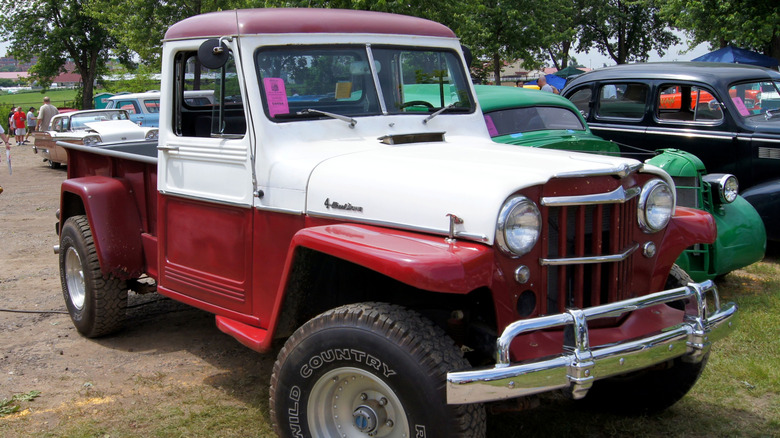
Willys-Overland had built passenger cars before World War II, but the company took a gamble on a more specialized category after the war by building three vehicles that drew inspiration from the wartime Jeep. One of these was the Willys truck, also known as the Jeep Truck. However, due to the trademark tussle with other carmakers, Willys had to put "Jeep" in quotation marks in its early ads. Introduced in 1947 and initially marketed to farmers, the Jeep Truck's production run lasted until 1965.
The Jeep Truck came with either two-wheel drive or four-wheel drive, the latter of which was rare on pickup trucks when the model debuted. Ford and Chevy didn't offer 4x4 options on pickups until the late 1950s. The pickup shared much with the Willys Station Wagon that went on sale the previous year. It was also visually similar to the CJ-2A, especially in the front. It was a stepside pickup with a 118-inch wheelbase and an 80-inch bed.
Power came from a 63-horsepower Go Devil four-cylinder engine and was channeled through a Warner Gear T-90 column-shifter transmission. It shared a transfer case with the CJ-2A and sported a similar front suspension, but it had a split-housing semi-float axle in the rear, which was rated for 4,800 pounds. The truck itself weighed 3,330 pounds with a gross vehicle weight (GVW) of 5,300 pounds. Sales were brisk until other truck makers caught on and started offering competing 4x4 pickups.
1957-1965: Jeep FC 150 and FC 170
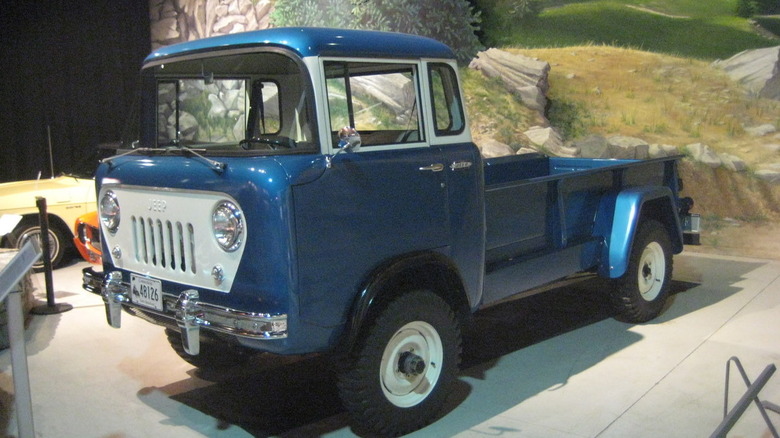
In 1957, Jeep introduced its "Forward Control" pickups that put the cab over the front axle, providing more room in the bed as well as a dizzyingly tight 18-foot turning radius. This maneuverability, combined with the fact that the FC-150 was based on the rugged CJ-5 chassis, made the FC series into very useful go-anywhere work trucks. Their low beds were easy to load, too. And despite their beefy industrial appearance, they were small, riding on an 81-inch wheelbase.
The Forward Control pickups were a jolting departure from other Jeep designs, although you can still see the Jeep DNA in its seven-bar grille and round headlights. It also shared components with the CJ under its sheetmetal, including its 70-hp, 134-cubic-inch F-head inline four-cylinder engine. Chassis-cab versions were available for customers to put their own bodies on. The FC-170 offered a weight rating that was one ton higher than that of the FC-150 and it featured a six-cylinder engine.
Farmers, fire departments, and airports were all quick to recognize the utility offered by the FC series. The truck's success caught the attention of Jeep's competitors, leading Ford, Chevy, and Dodge to develop forward-cab pickups. The Jeep truck that inspired the trend has developed a following over the years, with a 1958 Jeep Forward Control listed for sale for a cool $22,000 in April of 2025. Sometimes "forward" thinking pays off.
1963-1987: Jeep Gladiator/J-Truck Series
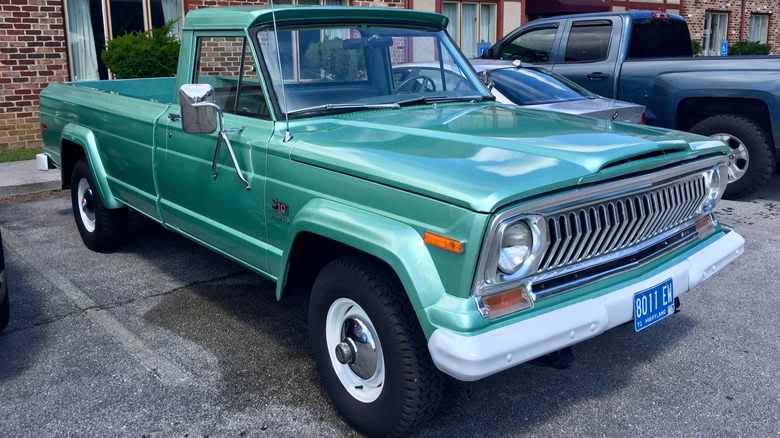
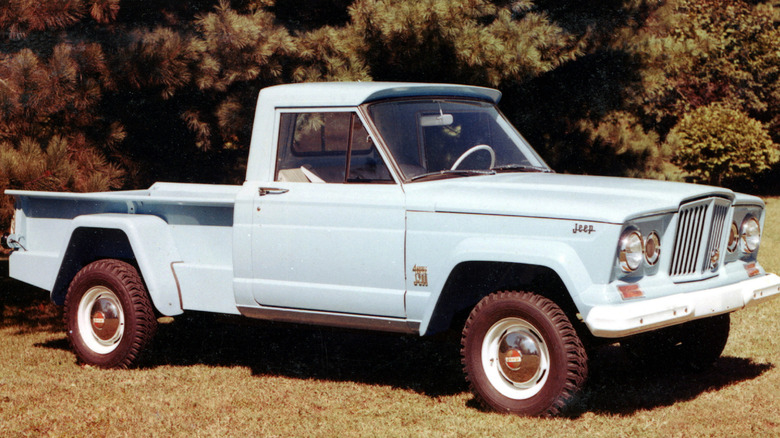
The Jeep Gladiator was launched in 1963 with two models, the J-200 and the J-300. The former featured a 120-inch wheelbase, while the latter measured 126 inches. The pickups shared a platform and engines with the Jeep Wagoneer. Narrow-box and wide-box beds were available, as well as chassis cab models, stake beds, campers, and other body styles. Over the 25 model years that it was produced, the series had several name changes. In 1965, Jeep changed the names of the J-200 and J-300 to J-2000 and J-3000.
Half-ton, three-quarter-ton, and one-ton models were offered. Of course, 4x4 was available on all models and standard on one-ton models. Two camper models joined the lineup in 1970: the lightweight Camper and the heavier Camper Truck, the latter of which shared a 132-inch wheelbase with the new-for-1970 J-4000. The J-3000 was dropped from the lineup. The grille was redesigned for this model year, changing from a very Jeep-like vertical grille to a more horizontal style.
Up to this point, the truck still appeared as the Jeep Gladiator in ads, still putting quotation marks around "Jeep," but in 1972, the lineup became the J-Truck series. The J-Truck offered a half dozen models ranging from the J-2500 through the J-4800. In 1974, the model range was simplified to the J-10 and J-20. The J series initially offered a range of six-cylinder and eight-cylinder engines, one of which was sourced from Buick. Under AMC, choices included a 110-hp straight-six, a 150-hp, 304-cu-in V8, and a 175-hp, 360-cu-in V8. After Chrysler acquired Jeep when it bought AMC in 1987, it canceled the J-Truck to end competition for its Dodge pickups.
1967-1973: Jeep Jeepster Commando
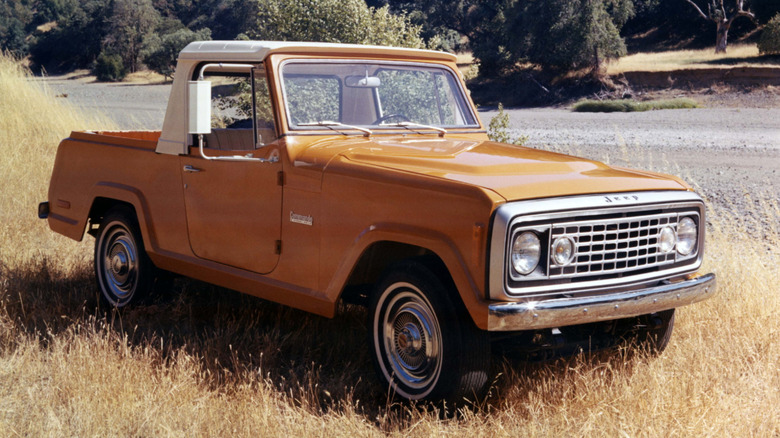
The Jeepster Commando is a lesser-known example of a classic Jeep. It was inspired by the Willys Jeepster of 1948 through 1950, which was an odd duck of a convertible passenger car that featured vaguely CJ-like design language. Under Kaiser's ownership, the nameplate was revived as the Jeepster Commando in 1967 to compete with vehicles like the Ford Bronco. This strange model might be a Jeep you never knew existed.
It offered several body styles, including a pickup. Like the Bronco and other utes such as the Toyota Land Cruiser, the Jeepster Commando offered passenger car comforts in a platform designed for off-roading. Its original model designation of C-101 indicated the length of its wheelbase; when AMC lengthened it to 104 inches in 1972, its model number changed to C-104. AMC also dropped the word "Jeepster," now referring to the model simply as the Jeep Commando. About 77,000 Jeepster Commandos and just-plain Commandos were sold during their combined seven-year run.
The C-101 Jeepster Commando offered two engines: a 75-hp version of Jeep's long-running 134-cubic-inch F-head inline four, and a Dauntless V6 with more than twice the F-head's horsepower. Under AMC, the C-104's engine choices included an inline six and a V8. There was also a one-year Hurst Jeepster model powered by the Dauntless V6 paired with a Hurst shifter, along with a number of exterior features such as a graphics package, a roof rack, a hood-mounted tachometer, and wider wheels and tires.
1981-1986: Jeep CJ-8 Scrambler
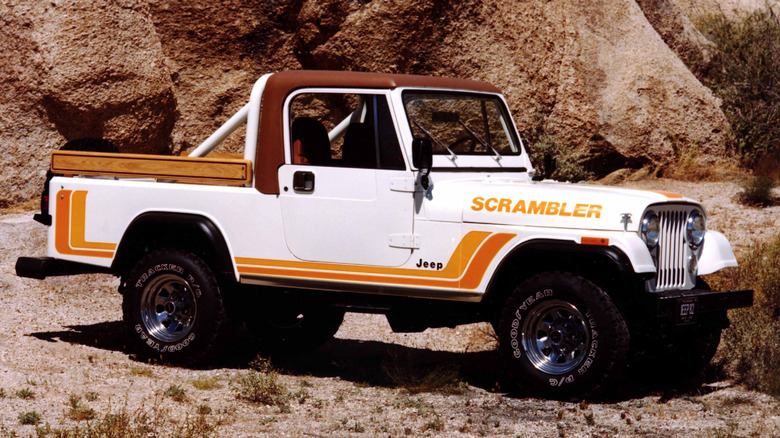
For our next Jeep pickup, we take a big jump forward to the 1980s. Jeep had previously offered a long-wheelbase version of the venerable CJ-5 sport utility called the CJ-6 for customers who desired more room. In 1981, Jeep repeated that trick by stretching the CJ-7 (introduced in 1976) to create the CJ-8 Scrambler, but this time, instead of an open sport utility with a vaguely pickup-like rear end like the CJ-6, it went all the way and made the Scrambler into a true pickup truck, complete with a choice of hard or soft tops.
The Scrambler competed in the increasingly crowded compact pickup truck market of the 1980s, but it brought Jeep's off-road chops. It offered a variety of engines over the years, including GM's 82-hp Iron Duke four-cylinder, a 105-hp AMC four-cylinder, and a 115-hp inline six. The CJ-8 never offered a V8, unlike the CJ-7 that it was based on. Several manual and automatic transmissions were offered over the years, but the best-known was probably the T5 five-speed manual.
The suspension was the same as that in the CJ-7, but the CJ-8 Scrambler featured a reinforced frame in the rear to increase torsional rigidity. Overall, it was two feet longer than the CJ-7, offering enough length for its five-foot pickup bed. Its longer wheelbase also gave it a more civilized ride on pavement than its CJ-7 cousin. Jeep marketed it as the first convertible pickup truck.
1981-1986 Jeep CJ-10 and CJ-10a
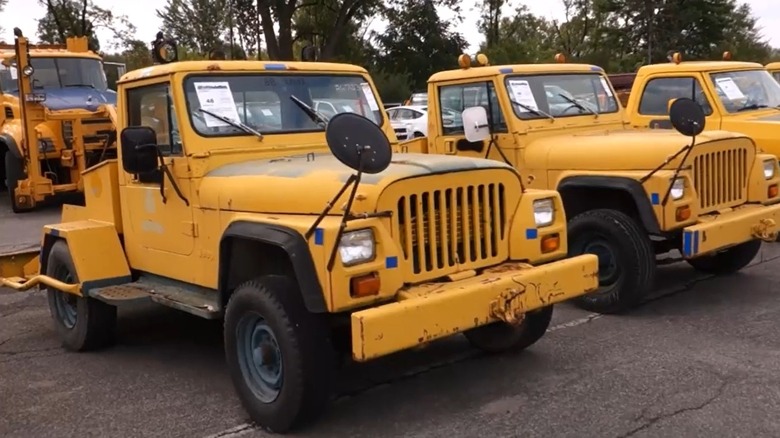
Next up is a truly obscure Jeep model, nearly unknown here in the U.S. except to hard-core Jeep faithful: the CJ-10 and its CJ-10a aircraft tug variant. Jeep built the CJ-10 exclusively for the export market, primarily in Australia. Despite having "CJ" in its name, this truck was actually based on the J-10 pickup rather than the CJ-5 or CJ-7. Introduced in 1981, it never sold in large numbers, with model runs tallied in the hundreds each year.
In Australia, the CJ-10 was called the J10 or the Jeep One-Tonner. Reviews were good, but Japanese competition and the falling Australian dollar conspired to prevent success. Jeep stopped exporting CJ-10s by 1985. While some consider it the ugliest Jeep truck ever, the CJ-10 has become a sought-after collectible among enthusiasts.
In 1984, a company called PSI-Mobile modified the CJ-10 into an aircraft tug called the CJ-10a for government contracts. Each tug began life as a chassis cab model at AMC's VAM factory in Mexico. After this, they were sent to PSI-Mobile, which modified them to shorten the wheelbase and add a fuel tank, air compressor, and other gear to the back. Fully equipped and ballasted, the CJ-10a could tow 40,000 pounds. Production ran from 1984 through 1986, but CJ-10a tugs continued to be used into the 21st century.
1985-1992: Jeep Comanche (MJ)
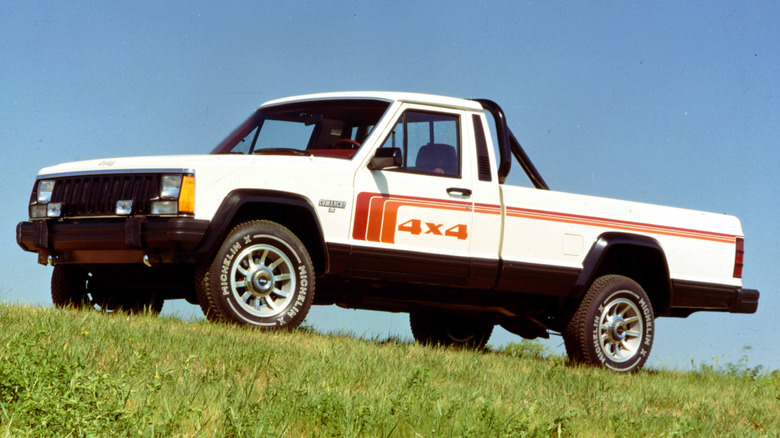
Based on the wildly successful XJ Cherokee, the MJ Comanche carried on as Jeep's sole pickup truck for several years after the demise of the Scrambler and the Gladiator. From the front bumper to the B-pillar, its resemblance to the XJ Cherokee was obvious. The Comanche was one of the last Jeep models introduced during the AMC years. Basing the new pickup on the existing SUV's platform reduced costs for cash-strapped AMC and resulted in a tidy little truck.
The Comanche featured a unibody chassis that was unique in its segment. It was also larger than most compact trucks, although small by today's standards. Buyers had a choice of 6-foot or 7-foot bed lengths. Off-road competence came from a choice of Jeep's Select-Trac and Command-Trac four-wheel drive systems. For 1986, the Comanche offered a choice of three engines: a 2.5-liter four-cylinder, a 2.8-liter GM V6, or a 2.1-liter Renault turbodiesel.
According to a contemporaneous review in Hot Rod magazine in 1987, Jeep upgraded the V6 option to a 173-hp, 4.0-liter AMC-built unit. The magazine said that this transformed the Comanche into "a highly attractive hot rod with a bed attached." In subsequent model years, the V6 would offer increased horsepower, peaking at 190 by 1991.
2020-present: Jeep Gladiator
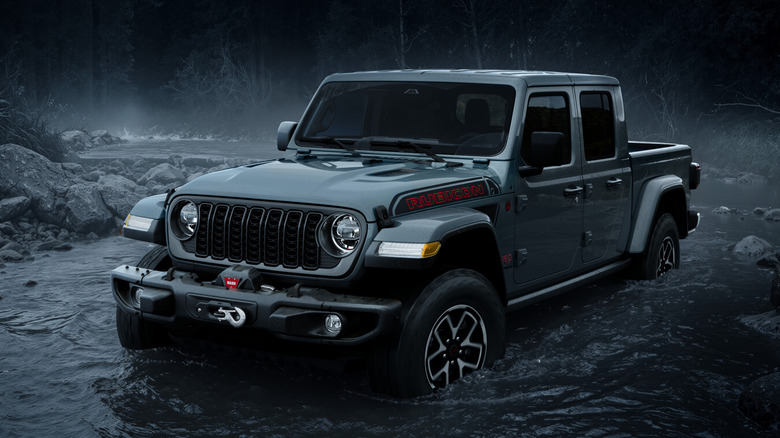
Rejoining the pickup game after 28 years and reviving the Gladiator name were both shrewd moves for Jeep, at least for the first couple of years after the new model's debut in 2020. Sales were hot, peaking at nearly 90,000 units in 2022. However, by 2024, sales had cratered to less than half that. This could be due to a combination of a relatively high price and certain flaws, such as a rough ride and a lower bed volume than some competitors.
It's too bad, because this Wrangler-based truck has a lot going for it. With standard four-wheel drive, off-road tires, skid plates, and a beefy suspension, the Gladiator is at home on rocky trails and in the mud. Its axle ratios were designed with rock crawling in mind. Removable roof and body panels offer al fresco driving. Rear seat legroom is better than that in the Wrangler thanks to the Gladiator's longer wheelbase. This extra length also gives it better handling than the Wrangler on pavement.
For 2026, the Gladiator comes equipped with a 285-hp, 3.6-liter Pentastar V6, which produces 260 pound-feet of torque and boasts a 7,700-pound tow rating. It's available in seven trim levels from the base Sport through the top Mojave X trim. Starting prices for each trim range between $38,830 for the Sport to $59,995 for the Mojave X. According to Jeep executives, the 6.4-liter 392 Hemi from the Wrangler Rubicon 392 will also find its way under the Gladiator's hood in the very near future, too.