

Why Mustang II Front Suspension Became So Popular With Hot Rodders
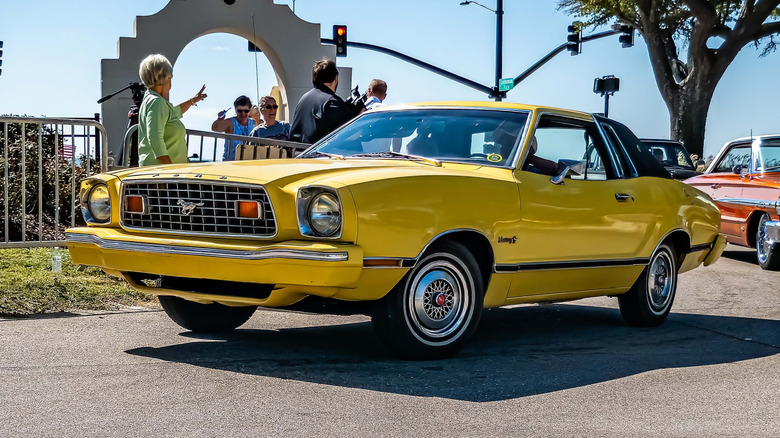
For most of us, "Mustang II" conjures an image of a classic done dirty – an unpleasant memory of that time Ford decided to base its next Mustang on the Pinto (whether the "rebadged Pinto" assertion is fair or not, it stuck). But for hot rodders, "Mustang II" might as well be a part number. In the early 1970s, if you wanted to make a '29 Ford Model A handle like a then-modern car, there were a few ways you could go about it, including welding the entire front clip from a Camaro or trying to adapt the Corvair's front suspension. There weren't many independent suspension options that would fit early Ford wheelbases, and it got so desperate that hot rodders were starting to pilfer AMC Pacer suspensions.
Then, in 1974, hot rodder Chuck Lombardo (RIP) grabbed the front suspension from a Mustang II and found that it had the perfect attributes for a street rod. The track width was a match with old Fords, it had coil springs instead of struts (with admittedly little travel), it used rack-and-pinion steering, it had disc brakes,and its wrecked models were becoming common in scrapyards.
But wait, there's more! Since the 'Stang II's coil springs are so low profile, they can accommodate a huge variety of engine sizes. The frame that held the suspension in place was also well-isolated, preventing the standard 2.3-liter four-cylinder from sending its vibrations through the rest of the car. This was a ready-made bolt-in independent front suspension system that seemed almost like it was designed specifically for retrofitting pre-war cars.
Replica business failure is hot rodder's fortune

The best-laid plans of mice and men oft go awry. And that's how it went for Ford engineer Bob Shay (or Harry Shay, possibly Art Shay; different sources claim different names). He wanted to create modernized replicas of the Ford Model A so that people could enjoy an at-the-time 50-year-old car without the carbureted flathead four, non-synchro three-speed, and solid front and rear axles. Ford supplied parts (including the Mustang II and Pinto suspension) and let Shay offer his replicas at Ford dealerships.
Despite getting 10,000 pre-orders and building 5,000 cars, he went out of business in 1982. Too bad for Shay, but there was a massive silver lining for hot rodders: his warehouse of unused parts. Thousands of brand new suspension assemblies went to auction where they sold for a fraction of what Shay paid. No more scouring junkyards for Mustang IIs and demolition derby-ed Pintos from Ford ads.
Those who bought the suspension assemblies weren't just hot rodders looking for a deal. Many buyers were also burgeoning suspension companies who wanted parts to re-engineer and offer for sale. Perhaps the most famous of these companies that scored some of Shay's inventory was Heidt's Hot Rod Shop, which continues to offer refined versions of Mustang II suspension for builders over 40 years later.
A word about the Mustang II
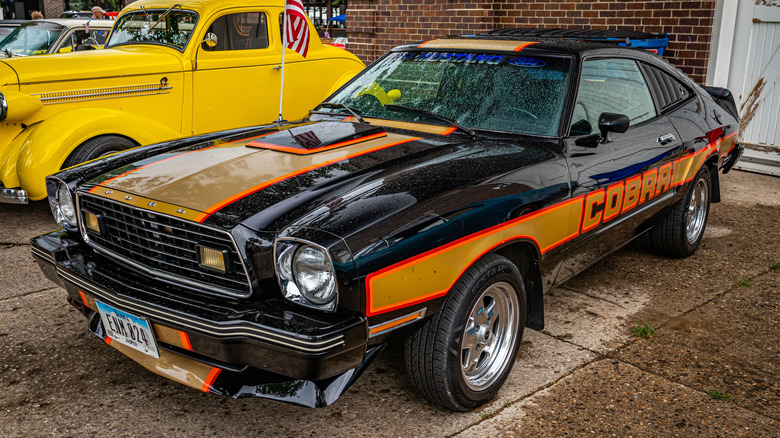
The Mustang II appeared specifically because people thought the Mustang had become overstuffed. Despite 1971-1973 Mustangs only being two inches longer than '70 models, fans of the lithe versions hated the bloat. The New York Times reported the words of Anna Muccioli — wife of a Ford Engineer — as she told Henry Ford II, then-CEO of the automaker, "I have a '65 Mustang, and I don't like what's happening. They are blowing that one up. Why can't you just leave a sports car small?" She said this in 1968, so imagine how she felt when '71 models dropped.
Lee Iaccoca, father of the Mustang and the long-term car loan, felt the same way. When he became president of Ford in December 1970, he declared Mustangs would shrink again. And so, the '74 Mustang II was 900 pounds lighter, 12 inches shorter, and 4 inches narrower. Its reception was incredible, selling 386,000 models in 1974. Though '74s didn't get V8s, that excellent front suspension and shorter wheelbase made it quite the quick handler.
The November 1975 issue of Motor Trend even declared "Ford's Snake is Back!" On the cover was the new 302 V8-powered Mustang Cobra II, complete with a GT350-like blue-and-white paint scheme. But with 139 horsepower and a 17-second quarter mile time, its stats are only impressive when compared to other performance-strangled cars of the era. As the energy crisis waned, buyers wanted size and muscle car power again, and the Mustang II lost its goodwill. Ford's subsequent Fox-based Mustang would ultimately be the one to bring the model back to glory, leaving the Mustang II's legacy largely as an organ donor for hot rods.