

What's The Difference Between Ford's 351 Cleveland, Windsor, And Modified Engines?
For the most part, the Gen-I and II Chevy small-block has been the same basic engine since 1955 (except you, 400, you made things weird), but Ford V8s do not play by the same rules. Asking for a "Ford 351" is like asking for "a beer." You have to specify what kind. Ford's 351 Cleveland, 351 Windsor, and 351 Modified merely share some attributes. Factory stock examples have cast iron heads and blocks (except for a few experimental aluminum Cleveland blocks), a four-inch bore, a 3.5-inch stroke, a 4.38-inch bore center spacing, external balancing, and a firing order of 1-3-7-2-6-5-4-8. (Still, don't expect parts to interchange happily.)
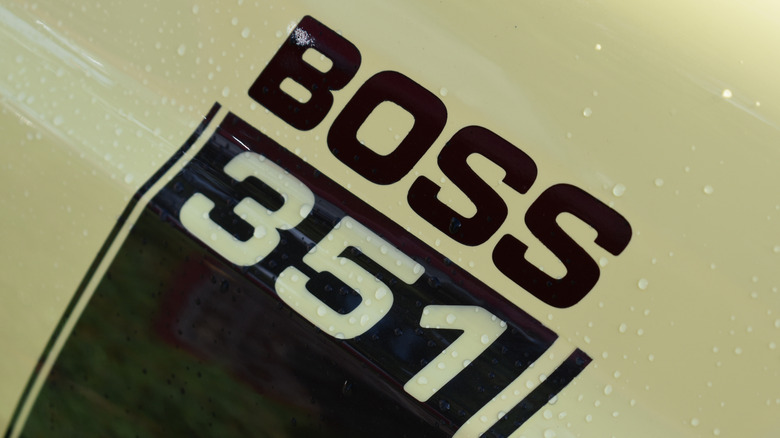
The 351 Windsor snatched the 302's block, raised the deck height by as much as 1.3 inches, and marched off to compete with Chevy 350s and Chrysler 340s. Ford used it from 1968 to 1997 in models like Thunderbirds, E-series vans, Mustang Mach 1s, the original F-150 Lightning, and the 1995 Mustang Cobra R. In 1970, Ford introduced the 335-Series V8s, including the 1970-1974 351 Cleveland. The Cleveland is a performance engine with heads that flow more air than a politician giving a filibuster, which is why it powered Boss 351 Mustangs and De Tomaso Panteras. The 1975-1982 351M (the "Modified" designation is fan-made, Ford never said "M" stood for anything), while still part of the 335 lineup, was basically a de-stroked 400. It only existed to cut costs, as Ford eliminated the short-deck Clevelands to just make tall-deck 335-Series engines with different strokes.
Windsor vs. Cleveland
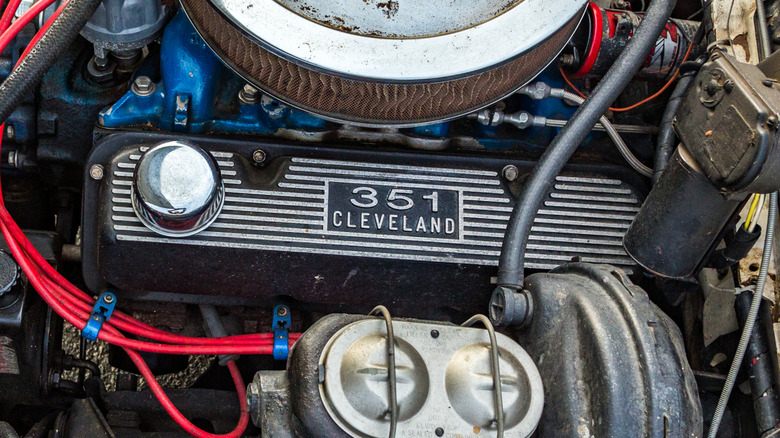
Windsors were made in Windsor, Ontario, making them as Canadian as Molson beer and John Candy.335-series 351 Cleveland blocks were cast in Ford's Cleveland, Ohio casting plant, and are wider and lower than Windsor 351 blocks. Plenty of arguments on forums center around whether Windsor or Cleveland blocks can handle more power, with some saying that the Windsor's three-inch main bearings make the webbing weaker than the 2.75-inch mains in Cleveland blocks.
Both Windsors and Clevelands have strong nodular-iron cranks with a tensile strength of 95,000 psi and excellent fatigue resistance. Cast iron (tensile strength 80,000 psi) is slightly more brittle. Although the Cleveland's smaller main bearings might seem insufficient, crank journal diameters don't really contribute to overall strength and smaller mains generally translate to faster spinning. It's sort of like the situation with Chevy's LS6 454 and Pontiac's 455 Super Duty. Speaking of mains, 1971 Mustang Boss 351 Clevelands got four-bolt mains, not to mention forged aluminum pistons and an aluminum intake (while regular Clevelands only got iron intakes).
There's no arguing Cleveland heads flow better than Windsor heads, which helped establish the Cleveland's performance reputation. Its canted valves and gargantuan ports are wider than someone's nostrils after eating a hunk of fresh horseradish, especially in four-barrel heads with their 1.71-inch exhaust valves and 2.19-inch intake valves, the largest intake valves on any midsize V8 at the time. (There's also a two-barrel Cleveland with smaller ports).
Modified vs. Cleveland
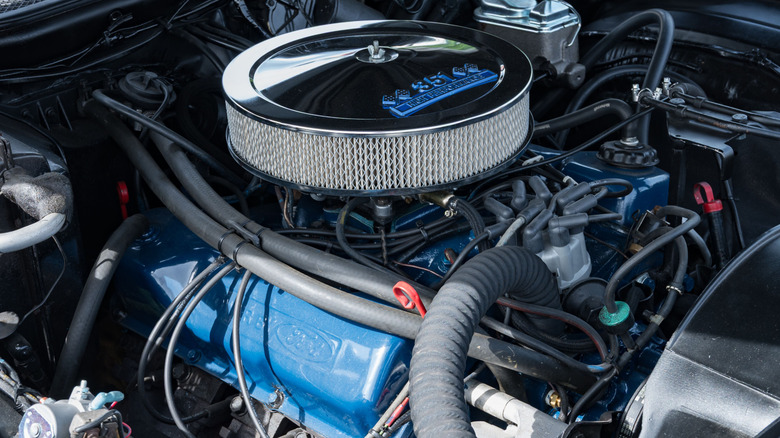
The Cleveland and Modified are both 335-series V8s, but they act like twins trying to distinguish their own identities with different clothes and haircuts. They also take turns grabbing attributes from cousin Windsor — perhaps jealous of its fling in Parnelli Jones' "Big Oly" Ford Bronco. Clevelands have a 9.206-inch deck height while 351Ms have it at 10.297, same as the 1970-1982 400. The 351M and 400 also have a three-inch main journal diameter, similarly to the Windsor. 351Ms also only came with two-barrel carbs, and their manifold is wider than a Cleveland's due to the taller deck.
Ford's 351M also uses unique tall-height dished pistons that lower compression to appease mid-1970s emissions requirements, fluctuating between 7.74:1 and 8.6:1 depending on the year. Also, while the Cleveland and Windsor both use "small-block" bell housing, the 351M and 400 use the "big-block" housing, not to mention three motor mounts compared to the Cleveland's two. Both the 351M and the 400 were available in Ford cars through 1979, while trucks kept them around until 1982. Confusingly, sometimes Ford referred to the 351M as a "Cleveland," which is just kind of mean since it made some owners think that their pickups came with 351 Clevelands.
Oh, and before we finish, no, the heads on the 1969 and 1970 Mustang Boss 302 aren't from the 351 Cleveland. Remember, 302s are Windsor engines, and they won't take kindly to someone Hercules-ing head bolts through where there aren't willing threads. Actual Boss 302 heads are basically Windsor heads modified to be as close to Cleveland's as possible while retaining the same cooling passages and bolt pattern.