

Here's Why Semi Truck Drivers Choose Snow Chains Instead Of Winter Tires
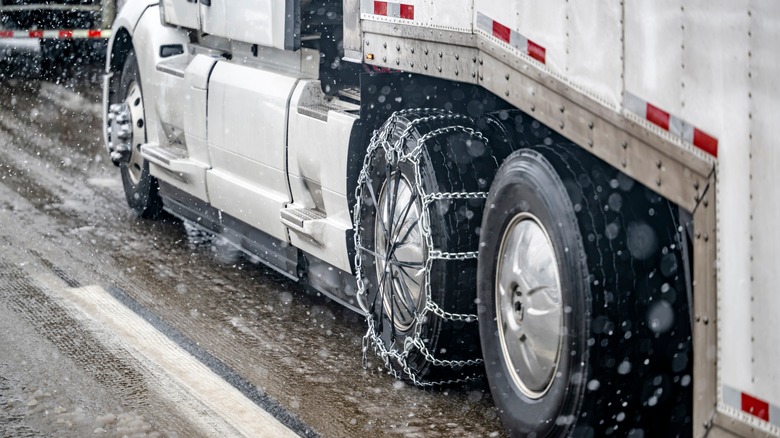
While many travelers can avoid areas like high-elevation mountain passes or wait out severe winter storms, truckers are on the road every day of the year. The first semi truck was invented in 1898 to transport the earliest American cars, but semis have expanded greatly since, hauling a wide variety of goods, including food, electronics, and oil.
While winter tires offer features that help them adapt and perform better on snow, sometimes that's not enough, especially when surfaces get icy. Since semi trucks can have a legal limit of up to 80,000 pounds fully loaded, one of these rigs sliding out of control across the road can be a disaster, or at least a dangerous close call like this big rig losing control on a snowy Wyoming highway:
During inclement weather, authorities keep a close eye on the condition of the roads, and in places like Washington state, they'll institute mandatory chain use for some vehicles in certain areas at specific times. While rules vary by state, often semi trucks are required to install tire chains even if passenger vehicles don't have to. And failure to do so is not only illegal, but can carry hefty fines. In Oregon for example, commercial vehicles' drivers face a minimum fine of $880 for disregarding a chain notice.
Many big rigs don't use winter tires

While a good snow tire can make a noticeable difference on winter roads, that semi truck passing you this winter probably isn't running snow tires. For commercial fleets, tires occupy second place in terms of largest expenditures. And though according to Michelin a trucker can drive as much as 200,000 long-distance miles on a tire before needing a replacement, those miles add up quickly when your job is to drive, so long-distance trucks may need new tires every year. Considering you can spend $600 per truck tire, with premium tires costing up to twice as much, doubling it again — times 10, 18, 24 or 36 wheels — to invest in winter tires becomes daunting.
That's why owners of another kind of large commercial vehicle, buses, don't always choose winter tires even in areas that see significant snowfall. Thor Diakow, a spokesperson for the TransLink public-transit system in Vancouver, British Columbia, told the Vancouver Sun: "Snow patterns are changing every year in Metro Vancouver. We could get a huge dump one year and a few flakes the next. Switching out 10,000 tires on our buses for those few days of a year, taking into account the storage, labour, and maintenance costs, would be significant."
Why chains are the preferred method for American truckers in severe winter weather

Good winter tires do provide advantages on snowy roads. Winter tires often feature much more aggressive tread patterns, with wider gaps in between, meant to enhance traction by digging into the surface, and channeling snow around and away from the tire. These seasonal tires are also made with material that copes with the cold much better than alternatives, letting the rubber stay more pliable instead of hardening.
However, for semi trucks, tire chains are still the preferred choice when conditions worsen. Sets of two chains can be under $250 (depending on the size), and if cared for properly won't need a replacement for a couple of thousand miles. These chains wrap around the wheel, and are made so that the metal links run across the width of the tire. The big rig's weight presses down on those chain links as the wheels rotate, causing them to bite into the road surface, gripping it through snow and ice.
This can be especially important on significant inclines, where a semi could fail to make progress, or worse, begin sliding. This can happen even after state DOTs deal with snow on the roads. Still, while effective in difficult winter conditions, chains are highly regulated, because when used in excess, they can actually damage the road surface.