

Stepside Vs. Fleetside Truck Beds: What's The Difference?
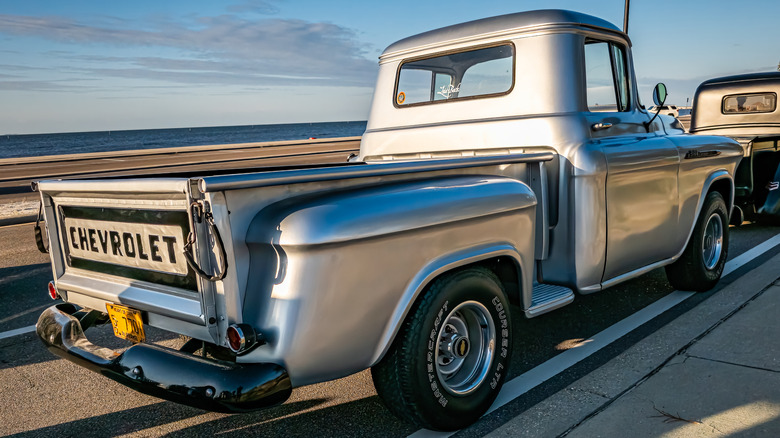
The design of most modern pickups doesn't leave much room for creativity — except up front, and there we've ended up with tall hoods and big grilles that give a new definition to "killer good looks." But if you peek back at classic trucks, especially from the 1940s and 1950s, you may be surprised by their dramatically curved flanks. Go in for a close-up and you'll soon see why: Those older trucks — going right back to the start — have external rear fenders. And at its most basic, that's the difference here: Stepside trucks have external rear fenders, often with running boards connecting to the front fenders that provide an access step into the bed; fleetside trucks don't.
It really all starts with Henry Ford, who may not have built the first modern car but does get credit for the first modern truck. Many owners, including Mr. Ford, were already converting Model Ts to cargo haulers on their own by simply adding a box/bed to the back of a pre-existing car. And when Ford decided to cash in on the trend in 1925, it was with the same kind of simplified assembly process that helped drive costs down for his car. That meant just following the DIY method of dropping the bed in between the rear wheels — instead of taking additional time and money to develop a better-integrated solution. It would take about three more decades for that to happen, and when it did, Chevrolet would set the pace.
When stepside and fleetside trucks made a name for themselves
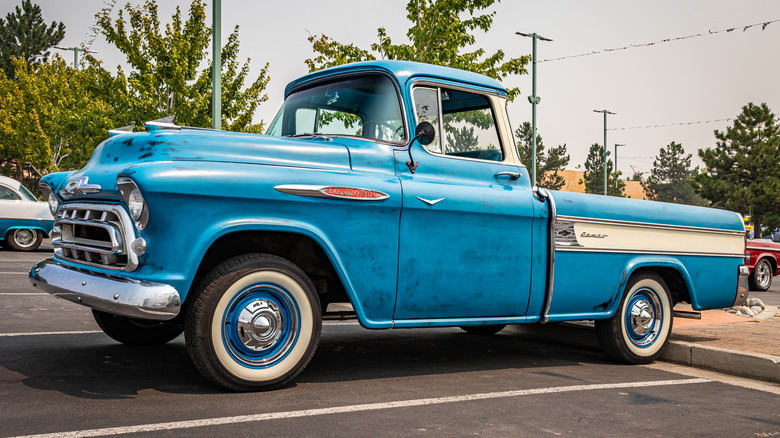
Truck design went through a major change in 1955 when Chevy began offering the Cameo Carrier. Chevrolet essentially added fiberglass rear body panels to the vehicle to make the sides of the bed flush with the bodywork of the cab; it created a more premium, car-like appearance that certainly came with a premium. At a time when the entry-level Chevy pickup started at about $1,430, upgrading to the Cameo setup cost another $405 – an increase of almost 30%.
Also, the Cameo style upgrades were just that: The box remained the same, as the enhancements were meant to boost style, not functionality. Ford found a way to do that with the 1957 F-100 that was available with what it called a Styleside bed. It had the same smooth exterior look as the Cameo Carrier, but the Blue Oval engineers further increased the interior capacity of the cargo bed to take advantage of the extra truck width – FYI: Ford didn't switch from the F-100 to the F-150 until 1975.
Chevrolet followed the same path beginning with its 1958 trucks, but the Bowtie brand called its setup a Fleetside bed. Chevy then coined the term stepside to distinguish its models with the old-fashioned truck-bed design. Most of the big truck makers began offering both bed styles during this time, with names like Ford's Flareside and Styleside coming into use, but it was Chevrolet's version that got genericized into a common noun.
The last of the stepside pickups – sort of
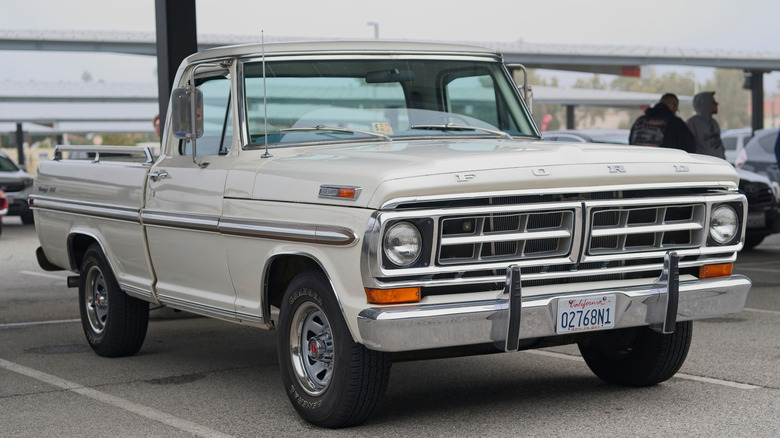
Ford was the last automaker to supply a stepside setup. Ford offered its version, the Flareside, on the F-150 XLT, STX, and FX4 trim levels through the 2009 model year. At the time, the cargo volume of Ford's Flareside box — with a length of 6.5 feet — was 59.5 cubic feet. The same length Styleside box had a cargo capacity of 65.5 cubic feet, which was a difference of more than 10% that was most noticeable in terms of maximum floor width. The Styleside box was 65.2 inches wide — where the rear wheel wells didn't intrude on the bed — compared to the 59.6 inches of the Flareside.
This led to some small differences in payload as well. For example, a 2009 F-150 SuperCab model, with a 145-inch wheelbase, a 5.4-liter V8, and a Flareside box checked in with a payload of 1,680 pounds. The same truck with a Styleside bed was rated for a payload of 1,660 pounds.
But it turns out there was at least one functional drawback to fleetside pickups, and it was exacerbated by the fact that trucks aren't just too big now, they're also too tall. Without the steps of a stepside box, people began having more trouble reaching over the sides to get to what's in the bed. So, in 2020, Chevrolet found a way to bring back side steps by integrating them into a fleetside setup. As a result, access steps are again available throughout the truck world.